
Your needs, this model
Does it fit your priorities?
Would you rather set Low or High yourself and have a mechanical thermostat cycle that selected level?
The HCE210 manual describes two power-dial heat settings and a separate adjustable thermostat that cycles the heater; this is a direct-control alternative to a digital high-only temperature routine.
Explore this need in the finder →Do two power levels and a thermostat suit you if a countdown shutoff is not required?
The HCE210 manual specifies 900 W Low and 1,500 W High with thermostat cycling, but its model-specific operation section provides no auto-off countdown.
Explore this need in the finder →Can you use it on a stable, open indoor surface with the required clearance and stay present?
The manual calls for a level open surface, three feet from walls and combustibles, a direct wall receptacle, and says never to leave it operating unattended. Bathroom/near-water permission is not stated.
Explore this need in the finder →The Honeywell UberHeat 5 HCE210 is the simpler of Honeywell’s two compact UberHeat ceramic heaters in this family. It gives you a mechanical power dial with Low and High heat, a separate adjustable thermostat, and no digital menu to learn. That makes it a sensible fit when you want uncomplicated supplemental warmth and can supervise the heater. It is not a good choice if an automatic shutoff timer, fan-only airflow, or a tightly specified footprint is essential.
Two heat levels, then let the thermostat cycle
The manual identifies a 900-watt Low setting and a 1,500-watt High setting. You choose the power level with the main knob, then adjust the thermostat separately: turn it up while the room warms and back it down until it clicks at the comfort point. The thermostat then cycles the heater on and off around that selected room condition. Unlike the HCE220, there is no digital display or four-button temperature preset list. The HCE210’s appeal is directness, not fine-grained digital control.
The lower setting is useful when the full 1,500 watts is more than you need at that moment, but both heat levels still use a fan to push warmed air into the room. This is not a fanless radiant panel, and the model-specific manual describes no separate fan-only mode. Honeywell calls the heater quiet, but it publishes no decibel measurement; treat that as the maker’s description rather than a noise guarantee.
Compact does not mean that every dimension is settled
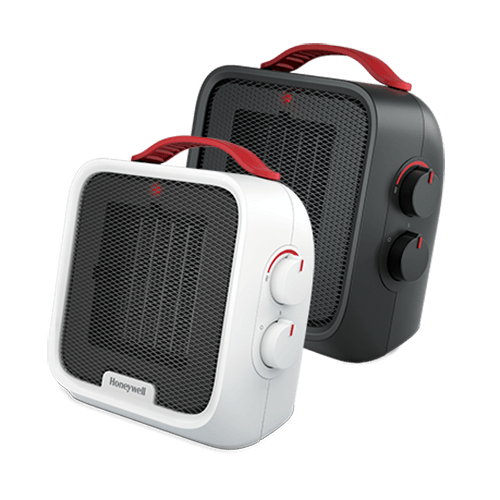
Honeywell’s HCE210 product page lists black HCE210B and white HCE210W versions and describes the heater for personal and small-room use. It does not provide a model-specific square-foot rating. More importantly for a tight desk, shelf, or storage space, the product page and the shared HCE210/HCE220 owner’s manual give different body dimensions. The page lists 8.5 inches high by 4.5 inches long by 8.86 inches wide; the manual’s series specification lists 8.2 inches high by 4.8 inches wide by 7.8 inches long. Because both are primary sources and do not agree, I would not use either set as a fit guarantee. Check the exact carton or ask Honeywell if a close clearance is decisive. The black and white finishes are listed as HCE210B and HCE210W; the official image shown here is a representative HCE210 family view, not an assertion that one finish is included with every listing.
The safety rules shape where it works
The manual calls for a firm, level, open surface and at least three feet between the heater and walls or combustible items. Keep it away from bedding, curtains, papers, furniture, and other materials, and do not use it on a bed or deep carpet where the air openings could be blocked. Honeywell expressly prohibits outdoor use. Its instructions do not expressly approve bathroom use or close-to-water placement; they warn never to locate the heater where it may fall into a bathtub or other water container. If bathroom or near-water placement is essential, do not treat that silence as permission. The tip-over switch and two high-temperature safety sensors do not change those limits.
Electrical setup is equally specific: the heater is rated for 120 volts, 60 Hz, and draws 12.5 amps at its 1,500-watt maximum. Plug it directly into a suitable wall receptacle—never an extension cord or power strip—and do not share the circuit with another operating appliance. The manual says never to leave an operating heater unattended and to unplug it when it is not in use. That is why the lack of a timer matters: if you need a documented countdown to turn the heater off, compare the HCE220 or another exact model with a manual-backed shutoff feature. A timer on another heater would not override that model’s own supervision instructions either.
Who should choose the HCE210?
Choose it if you value a small portable body, simple mechanical controls, two clearly differentiated power levels, and a thermostat that cycles the selected setting. It may suit a supervised desk-side or small-room routine when the required clear space and direct outlet are practical. The manual includes a three-year limited warranty. Honeywell’s product page also makes an annual heating-cost savings claim, but its footnote depends on a particular dated electricity rate, runtime, and thermostat scenario; it is not a forecast for your home, so I would not use it to estimate your bill.
Look at the UberHeat Plus HCE220 instead if you want a digital thermostat, preset temperatures, and a 2-, 4-, or 8-hour shutoff selection. The HCE210’s mechanical thermostat is more continuously adjustable by feel, while the HCE220’s automatic temperature routine operates on High. If you require a fan that runs without heat, a later start, bathroom approval, wall mounting, or unattended operation, do not infer those functions from the HCE210’s compact design; its reviewed instructions do not establish them.
Bottom line
The HCE210 is a straightforward ceramic heater, not a feature-rich room-control system. Its useful distinction is the combination of a manual thermostat and selectable 900/1,500-watt heat—not an unverified coverage promise or safety shortcut. It fits only where you can provide the manual’s clearance, stable surface, direct receptacle, residential indoor use, and supervision. If the product’s dimensions must fit a narrow space or you need an automatic shutoff, verify those points before choosing it.
Key details at a glance
| Maximum listed input | 1500 W |
|---|---|
| US supply voltage | 120 V |
| Installation form | Floor-standing and movable |
| Power-heat levels | 2 |
| Listed wattage values | 900 / 1500 W |
| Separate fan-only mode | No |
| Timer behavior | No auto-off timer is documented for HCE210. |
| Fanless convection heating | No |
| Heating element description | Ceramic heating elements with fan-forced directional airflow, as identified by Honeywell. |
Use the exact model’s instructions for operating limits, supplied equipment and version differences.
Sources for this assessment

Check whether the room and routine line up.
Check room restrictions and full wall clearances first, then compare fan-only versus fanless heat, fit, app controls and the timer behavior the exact manual describes.