
Your needs, this model
Does it fit your priorities?
Do you want digital temperature presets, with the automatic thermostat operating on High rather than a lower stage?
The HCE220 has four preset temperatures, and its manual says automatic heating operates at High to reach the selected setpoint. It does not document the lower heat stage as the automatic thermostat stage.
Explore this need in the finder →Would a 2-, 4-, or 8-hour shutoff countdown fit your supervised heating session?
The manual lists 2-, 4-, and 8-hour selections and says the HCE220 defaults to the eight-hour shutoff when powered on; it does not document a later-start schedule.
Explore this need in the finder →Can you meet the direct-outlet, open-clearance, and supervision conditions even though a timer is available?
This remains a 12.5-amp, 120-volt heater needing a direct receptacle and three-foot clearance. Its instructions prohibit leaving the heater unattended; the timer does not waive that rule.
Explore this need in the finder →The Honeywell UberHeat Plus HCE220 is the digital-control sibling to the manual-dial HCE210. It keeps the same compact ceramic-heater format and the same 900-watt Low / 1,500-watt High choices, but adds four preset thermostat temperatures and a selectable auto-off countdown. That makes it the stronger fit when you want a scheduled stop without programming an app. The tradeoff is that its automatic temperature routine heats on High until the chosen target is reached; this is not a low-stage thermostat strategy, a fan-only appliance, or permission to leave a heater unattended.
Digital settings add convenience, not continuous precision
The HCE220’s electronic thermostat offers 65°, 70°, 75°, and 80°F presets. The manual says the heater operates at High until it reaches the selected temperature, then switches off and restarts when the room falls below that point. If you want the device’s thermostat to maintain temperature while the heater remains on the lower 900-watt stage, the HCE220 instructions do not support that expectation. The separate Low/High button still gives you a lower-power mode, but the documented automatic thermostat sequence is High-only. By contrast, the HCE210 uses a mechanical thermostat that cycles the selected power level.
The most useful extra is the timer: you can choose 2, 4, or 8 hours. The manual also says that the HCE220 powers up with the eight-hour timer selected as an added automatic shutoff. That is a real convenience for a supervised room-warming session, but not a delayed-start clock. The manual says not to leave the heater operating unattended; a countdown does not reverse that warning. When the heating element turns off, the fan continues briefly to cool the internal parts, so pressing Power may not silence the unit instantly.
Small footprint, but verify the exact body size
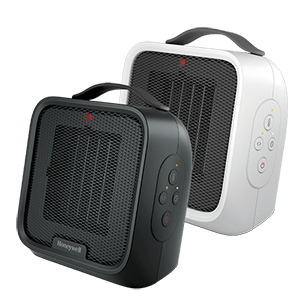
Honeywell lists black HCE220B and white HCE220W configurations. The product page describes personal and small-room heating without a model-specific square-foot coverage figure. Its listed dimensions are 8.5 inches high by 4.5 inches long by 8.86 inches wide, but the shared HCE210/HCE220 owner’s manual gives a different series measurement: 8.2 inches high by 4.8 inches wide by 7.8 inches long. These are both official sources, and the difference is large enough that I would not treat either one as a precise fit promise. If it must clear a shelf edge or fit a defined nook, check the exact package or confirm the measurement with Honeywell before buying. The manufacturer’s official product-family image shows both finish options; it is not a room-scale comparison.
Use it only in a suitable, supervised location
The manual requires a firm, level, open surface, free from obstructions, with at least three feet from walls and combustible materials. Keep bedding, clothing, curtains, paper, and furnishings out of that space. Honeywell prohibits outdoor use, but the instructions do not expressly approve bathroom or close-to-water placement; they warn never to place the heater where it may fall into a bathtub or other water container. If you need bathroom or near-water permission, do not read the absence of a prohibition as approval. Its tip-over switch and two high-temperature safety sensors are documented protections; the HCE220 housing and handle are also described as cool-touch. Those features do not permit closer clearances or a less supervised routine.
This is a substantial electrical load for such a small heater: 120 V, 60 Hz, and 12.5 amps at the 1,500-watt maximum. Plug directly into a sound wall receptacle. Honeywell expressly warns against extension cords and power taps and says not to put the heater on a circuit that already has another appliance operating. Do not use a loose or worn receptacle. The manual also says never to leave the operating heater unattended and to unplug it when it is not in use. If your routine depends on running a heater while asleep or away, this model’s timer is not authorization to do that.
How it compares with the HCE210
Pick the HCE220 when a digital control panel, four preset comfort temperatures, and a timed shutoff are worth more to you than an analog dial. Honeywell describes its operation as quiet, although it supplies no sound measurement; the cooling fan after shutoff is still audible by design. The HCE220’s feature list also identifies a carrying handle and two overheat protections. Its HCE210 sibling is simpler, with a continuously adjusted mechanical thermostat and manual power dial, but no documented countdown timer. Both retain the same 900/1,500-watt levels, the same 120-volt, 12.5-amp circuit caution, three-foot spacing, and the rule against unattended use. Both carry a three-year limited warranty in the shared manual.
The HCE220 is a better choice only if those digital conveniences match your real routine. It does not provide a separate fan-only mode; the post-heat cooling run is not a selectable cooling or air-circulation setting. The product page and manual do not document a later-start schedule, wall installation, bathroom approval, app control, or a remote. If any one of those is essential, compare models that explicitly document it rather than treating an unlisted feature as present.
Bottom line
The HCE220 adds useful shutoff timing and convenient preset temperatures to a compact portable heater, while keeping modestly simple two-level ceramic heat. The timer makes it easier to end a planned session, not safe to forget about the heater. Buy only for a stable dry indoor location where the three-foot clearance, direct outlet, circuit load, and supervision rules are realistic. If you prefer a mechanical thermostat or want the selected lower heat stage to cycle automatically, the HCE210 is the more appropriate comparison; if size tolerance is tight, resolve the published dimension conflict first.
Key details at a glance
| Maximum listed input | 1500 W |
|---|---|
| US supply voltage | 120 V |
| Installation form | Floor-standing and movable |
| Power-heat levels | 2 |
| Listed wattage values | 900 / 1500 W |
| Separate fan-only mode | No |
| Timer behavior | HCE220 offers 2-, 4-, and 8-hour countdown choices; the owner's manual says 8 hours is the default at power-up. This is an auto-off countdown, not delayed start. |
| Fanless convection heating | No |
| Heating element description | Ceramic heating elements with fan-forced directional airflow, as identified by Honeywell. |
Use the exact model’s instructions for operating limits, supplied equipment and version differences.
Sources for this assessment

Check whether the room and routine line up.
Check room restrictions and full wall clearances first, then compare fan-only versus fanless heat, fit, app controls and the timer behavior the exact manual describes.