
Your needs, this model
Does it fit your priorities?
Do you need an adjustable thermostat with an automatic lower heat stage rather than simple on/off cycling?
The VH10 uses a mechanical thermostat that switches both heat and fan off at its target, then restarts as the room cools. It does not document Auto Climate lower-stage modulation; the AVH10 does.
Explore this need in the finder →Will you require the heater to run a fan without heat?
The VH10 product page and instructions do not document a fan-only selection. The AVH10 lists a separate fan-only mode; it circulates existing room air but does not cool it.
Explore this need in the finder →Would a six-hour shutoff countdown or a later start be essential?
No user-set countdown or delayed start is documented for this VH10. Its adjustable thermostat is not a timer.
Explore this need in the finder →The Vornado VH10 is the simpler of these two cube-shaped whole-room heaters: it gives you High and Low, a mechanical adjustable thermostat and a carryable floor format, but no separately documented fan-only or scheduled-timer mode. Its useful distinction is a familiar dial-and-switch arrangement, not a low electrical ceiling. The listed High input is 1,500 watts, so placement, outlet and supervision matter more than its modest footprint.
Simple controls, full-size draw
Vornado lists two heat choices: High at 1,500 watts and Low at 750 watts. At a nominal 120 volts, those settings correspond to 12.5 and 6.25 amps in the manufacturer's FAQ. The separate thermostat is mechanical. The product's control layout makes the adjustment direct, but the available documentation does not establish a calibrated Fahrenheit range or a set-point accuracy; do not treat its dial as a room thermometer. The maximum wattage describes electrical input, not the speed or area of heating in your home.
One distinction matters if you are comparing it with the AVH10. The VH10 thermostat works more like an on/off control: at its target, both the heater and fan stop; they start again as the room falls below the setting. It does not shift automatically to the 750-watt stage before shutting down. If lower-stage automatic temperature control is your essential requirement, the AVH10's Auto Climate system is the more appropriate match. If you would rather set High or Low yourself and let a mechanical thermostat switch operation, the VH10 is the less involved choice.
Air movement is not a separate cooling mode
Both models use a fan to carry heat, and Vornado describes the VH10's whole-room air circulation as its central design idea. That describes an intended circulation pattern, not an independent room-heating test or guaranteed temperature uniformity. The VH10 instructions and product feature list do not document a fan-only mode. It is therefore a poor fit if you want the same appliance to run as an ordinary air-moving fan during warm weather. The AVH10 does document a fan-only selection, although that moves existing room air rather than cooling it.
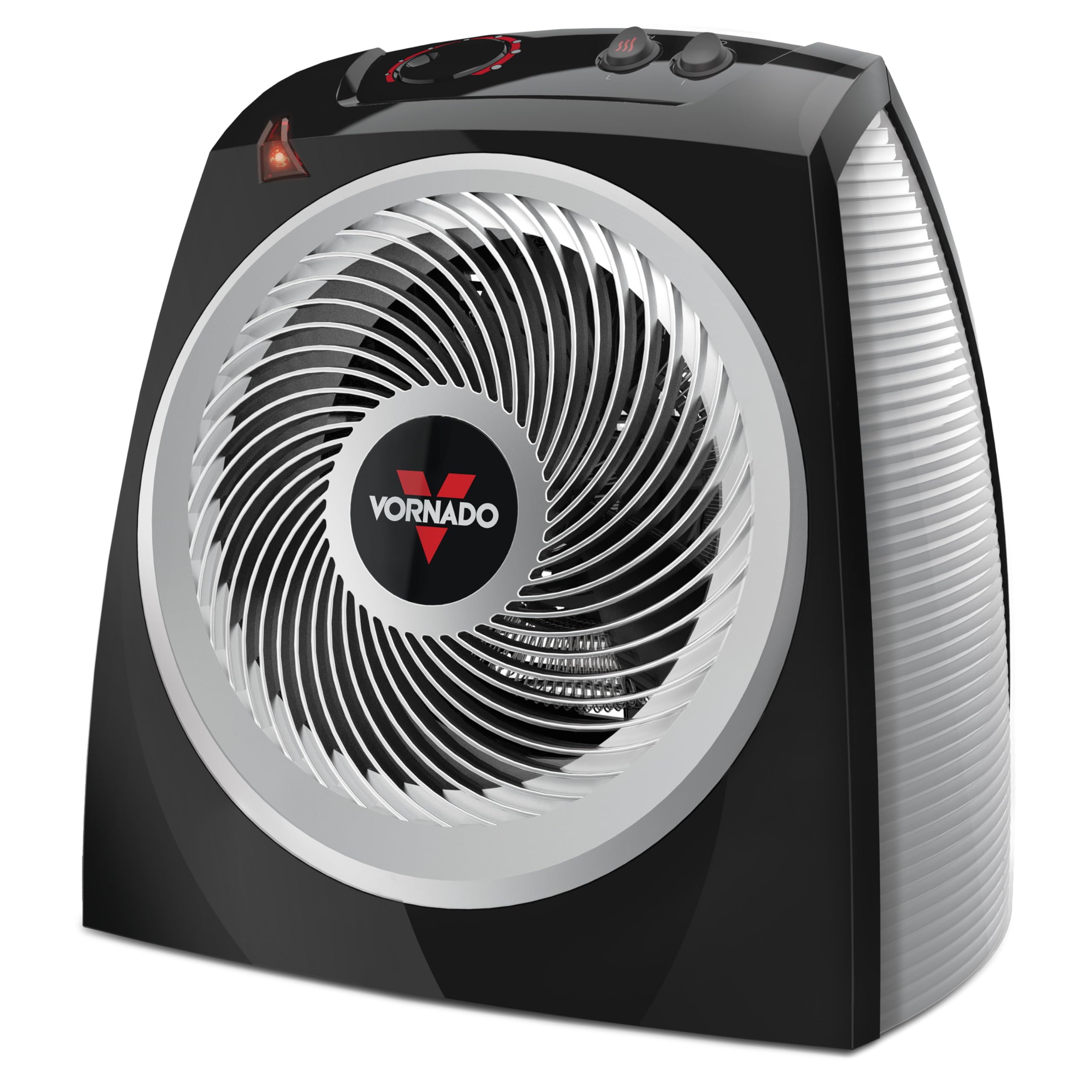
The VH10's black, compact cube body has a top control panel and an integrated cord wrap. I inspected the exact model image: it depicts a black housing, circular front grille and top controls; the manufacturer does not say whether this clean catalog image is a photograph or a computer rendering. Dimensions and body weight are not established in the reviewed product materials, so I would not plan around a narrow shelf or weight limit. Use the published floor placement and follow the exact instructions rather than assuming a tabletop arrangement from the compact shape.
Operating limits that matter more than convenience
Vornado documents overheat and tip-over protection, a cool-touch case and a close grille. Its manual describes automatic shutoff if the unit tips more than about 10 degrees in any direction; this is a protective switch, not permission to place it where it can be knocked over. The manufacturer calls for keeping airflow clear and using a proper wall receptacle. Its safety guidance expressly says not to use extension cords, power strips, multi-outlet adapters, timers or smart plugs with portable heaters. A small heater is still a high-load appliance.
The guidance also treats portable heaters as attended, short-term equipment: switch it off when leaving the room or going to sleep. A thermostat is not a substitute for supervision. Do not use the unit in a bathroom or wet area, near water, or outdoors. The exact product material does not give a numerical clearance schedule, so I will not invent one; check the physical instruction booklet, maintain the required open space and never block the intake or outlet. Basic upkeep is modest: let the unit cool and unplug it before cleaning, keep its grille and air openings free of dust, and use the manual's dry cleaning instructions rather than introducing moisture.
Who should shortlist the VH10?
Choose it when you want a portable floor heater with two manually selected heat levels, a mechanical thermostat and a simple local control panel, and you do not require fan-only operation, a shutoff countdown or a later start. The AVH10 is a better functional alternative if you need a distinct fan-only mode or thermostat behavior that automatically lowers output before switching off. The DREO Heater 320 is another small fan-heater alternative with a documented fan-only setting, multiple selectable fan speeds and a separate countdown shutoff; its body and operating requirements are different, so compare its exact review rather than assuming the features carry over.
Both Vornado models are intended for a dry indoor location and direct, attended use—not for unattended overnight heating or a damp bathroom. Vornado's directly linked VH10 use-and-care booklet prints “VH10+” on its cover while the current U.S. retail page identifies the item as VH10, SKU EH1-0241-06. Those labels are close but not identical; check the appliance rating label against the supplied instructions before relying on a model-specific detail. The page states a five-year guarantee. Confirm its current terms and the exact unit identity before purchase.
Key details at a glance
| Maximum listed input | 1500 W |
|---|---|
| US supply voltage | 120 V |
| Installation form | Floor-standing and movable |
| Exact manual permits bathroom use | No |
| Power-heat levels | 2 |
| Listed wattage values | 750 / 1500 W |
| Separate fan-only mode | No |
| Timer behavior | No user-set auto-off or delayed-start control is documented for VH10. Its mechanical thermostat cycles operation; that is not a countdown timer. |
| Can the heater start on a timer? | No |
| Phone-app control | No |
| Fanless convection heating | No |
| Heated-air direction | |
| Manual vertical outlet tilt | No |
| FortPlug plug-area overheat cutoff | No |
| ALCI leakage-current plug | No |
Use the exact model’s instructions for operating limits, supplied equipment and version differences.
Sources for this assessment
- VH10 Whole Room Heater (Black; SKU EH1-0241-06)
- Vornado native record for product 7509378138206
- VH10 Use & Care (cover prints VH10+)
- Product support for model VH10+
- Current Vornado heater collection native row for VH10
- Vornado official heater FAQ: VH10 / AVH10 differences
- SaferProducts exact-string recall lookup for VH10
- Vornado official recall index
Check whether the room and routine line up.
Check room restrictions and full wall clearances first, then compare fan-only versus fanless heat, fit, app controls and the timer behavior the exact manual describes.