
Your needs, this model
Does it fit your priorities?
Can you provide an attended floor position and keep the heater under a 900-watt input cap?
The exact page lists 900/450 W and the manufacturer FAQ maps those figures to High/Low. The manual requires indoor, upright floor placement with three feet of clearance; a 900-W maximum is electrical input, not a heat-output or room-size rating.
Explore this need in the finder →Would a separately adjustable thermostat and two heat stages be useful, without needing a digital temperature readout?
The exact table lists an adjustable thermostat and Low/High. The handbook shows a numbered 1–7 mechanical dial but does not give Fahrenheit setpoints, calibration or accuracy.
Explore this need in the finder →Do you need the fan to run without heat, or natural and sleep fan patterns?
Fan Only is documented by setting the thermostat to Fan Only and the fan switch to Continuous. The manual only documents Auto/Continuous fan behavior; it does not confirm natural/sleep patterns or a fan-speed count.
Explore this need in the finder →Will an adult remain present, and can the heater stay at least three feet from bedding and all other objects?
Vornado does not recommend unattended or unsupervised operation. Its manual specifically warns not to leave the heater running unattended in a confined space around infants and says not to place it near a bed. The covered cord and child-resistant power switch do not change those limits.
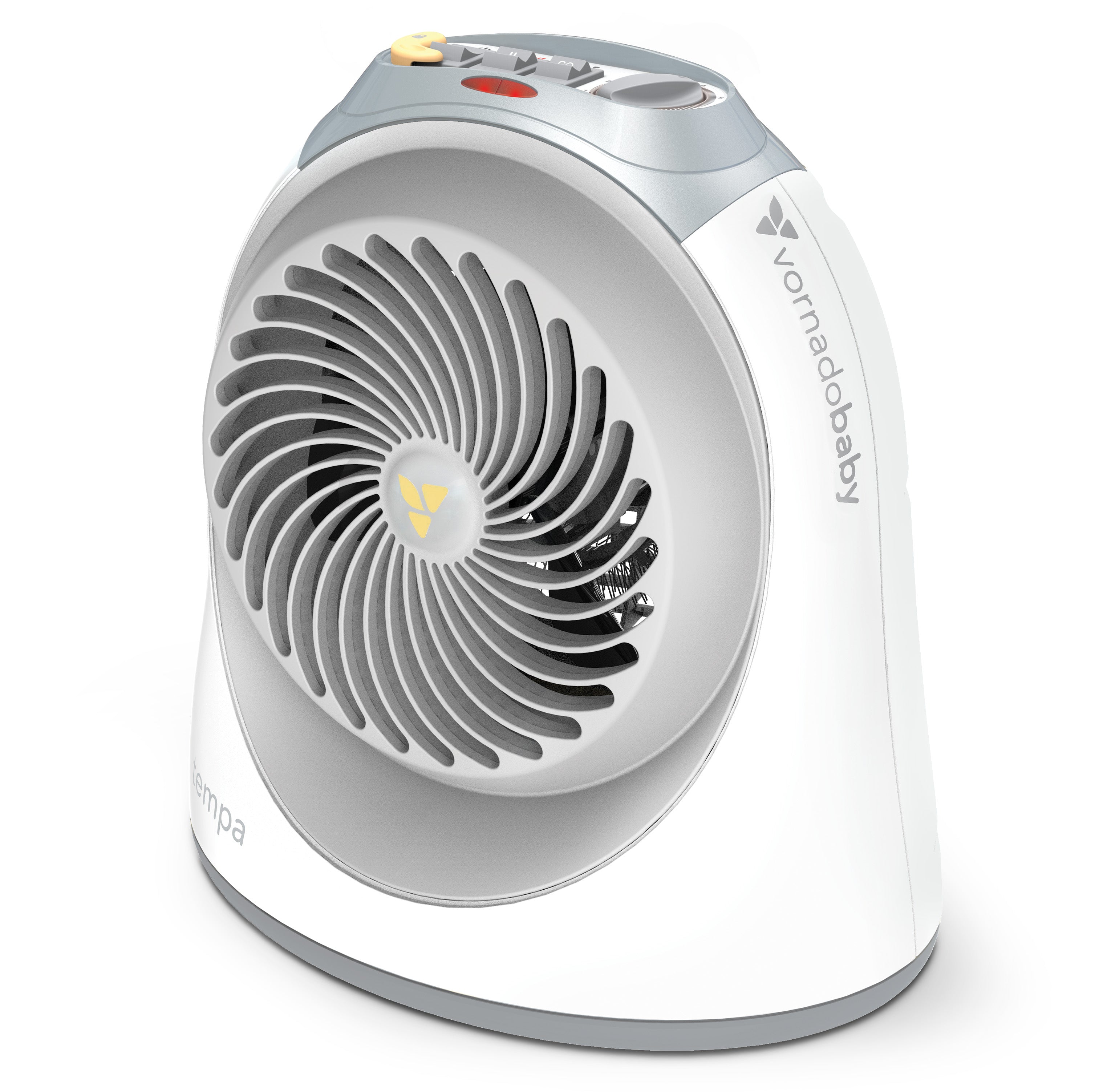
Explore this need in the finder →Tempa is an unusual small fan heater because it pairs a low listed maximum input with physical cord storage and a child-resistant power-switch guard. Its nursery branding deserves careful reading: the exact owner’s handbook says Vornado does not recommend unattended or unsupervised use, and specifically says not to leave it running unattended in a confined space around infants. That warning outranks any implication that its label or protective features make it suitable for a baby’s unattended sleep space.
Exact identity and what the controls do
The current U.S. heater-collection row identifies a single “Default Title” variant, SKU EH1-0137-43. Vornado’s exact Tempa Small Nursery Heater page links the 19-page Tempa Owner’s Handbook; its cover also identifies the Tempa whole-room heater, so the page-to-guide model-family bridge is clear. The native listing marked the one variant available on October 24, 2026, a dated observation rather than a promise about later stock.
The product specification table lists 120 volts, 60 hertz, 900/450 watts, a six-foot three-pin grounded cord, a weight of 3.8 pounds, and a body measuring 10.1 × 7.5 × 10.85 inches (depth × width × height). Vornadobaby’s FAQ maps 900 watts to High and 450 watts to Low. A 900-watt ceiling may suit someone who wants a lower maximum electrical input than a conventional 1,500-watt portable heater, but it is not an efficiency rating, room-heating output, or evidence that the unit can heat a particular floor area. The FAQ declines to give a specific room-size figure, and the product table provides none.
Heat is selected with a Low/High switch, while the separate thermostat knob is marked 1 through 7. The handbook does not translate those dial positions to Fahrenheit or publish thermostat accuracy. The fan switch has Auto and Continuous positions: in Auto, the fan cycles with the heating element; in Continuous, the fan keeps running while the heating element cycles. For fan use without heat, set the thermostat to Fan Only and the fan control to Continuous. That is one documented fan-only arrangement, not proof of multiple selectable airflow speeds or Natural/Sleep/Auto fan patterns.
A real power guard, not a childproof heater
Tempa’s lock arm must be pivoted before the power switch can be pressed; after switching the unit off, the arm returns to protect that switch. This is a useful barrier to accidental activation, but it is not the kind of active control lock that freezes an already-running thermostat or setting. It does not replace adult supervision. Likewise, the manufacturer advertises a cool-touch case, tip-over cutoff, and two-stage overheat shutdown, but these features do not remove the handbook’s burn, fire, and hyperthermia cautions.
The manual requires a stable, level floor and upright operation only—not a crib rail, desk, shelf, bed, or other soft surface. It says to keep at least three feet of open clearance on every side from outlets, furniture, bedding, clothes, curtains, paper, and other items that could catch fire; it also says not to place the heater near a bed. Place it near an accessible grounded wall receptacle, route the cord away from traffic, and secure the slack in the covered base storage. Vornado warns that a cord can increase strangulation risk and recommends storing as much excess as possible. The handbook calls for direct wall connection and prohibits extension cords, power strips, surge-protected units, GFCI outlets, and external timers. It also rules out bathroom, laundry, wet, damp, outdoor, RV, boat, and commercial use. Follow the complete model guide and local electrical requirements; never use a questionable or warm-fitting outlet.
Plan on regular upkeep: the handbook recommends weekly exterior cleaning with a brush-vacuum attachment or soft, dry cloth and periodic compressed air to clear internal dust. Unplug first, do not use solvents, and do not open the housing for repair; the manufacturer directs service to an authorized center.
Where it fits—and where it does not
Consider Tempa for a small, dry indoor floor position where an adult can remain present, the three-foot clearance is genuinely available, and two heat levels, a separate thermostat, continuous fan circulation, a fan-only option, and a covered cord compartment solve real needs. Its smaller body and 900-watt maximum distinguish it from many higher-input heaters; that lower maximum may also mean it is a poor fit when you need more electrical input or expect a heater to compensate for a cold, leaky, or large room.
Do not choose it to warm a sleeping infant’s confined room while no adult is present. The handbook expressly says not to leave it running unattended around infants, and Vornado does not recommend unsupervised operation generally. Three-foot clearance from bedding can also be impractical in a nursery layout. No countdown timer, delayed start, remote, app control, wall mount, tabletop plan, or documented tested square-foot rating is listed. The simple dial can’t give a verified digital setpoint. If an exact automatic timer, remote, or precise room-temperature range is essential, look for a different, documented fit—but do not treat those features on another heater as permission for unattended operation.
For a different Vornado approach, the VHEAT guide documents a manually pivoting head and Low/High heat with a separate thermostat, but not Tempa’s fan-only mode or covered cord arrangement; its own guide also calls for floor-only supervised use. A typical 1,500-watt portable heater offers a higher listed maximum, not guaranteed better comfort or efficiency. In either comparison, check the exact manual, outlet, clearance, and presence routine first. Tempa’s strongest distinction is its lower documented input and protected power-switch design; its main limitation is that nursery branding can sound broader than the manufacturer’s actual operating cautions.
Vornado’s Tempa product page, its linked Tempa Owner’s Handbook, and the manufacturer’s Vornadobaby heater FAQ are the primary sources for the identity, specifications, controls, and safety limits discussed here.
Key details at a glance
| Maximum listed input | 900 W |
|---|---|
| US supply voltage | 120 V |
| Published body height | 10.85 in |
| Published body width | 7.5 in |
| Published body depth | 10.1 in |
| Published body weight | 3.8 lb |
| Installation form | Floor-standing and movable |
| Exact manual permits bathroom use | No |
| Power-heat levels | 2 |
| Listed wattage values | 450 / 900 W |
| Separate fan-only mode | Yes |
| Timer behavior | No built-in countdown or delayed-start timer is listed in the exact product page, specification table, or handbook; the handbook prohibits use with an external timer designed to switch the unit on or off. |
| Can the heater start on a timer? | No |
| Phone-app control | No |
| Fanless convection heating | No |
| Heated-air direction | whole_room |
| Manual vertical outlet tilt | No |
| FortPlug plug-area overheat cutoff | No |
| ALCI leakage-current plug | No |
| Powered outlet louvers | No |
| Control lock | No |
Use the exact model’s instructions for operating limits, supplied equipment and version differences.
Sources for this assessment
- Tempa® Small Nursery Heater exact U.S. listing
- Exact native product, single variant and gallery
- Exact current U.S. Vornado heaters catalogue row 25
- Exact-page-linked 19-page Tempa Owner’s Handbook
- Official Vornadobaby Heater FAQ
- Official Vornado recall index reused from active site archive
- Dated exact-SKU CPSC/SaferProducts recall query
- Dated exact-name CPSC/SaferProducts recall query
Check whether the room and routine line up.
Check room restrictions and full wall clearances first, then compare fan-only versus fanless heat, fit, app controls and the timer behavior the exact manual describes.