
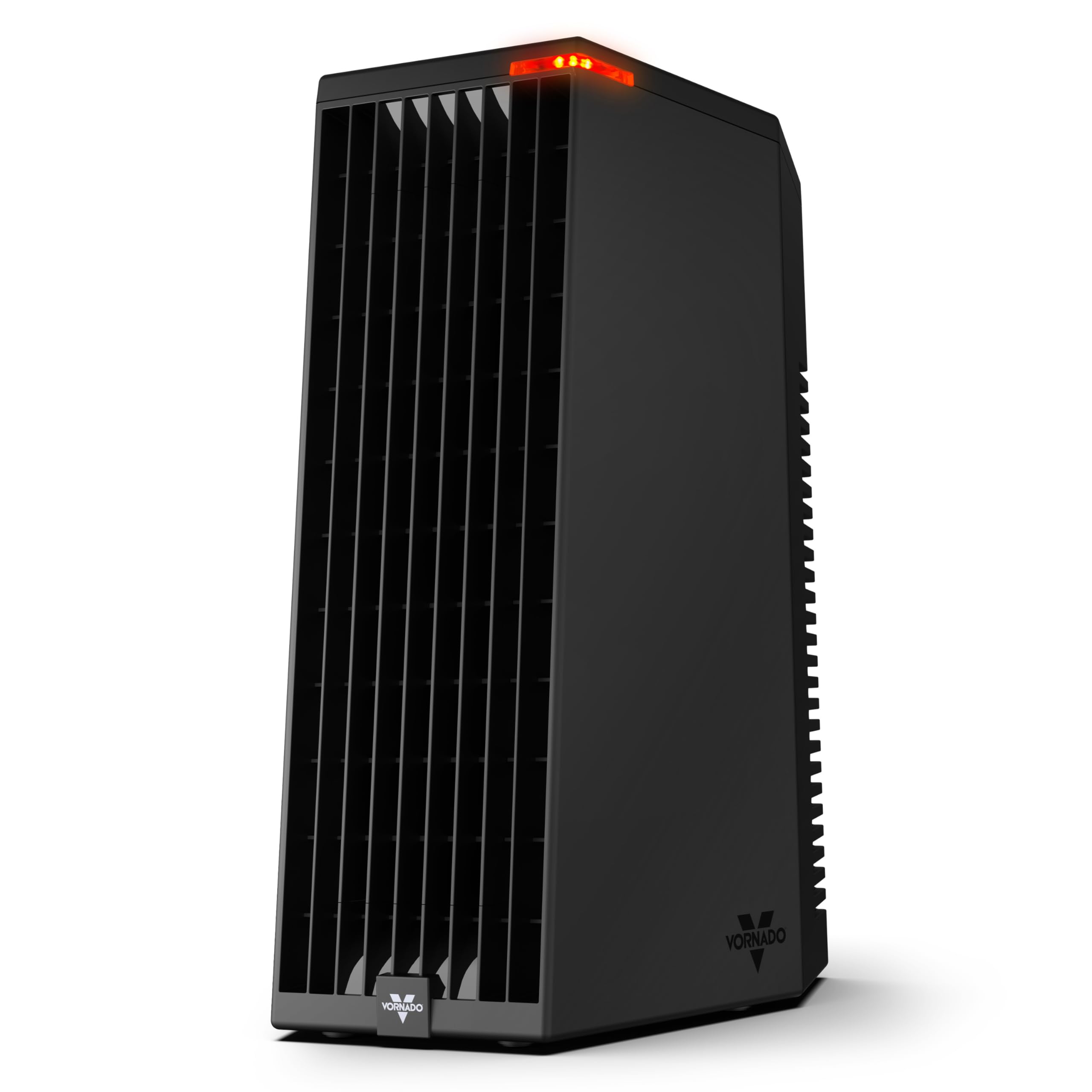
Your needs, this model
Does it fit your priorities?
Do two heat positions and a separate Fan Only mode suit your small personal-heater routine?
The exact product page lists two heat levels and Fan Only; the linked RISE 12H+ mode diagram shows Off, Fan Only, Low and High. It is a single fan-only mode, not a documented fan-speed range. The published 900/450 W values are not mapped to Low and High.
Explore this need in the finder →Does the 12.79-inch body and 900-watt maximum fit the floor space and power ceiling you have?
Vornado lists the Rise 12H at 12.79 inches high, with a 6.76 × 8.54-inch footprint and a maximum listed input of 900 W. The body dimensions are not clearance specifications; follow the full safety instructions for placement.
Explore this need in the finder →Is a manual mode dial enough, or do you need a thermostat or timed/remote control?
The page and direct-linked mode guide identify Off, Fan Only, Low and High; they do not document a thermostat, user countdown, app or included remote. The manufacturer calls for attended use, so a safety cutoff is not permission to run it while away.
Explore this need in the finder →Is the manufacturer-described desktop placement the routine you need, and does the exact unit fit your available space?
The current page calls the heater a source of desktop heat and the exact specification table gives a 12.79-inch body height. The supplied manual does not state numeric desk clearance; check the complete instructions for the exact heater before placing it on a desk.
Explore this need in the finder →The Vornado Rise 12H is a compact black personal tower heater for someone who wants a physical mode dial, two heat choices and a separate fan-only setting—not a thermostat or a row of smart controls. Its current U.S. listing presents it as personal space heat, talks about desktop heat and shows small-room circulation at the higher setting.
Two heat positions and fan-only, without a thermostat
Vornado’s page-linked English Use & Care Guide labels the unit RISE 12H+. Its mode chart gives Off, Fan Only, Low Heat and High Heat. The current retail page lists the two heat settings and fan-only mode; the technical table calls the controls a mechanical knob / push dial / rocker switch. There is no documented adjustable thermostat or temperature display, so this is a select-a-mode heater rather than a unit that cycles around a chosen room temperature.
The specification table lists 900 and 450 watts, but it does not explicitly pair those figures with High and Low. The safe takeaway for a power-sensitive shortlist is a 900-watt maximum listed input and two distinct heat levels—not an assumption that Low is exactly 450 watts. That modest listed maximum separates the 12H from the larger 1,500-watt Rise 20H, but wattage alone is not a promise of room warmth or a cost estimate. Insulation, drafts, room volume and the desired temperature all matter, and I found no independent room-heating test or coverage figure for this model.
Fan Only is useful when you want air movement without selecting heat. It is not an air conditioner, and one fan-only position does not establish multiple fan speeds. If a minimum fan-speed count, automatic climate control or fine temperature cycling matters, this simple dial is the wrong control set.
Personal scale, with two manufacturer use descriptions
The exact U.S. page names a Personal Space Heater and calls the product a tower heater; its description also uses “desktop heat.” In a separate lifestyle image the heater is on the floor while Vornado illustrates small-room circulation. The page’s contrast is practical: personal heat on Low, small-room circulation on High. I would choose it for a nearby occupied spot or a modest room where the maker’s stated function is relevant, not as proof that it will heat a particular room size.
The specifications give a 12.79-inch height, 6.76-inch width, 8.54-inch depth and 3.64-pound weight. The page describes desktop heat but also shows the tower on a floor, so I treat these as two separate personal-use placements, not one combined setup. Its manual says to keep airflow unobstructed and use a level surface, but supplies no numerical clearances. The lifestyle image is not a clearance diagram; check the complete instructions for the exact heater before choosing either position.
Safety is a placement decision, not a feature checkbox
The page and guide describe tip-over protection, a two-stage automatic shutoff and a cool-touch case. The guide separately warns that the front grille is hot during operation and cool-down. If airflow is blocked, its safety system cuts power; after it cools, the reset procedure calls for unplugging, clearing obstructions and waiting five to ten minutes. These protections are useful, but they are not permission to leave a heater running unattended or to crowd it against curtains, bedding or furniture.
Vornado’s general heater guidance says its portable heaters are for attended, short-term use; connect directly to a suitable wall outlet rather than an extension cord, strip, adapter, timer or smart plug; and avoid bathrooms or similar wet locations. The exact Rise guide says to position the heater with airflow unblocked, inspect it for damage, unplug before cleaning and vacuum dust from the front and rear grilles regularly. It does not identify a replaceable filter, thermostat, user countdown timer or included remote. The product specification table explicitly lists Remote Type: No. If unattended overnight use, a shutoff schedule, a remote or app operation is essential, shortlist something whose exact instructions and controls support that routine instead.
Who should choose another control style?
Choose the Rise 12H when two manual heat choices and a separate fan-only setting cover the job, a 12.79-inch body fits the planned safe placement, and a 900-watt maximum is compatible with the outlet and household circuit. Do not infer an exact Low wattage from the unlabeled 900/450 pair. Its absence of a thermostat, remote, app, oscillation and timer is a real tradeoff, not a hidden feature.
For finer floor-tower controls, compare the Vornado Rise 20H: the listed model has Low/Medium/High, an adjustable mechanical thermostat and Auto/Continuous fan behavior, but a 20.27-inch body and 1,500-watt maximum. For another personal format, the VH202 also lists Low/High plus Fan Only and is less than eight inches in any direction per its current page; however, Vornado’s directly linked documents call it VH202+, and its wattage values come from the maker-wide FAQ. Both of these comparison records also retain their own page-to-manual identity caveats. The 12H’s useful distinction is the compact tower body and 900/450 W table—not a proven advantage in comfort, efficiency or room coverage.
Keep the retail label and manual label distinct
The current retail title and native variant identify Rise 12H, Black, SKU EH1-0228-06. The page directly links English PDFs titled for RISE 12H+, and both documents identify their subject as RISE 12H+. Their listed controls align with the retail page, but I found no Vornado document connecting the extra “+” to this exact SKU or explaining whether it marks a revision. I therefore use those directly linked instructions for the listed operation while leaving the suffix-to-SKU bridge open. If a production revision matters for your decision, have Vornado verify the manual against the rating label and SKU before purchase.
Vornado Rise 12H product page · Use & Care Guide linked by Vornado · Product Support sheet
Key details at a glance
| Maximum listed input | 900 W |
|---|---|
| US supply voltage | 120 V |
| Published body height | 12.79 in |
| Published body width | 6.76 in |
| Published body depth | 8.54 in |
| Published body weight | 3.64 lb |
| Installation form | Floor-standing and movable |
| Exact manual permits bathroom use | No |
| Power-heat levels | 2 |
| Listed wattage values | 900 / 450 W |
| Separate fan-only mode | Yes |
| Timer behavior | The exact mode chart shows Off, Fan Only, Low and High; no user-set countdown or delayed start is listed. The two-stage automatic shutoff is safety protection, not a timer. |
| Can the heater start on a timer? | No |
| Phone-app control | No |
| Fanless convection heating | No |
| Heated-air direction | focused |
| Manual vertical outlet tilt | No |
| FortPlug plug-area overheat cutoff | No |
| ALCI leakage-current plug | No |
| Powered outlet louvers | No |
| Control lock | No |
Use the exact model’s instructions for operating limits, supplied equipment and version differences.
Sources for this assessment
- Rise® 12H Personal Space Heater (Black retail page)
- Native Shopify product record for Rise 12H Black
- Vornado current U.S. Heaters collection page 1
- RISE 12H+ English Use & Care guide directly linked from exact page
- RISE 12H+ English Product Support sheet directly linked from exact page
- Vornado heater FAQ and use guidance
- Vornado current Product Recalls index
- CPSC SaferProducts exact ProductModel query: RISE 12H
- First original image in the exact Rise 12H Black native gallery

Check whether the room and routine line up.
Check room restrictions and full wall clearances first, then compare fan-only versus fanless heat, fit, app controls and the timer behavior the exact manual describes.