
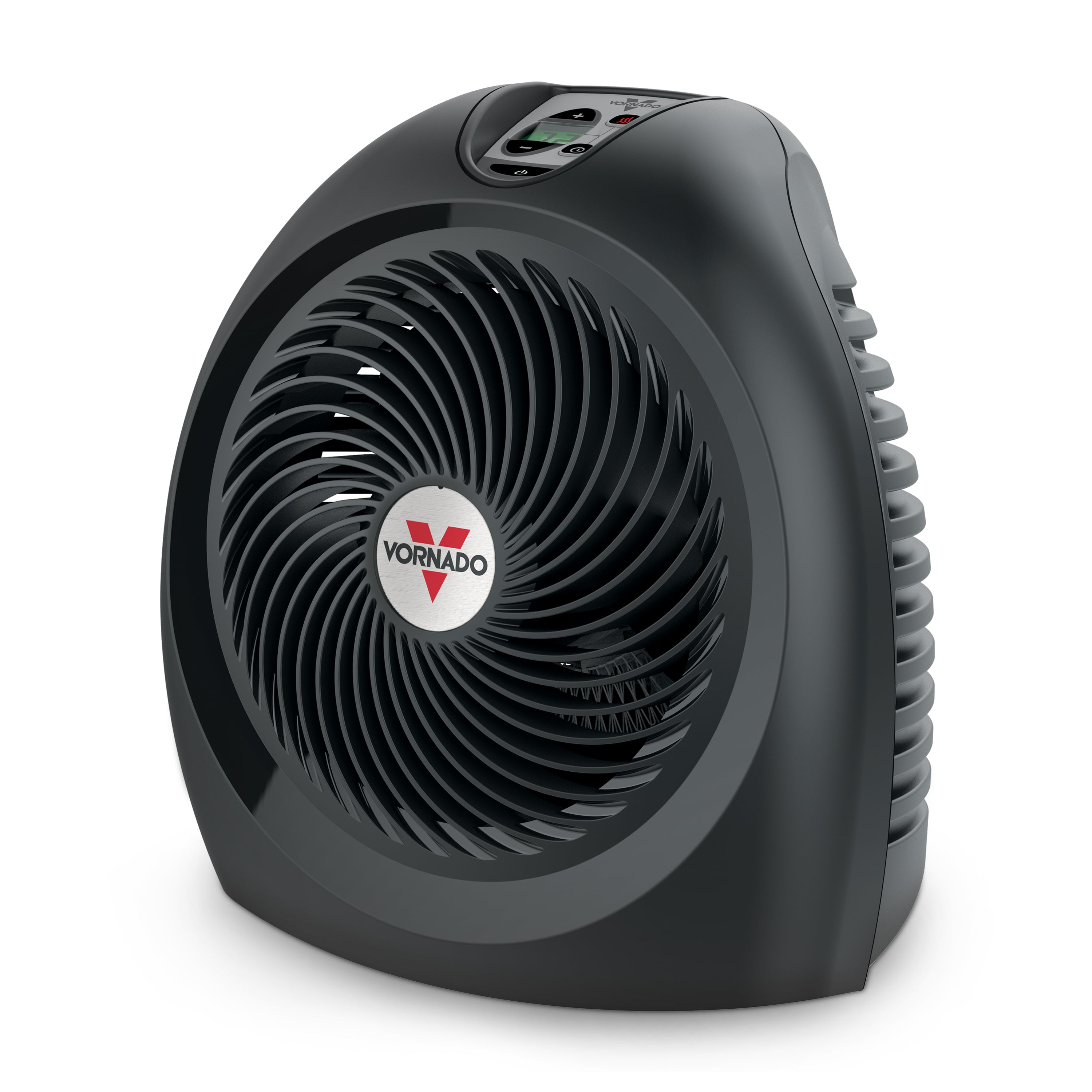
Your needs, this model
Does it fit your priorities?
Do you need a separate fan-only setting as well as two selectable heat levels?
The exact AVH2 Advanced guide lists High Heat, Low Heat and a separate Fan Only mode. Fan-only moves air without heat; it is not a third heat level or a cooling function. The page gives 1500/750 W but does not map either figure to Low or High.
Explore this need in the finder →Would a one-to-twelve-hour automatic shutoff fit an attended session, or must the heater start later?
The exact guide documents a built-in off countdown in one-hour steps up to 12 hours, with no delayed start. It also says Vornado does not recommend unattended operation, so a countdown is not leave-on permission.
Explore this need in the finder →Will its 11.89-inch body height and 1,500-watt maximum fit your space and electrical ceiling?
The exact specification table lists 11.89 inches high and 1,500 watts maximum. The guide separately requires three feet of clearance on every side; body height is not the clearance zone.
Explore this need in the finder →Can you provide an attended, dry indoor floor position with three feet of clearance?
The guide limits the heater to indoor living-space floor use and requires at least three feet of clearance on all sides. Vornado does not recommend unattended or unsupervised use; a required unattended routine does not fit.
Explore this need in the finder →The AVH2 Advanced makes sense for a dry indoor room where you want a digital target, separate low and high heat, and a fan-only setting in the same floor-standing heater. Its name is easy to confuse with Vornado’s separate “AVH2 Whole Room Heater with Auto Climate” listing, which the manufacturer labels discontinued. This review is for the exact AVH2 Advanced retail page and its directly linked guide; that guide cover says “model AVH2 ADVANCED,” and the current native listing identifies one Default Title configuration, SKU EH1-0149-06.
More control than a two-position switch
The controls are electronic push buttons with a digital display, rather than the mechanical dials found on some Vornado models. The mode button selects High Heat, Low Heat or Fan Only. High and Low are the two heating levels; Fan Only is not a third heat stage, and moves existing room air rather than cooling it. Vornado lists 1,500/750 watts and 120 volts, but the page and guide do not say which listed watt figure maps to which heat mode. Treat 1,500 watts as the maximum input, not a measured heating result, and do not guess the exact draw of Low.
The AVH2 Advanced adds two fan behaviors. In Continuous, the fan keeps running on either heat level. In Auto, High heat allows both fan and heat output to vary; with Low heat, the fan remains at its low speed. That distinction may matter if you prefer a more steady stream of air or want the heater to adjust its operation as it approaches the thermostat setting. The materials do not provide a thermostat calibration, accuracy tolerance, or a measured room-temperature response, so the digital target should not be treated as laboratory precision.
A one-to-twelve-hour countdown can switch the heater off in one-hour steps. That is useful as a reminder to end an attended session, but it is not a delayed start and is not permission to leave the appliance running alone. The guide warns against an external timer that turns the heater on or off because it could interfere with a thermal cutoff. The built-in off timer is a distinct product control; neither it nor the automatic shutoffs overrides Vornado’s statement that it does not recommend unattended or unsupervised use.
Body size is not the safety footprint
The manufacturer’s specification table gives a body measuring 9.21 inches deep, 11.65 inches wide and 11.89 inches high, weighing 4.48 pounds, with a six-foot cord. The same table calls the plug a two-pin polarized type. These are practical fit details for a room corner, but the manual requires at least three feet of clearance on all sides from outlets, furniture, bedding, papers, clothes, curtains and other objects that may ignite. It must stand upright on a level floor, not a desk, shelf, bed or other raised surface. Measure that clear floor area before choosing it: the cabinet is compact, but the required operating zone is not.
The guide limits the heater to indoor living spaces and excludes bathrooms, laundry rooms, similar damp locations, outdoor use, and commercial or industrial work. It says to plug directly into a standard wall outlet, not through an extension cord or power strip, and specifically warns against surge-protected or GFCI outlets. Its 120-volt rating is not a reason to add adapters or share an overloaded circuit. If an outlet or plug becomes hot, loose, sparks, or causes lights to dim, stop using the heater and have the electrical issue checked rather than trying a different intermediary.
Protection, cleaning and service
Vornado lists an automatic safety shutoff for blocked airflow and the owner’s guide describes a tip-over cutoff. The page also promotes a cool-touch case and a finger-resistant grille. Those are manufacturer design claims, not a promise that every surface is safe to touch: the guide warns that the front outlet grille is hot during operation and cooldown. Keep children supervised and keep bedding, curtains and other combustibles beyond the clearance zone. A safety cutoff is a backup, not an invitation to cover the heater or use it in a hazardous spot.
The guide recommends unplugging before cleaning, vacuuming dust from the side inlets and front grille with a brush attachment, and wiping the case with a soft, dry cloth. It also recommends periodically clearing internal dust with pressurized air. If airflow obstruction trips the heater, its reset steps are to unplug it, remove the obstruction, let it cool for five to ten minutes and retry; repeated shutdowns or failure to reset call for service. The manual directs repairs to a Vornado-authorized service center and lists a five-year limited warranty for the original buyer, subject to its terms.
Who should shortlist it?
Choose the AVH2 Advanced when digital push-button adjustment, two heat levels, a separate fan-only mode and an automatic shutoff countdown fit a supervised floor-use routine. Its whole-room circulation language is Vornado’s design description, not an independent coverage test; the sources give no verified room-size rating, heating-rate comparison, or measured energy savings. The right question is whether its controls and clearances suit your room, not whether a whole-room label guarantees even warmth in every layout.
If you prefer three mechanical heat positions and fewer electronic controls, compare the Vornado Velocity 4; it has a different exact manual and lacks this model’s fan-only mode and countdown. If you need an unattended heater, wet-area permission, tight placement against a wall, a remote, an app, or a verified watt draw for each stage, do not infer those features here. The exact guide’s floor-only, three-foot-clearance, direct-outlet and attended-use rules are central to the decision, not small print.
Key details at a glance
| Maximum listed input | 1500 W |
|---|---|
| US supply voltage | 120 V |
| Published body height | 11.89 in |
| Published body width | 11.65 in |
| Published body depth | 9.21 in |
| Published body weight | 4.48 lb |
| Installation form | Floor-standing and movable |
| Exact manual permits bathroom use | No |
| Power-heat levels | 2 |
| Listed wattage values | 750 / 1500 W |
| Separate fan-only mode | Yes |
| Documented fan-only speeds | 2 |
| Timer behavior | Built-in auto-off countdown in one-hour increments up to 12 hours; no delayed start. Guide warns against an external timer that turns the unit on or off; built-in shutoff does not make unattended use permissible. |
| Can the heater start on a timer? | No |
| Fanless convection heating | No |
| Heated-air direction | whole_room |
| Manual vertical outlet tilt | No |
| FortPlug plug-area overheat cutoff | No |
| ALCI leakage-current plug | No |
| Powered outlet louvers | No |
Use the exact model’s instructions for operating limits, supplied equipment and version differences.
Sources for this assessment
Check whether the room and routine line up.
Check room restrictions and full wall clearances first, then compare fan-only versus fanless heat, fit, app controls and the timer behavior the exact manual describes.