
Your needs, this model
Does it fit your priorities?
Do you need a separate fan-only setting as well as indoor floor placement?
Yes. The AVH10 lists Fan Only; it moves room air without heat and does not cool it. The VH10 does not document that mode.
Explore this need in the finder →Do you need automatic thermostat control to reduce heat output before shutting off?
Yes. Vornado describes AVH10 Auto Climate as reducing element wattage and fan speed at target, then switching both off if the room rises three degrees above it. This is distinct from VH10 on/off mechanical cycling.
Explore this need in the finder →Is a six-hour auto-off countdown or delayed start essential?
The AVH10 materials inspected do not document either timer. Its short post-use fan cooldown is not a user-set countdown; the hour-based timer reference is AVH30-only.
Explore this need in the finder →The Vornado AVH10 is the more control-oriented partner to the VH10: both are floor-standing 1,500-watt whole-room fan heaters with High and Low, but the AVH10 adds a digital panel, a separate fan-only mode and Vornado's Auto Climate temperature control. That makes its operation more flexible, not automatically safer or more suitable for every room. It remains a portable heater that requires an attended, dry indoor setup and a direct wall receptacle.
Auto Climate is the real difference
The AVH10's two selected heat settings are High (1,500 watts) and Low (750 watts). Its electronic temperature control behaves differently from the VH10's mechanical thermostat. Vornado says the Auto Climate system reads room temperature with a thermistor, then lowers both heater-element output and fan speed when the selected target is reached. If room temperature rises three degrees above that target, the heating element and fan turn off; they resume as the room cools. That staged behavior is useful when you prefer automatic adjustment rather than a fan and element that simply run at the chosen setting and stop together.
This is not a published thermostat accuracy rating, measured room-temperature result or promise of quieter operation. The supplied material does not specify a reliable Fahrenheit range or exact fan-speed curve for Auto Climate. The digital controls let you change a set temperature and show the room reading; the display dims after about 20 seconds. Use these as convenience controls, not as a substitute for a separate thermometer or a fixed heating plan.
Fan-only for airflow, not cooling
Unlike the VH10, the AVH10 has a Fan Only selection. That mode circulates air without calling for heat; it does not refrigerate or lower the room's temperature. The question is practical: if your household expects this heater to serve as a fan between heating seasons, the AVH10 has the more suitable documented mode. If you only need heat and prefer simpler controls, the VH10 avoids a digital display and extra control steps.
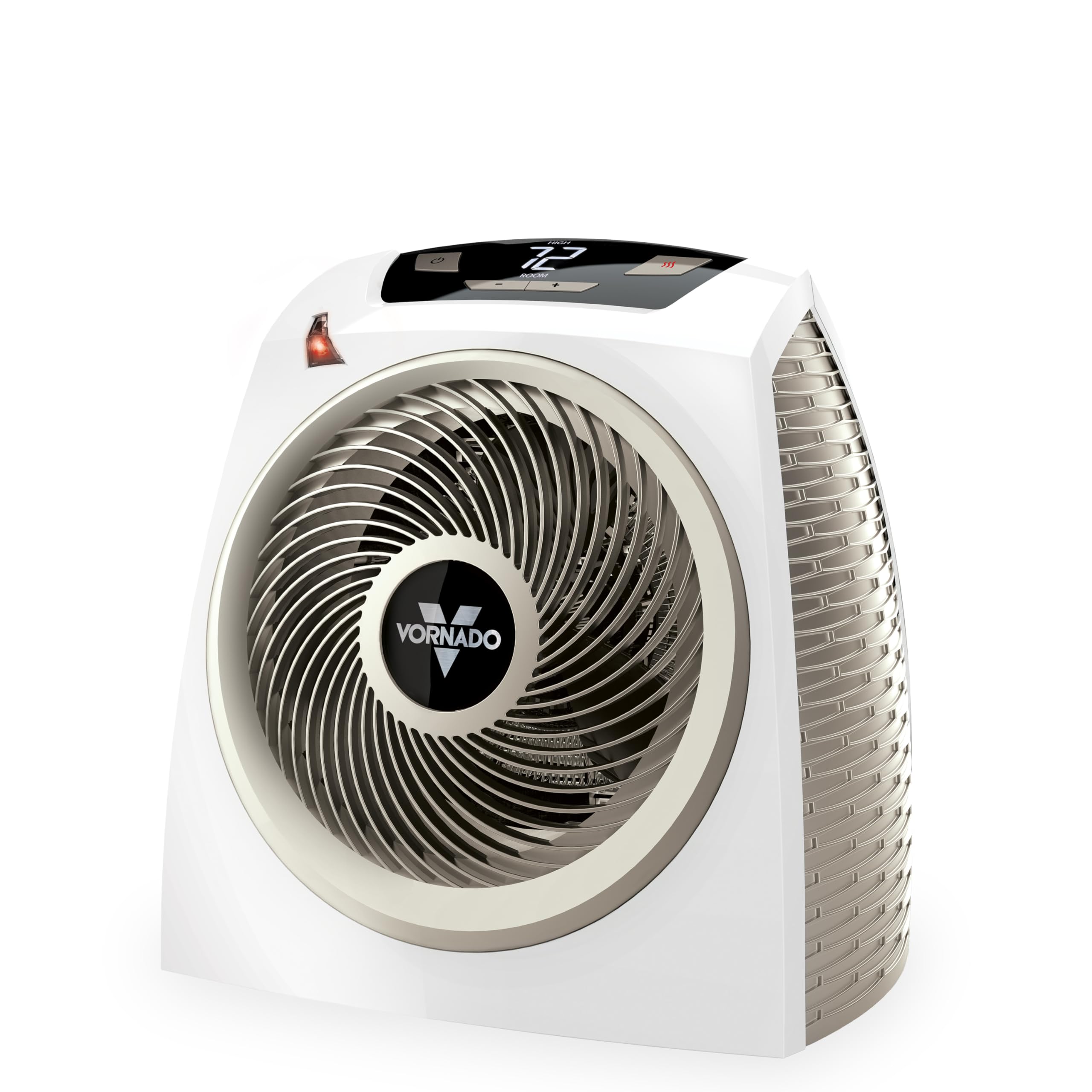
The white-and-metallic cube retains the broad circular outlet and top-mounted controls, with a digital temperature readout. The official image matches the white AVH10 finish, but the maker does not identify the clean catalog image as a photograph or CGI. Product-page materials do not give a supported body-height, width, depth or weight measurement, so a strict fit limit remains unknown. The heater is a floor appliance; do not infer shelf or desk use from its compact proportions.
A countdown display is not an off timer
The AVH10's shutdown routine can keep its fan running briefly after you switch the heater off: the display counts down from eight while it cools, then shuts down. That sequence is a cooldown, not a user-set eight-hour timer. Vornado documents an hour-based countdown function for the AVH30 in the shared manual, specifically identified as an AVH30-only feature; it should not be transferred to the AVH10. The AVH10 materials reviewed here do not establish an auto-off countdown or delayed start. If either timer behavior is essential, choose a model whose exact instructions document it.
As on the VH10, the product has overheat and tip-over protection, cool-touch housing, a close grille and cord storage. The manual describes tip-over shutoff beyond roughly 10 degrees. This does not make the device child-proof or suitable for an unstable location. The manufacturer requires clear, unobstructed airflow and an appropriate wall receptacle; its safety guidance prohibits extension cords, power strips, adapters, timers and smart plugs. The manual materials do not establish numerical room clearances, so follow the exact booklet for your unit rather than borrowing spacing from another Vornado heater.
Keep the plan supervised and dry
Vornado's official safety guidance says portable heaters should be used only under supervision for short-term heating, switched off when you leave the room or go to sleep. Neither Auto Climate nor a thermostat changes that advice. Do not use this heater in a bathroom, near water, in damp conditions or outdoors. For maintenance, unplug and allow the unit to cool, then clean its exterior and grille as the booklet directs; vacuum dust from the air openings and use compressed air only as directed. Do not immerse or wet the appliance.
Shortlist the AVH10 if you want automatic lower-stage temperature control or a separate fan-only airflow mode, and you can accept a digital interface and a 1,500-watt maximum. Choose the VH10 for manual High/Low selection and an on/off mechanical thermostat. A DREO Heater 320 is another portable option with three fan-only speeds and a documented auto-off countdown, but it is a different shape and control system. Both Vornado units are 120-volt indoor products, not outdoor or bathroom heaters, and neither should be left running unattended.
The current U.S. retail listing identifies this white configuration as AVH10, SKU EH1-0230-43. Its directly linked booklet is titled “AVH10+”; the plus suffix is not explained in the product materials, so check the physical model label against the included instructions. The product page states a five-year guarantee; verify its current terms before buying.
Key details at a glance
| Maximum listed input | 1500 W |
|---|---|
| US supply voltage | 120 V |
| Installation form | Floor-standing and movable |
| Exact manual permits bathroom use | No |
| Power-heat levels | 2 |
| Listed wattage values | 750 / 1500 W |
| Separate fan-only mode | Yes |
| Timer behavior | No user-set auto-off or delayed-start control is documented for AVH10. Its short eight-count fan cooldown after switch-off is not a timed operating schedule; the manual identifies an hour-countdown for AVH30 only. |
| Can the heater start on a timer? | No |
| Phone-app control | No |
| Fanless convection heating | No |
| Heated-air direction | |
| Manual vertical outlet tilt | No |
| FortPlug plug-area overheat cutoff | No |
| ALCI leakage-current plug | No |
Use the exact model’s instructions for operating limits, supplied equipment and version differences.
Sources for this assessment
- AVH10 Whole Room Heater with Auto Climate (Ice White; SKU EH1-0230-43)
- Vornado native record for product 7510253961310
- AVH10 Use & Care (cover prints AVH10+)
- Product support for model AVH10+
- Current Vornado heater collection native row for AVH10
- Vornado official heater FAQ: Auto Climate operation
- SaferProducts exact-string recall lookup for AVH10
- Vornado official recall index
Check whether the room and routine line up.
Check room restrictions and full wall clearances first, then compare fan-only versus fanless heat, fit, app controls and the timer behavior the exact manual describes.