
On this page
Your needs, this model
Does it fit your priorities?
Do you need heat without fan-driven airflow, or a separate fan-only breeze?
The PSHO06MR6ASB is fanless while heating and has no documented fan-only setting.
Explore this need in the finder →Must the radiator start later or switch off on a schedule?
The manual supports a 0–24 hour schedule in standby as well as a timed stop during operation; it is not an app-connected schedule.
Explore this need in the finder →Is an included remote essential?
Pelonis lists an included remote for the exact PSHO06MR6ASB page, and the manual shows its remote controls.
Explore this need in the finder →Is the selected 1,500-watt maximum acceptable on your available 120-volt outlet?
The manual rates this model at 1,500 W on 120 V/60 Hz; the product is not a low-voltage substitute.
Explore this need in the finder →Does the manual need to permit bathroom use?
No. Its exact instructions prohibit bathroom, laundry and similar locations and warn against water contact.
Explore this need in the finder →The Pelonis U.S. page identifies the heater as PSHO06MR6ASB; the linked support page and manual use that same code, with the manual also carrying the engineering designation NY1506-18SRA. This is a digital oil-filled radiator, not a portable fan heater or a separate remote accessory.
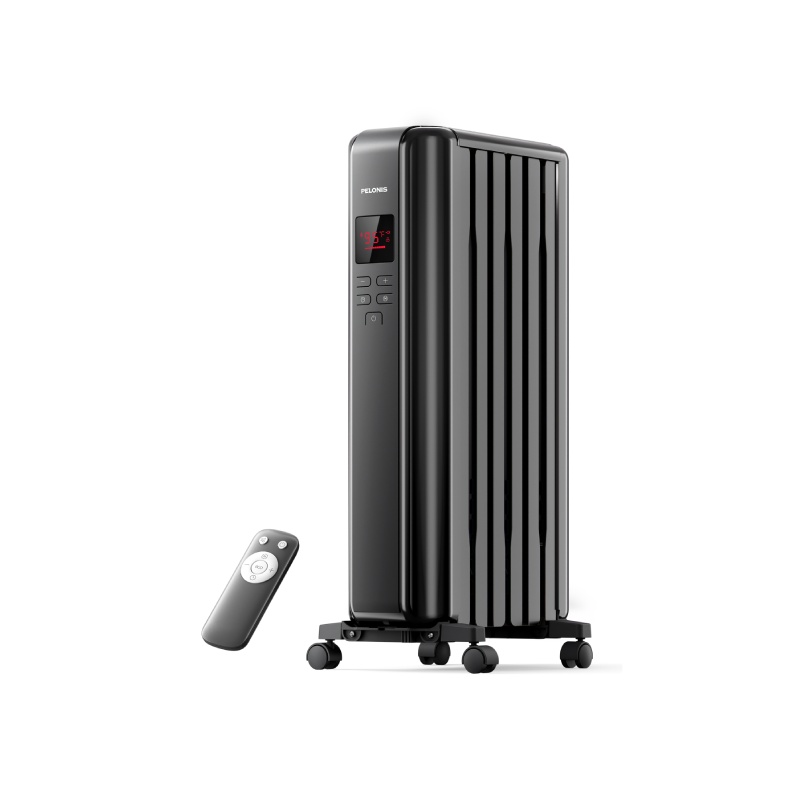
Image source and model notes
A quieter style of heat with a real timer
Pelonis lists three heat settings—600, 900 and 1,500 watts—and a digital thermostat adjustable from 41°F to 95°F in one-degree increments. Its fan-free radiator design is the practical distinction: it does not provide a separate fan-only breeze or a directed stream of heated air. If a desk fan that can warm a person quickly is what you need, a ceramic fan heater is a better match. If you want steady room heat without fan-driven airflow, this form can make more sense.
The feature set is unusually useful for a radiator. Pelonis lists an LED touchscreen, included remote, ECO mode and a timer up to 24 hours. The exact manual describes scheduled operation in both working and standby states: you can set a later start or a timed stop, in one-hour steps. That is more flexible than a basic dial radiator, but it is not an app or a network-connected schedule. The manual also documents a child lock that disables operation while active; this is a convenience control, not a substitute for supervising children around a hot heater.
Pelonis promotes M-shaped fins and faster heat dissipation on the product page. Those are manufacturer claims, not independent room-heating results. The source does not provide a verified room-size figure, physical dimensions or weight for this exact model, and there is no hands-on test here. Do not use an advertised efficiency phrase as a promise that the unit will heat a particular room or lower a bill by a predictable amount. Insulation, outdoor temperature, room layout, thermostat setting and run time all matter.
Plan for the outlet and the floor clearance
The exact manual rates the PSHO06MR6ASB at 120 volts, 60 hertz and 1,500 watts. At its maximum it is a substantial load for an ordinary household outlet; Pelonis’s instructions require a direct wall connection and warn against extension cords and relocatable power taps. Check the cord and receptacle, avoid adding other appliances to an overloaded circuit, and follow the manual rather than assuming that the lowest setting changes the required voltage.
Before heating, attach the wheel assemblies and use the radiator upright on a clear, level indoor floor. The manual requires at least three feet in front of the heater and says to keep furnishings and other combustibles away from its sides and rear. The radiator becomes hot: avoid skin contact, do not cover it, and keep clothing, curtains and bedding clear. The instructions prohibit outdoor use and bathrooms, laundry areas and similar locations where it could contact water. They also warn against leaving it running unattended. Tip-over and overheat protections do not remove those operating limits.
Who benefits from the controls?
Choose the PSHO06MR6ASB when you want fanless radiator heat but also value a remote, a readable digital setting and a schedule that can start or stop the heater. Its 24-hour schedule and fine thermostat adjustment are more capable than the simpler Pelonis PHO15A2AGB/PHO15A2AGW dial models, which have three wattage settings but no documented timer. The nearby PSHO07JR4AGB shares the fanless, remote-controlled idea and adds a named Sleep mode, while its manual documents an off timer rather than this model’s later-start schedule.
Skip this unit if a quiet-looking radiator is being chosen for bathroom use, unattended operation, a room-specific coverage guarantee, lower-voltage circuit planning, an exact height limit or an app connection. Those details are not established here, and an unknown is not a match. For a dry room where the timer, remote and steady fanless output are useful, the PSHO06MR6ASB is the more considered digital option; for basic manual operation, compare the PHO15 family instead.
Pelonis PSHO06MR6ASB product page · Pelonis PSHO06MR6ASB owner’s manual · Pelonis PSHO07JR4AGB review · Pelonis PHO15A2AGB/AGW review
Key details at a glance
| Maximum listed input | 1500 W |
|---|---|
| US supply voltage | 120 V |
| Installation form | Floor-standing and movable |
| Exact manual permits bathroom use | No |
| Power-heat levels | 3 |
| Listed wattage values | 600 / 900 / 1500 W |
More specifications and setup details
| Separate fan-only mode | No |
|---|---|
| Documented fan-only speeds | 0 |
| Maximum documented horizontal sweep | 0° |
| Temperature setting range | [41, 95] |
| Timer behavior | The exact manual describes scheduled work from standby and timed shutoff during operation over 0–24 hours in one-hour steps. Child-lock instructions state operation including standby is disabled while locked. |
| Can the heater start on a timer? | Yes |
| Fanless convection heating | Yes |
| Heated-air direction | |
| Manual vertical outlet tilt | No |
| Powered outlet louvers | No |
| Control lock | Yes |
| Heating element description | oil-filled radiator with fanless radiant warmth and natural convection |
Use the exact model’s instructions for operating limits, supplied equipment and version differences.
Sources for this assessment
Check whether the room and routine line up.
Check room restrictions and full wall clearances first, then compare fan-only versus fanless heat, fit, app controls and the timer behavior the exact manual describes.