
On this page
Your needs, this model
Does it fit your priorities?
Do you need a timer that can shut the heater off or start it later?
The exact manual documents both an auto-off and a standby start timer in one-hour steps up to eight hours. This is not permission for unattended use.
Explore this need in the finder →Do you need a manual aim position rather than a powered sweep?
The head has five manual positions at 0°, 18°, 38°, 53° and 75°. The manual does not describe powered oscillation, and the steeper heat angles force the High setting.
Explore this need in the finder →Do you want three known heat inputs plus separate low/high fan-only modes?
The manual specifies heat levels of 600, 900 and 1,500 W, plus 20- and 30-W cooling-fan modes. Cooling modes move air; they do not condition it.
Explore this need in the finder →The Pelonis PSH23FT4DBB is a small, round-head heater and air circulator with a real set of controls to evaluate: three heat outputs, two fan-only cooling outputs, an adjustable temperature target, an eight-hour start/stop timer, a remote and a manually pivoting head. Its manual also documents a constraint that changes how you use the tilt: at the higher 38-, 53- and 75-degree positions, Low and Medium heat automatically switch to High. This is not simply a heater that lets every angle and wattage setting operate independently.
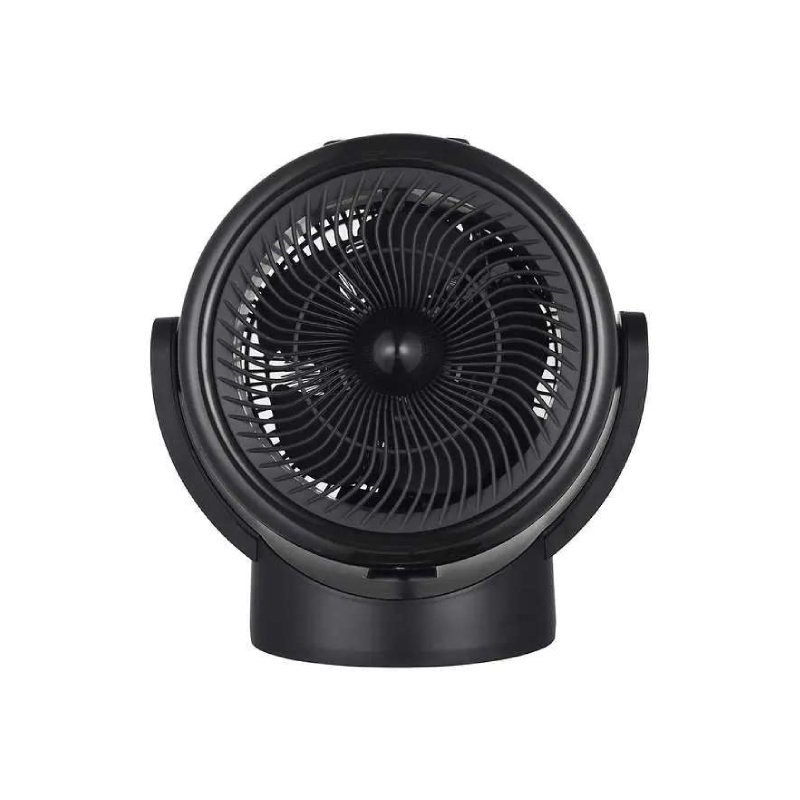
Image source and model notes
Choose a heat stage, then check the angle
The exact PSH23FT4DBB manual specifies 120 volts, 60 hertz and a 1,500-watt maximum. Its heating positions are 600 watts, 900 watts and 1,500 watts. The manual separately lists low and high cooling-fan modes at 20 and 30 watts. Those modes move air without heating it; they are not air conditioning. This combination gives a more complete fan-and-heater menu than a simple three-speed product title can tell you.
The head pivots manually among five named positions: 0, 18, 38, 53 and 75 degrees. The manual does not describe powered left-to-right or 3D oscillation. More importantly, it says a 38-, 53- or 75-degree angle automatically switches Low or Medium heat to High. If you need to keep output at the lower setting while aiming upward, the controls do not support that combination. For a fixed seat-level stream, the 0- or 18-degree positions retain more of the lower-stage choice; verify the actual set mode after changing the angle.
Temperature and timer behavior
The digital thermostat target spans 45 to 95°F in the manual. The unit enters standby when room temperature exceeds the target by 4°F, then resumes heating when the temperature falls below the set target. That is the manufacturer’s described cycle, not an independent accuracy test. The timer can power the heater off after up to eight hours or start it from standby up to eight hours later. A display, mode control and remote are included; the manual lists two AAA batteries in the package. The remote’s stated range is up to 16 feet from the front of the unit with a 30-degree deviation angle.
Those controls are useful if you want a set temperature or a finite start/stop window, but they are not permission to leave a heater running unattended. The manual calls for extreme caution whenever a heater is left operating unattended and specifically warns against unattended operation in a confined space around infants or people with reduced ability to respond. If unattended use is an essential condition, the manual does not clear the PSH23FT4DBB.
Small footprint, with the manufacturer’s coverage claim qualified
Pelonis lists a 7.4-by-7.4-inch footprint, 9.6-inch height, 4-pound weight and a 4.92-foot cord. The product page states coverage of up to 475 square feet; treat that as the manufacturer’s claim, not a measured heating result. Real comfort depends on insulation, drafts, ceiling height and whether the airflow can reach the occupied part of the room. The small body can make placement easier, but its cord and required safety gap still need to fit the actual room.
The owner’s manual calls for at least three feet in front of combustibles and keeping them away from the sides and rear. It says to plug directly into a wall receptacle rather than an extension cord or power tap, and excludes bathroom, laundry and similar damp locations. Keep the intake and exhaust clear. The manual also describes a thermal shutdown if internal temperature rises beyond its threshold; the on-page safety information should be read alongside the full model-specific guide rather than treating this protection as a reason to cover or crowd the unit.
How it compares with simpler Pelonis heaters
The PSH23FT4DBB is the control-rich choice among the small Pelonis fan heaters in this group. The PSHF10M1ABB is simpler and documents fan-only, 600/900/1,500-watt heat and two mechanical dials, but not a remote or timer. The PSH08F1ABB is shorter on its published dimensions and has mechanical controls, but its exact manual bridge remains unresolved and its product page does not document this five-position head, timer or separate cooling modes. The NF15-19UR lists an adjustable stand, but its linked PDF identifies another model; the PSH23’s exact manual gives a much firmer operating basis.
Consider the PSH23FT4DBB if you will use its selectable temperatures, timer and adjustable airflow, and can accept the automatic High transition at steeper heat angles. It is less appealing if you want a static low heat stage regardless of direction, a verified oscillation sweep, or a fully unattended schedule. Its timer can start from standby, but safety instructions still govern how and where the appliance is used.
Pelonis PSH23FT4DBB product page · Pelonis PSH23FT4DBB owner’s manual · Pelonis PSHF10M1ABB review
Key details at a glance
| Maximum listed input | 1500 W |
|---|---|
| US supply voltage | 120 V |
| Published body height | 9.6 in |
| Published body width | 7.4 in |
| Published body depth | 7.4 in |
| Published body weight | 4 lb |
More specifications and setup details
| Installation form | Floor-standing and movable |
|---|---|
| Exact manual permits bathroom use | No |
| Power-heat levels | 3 |
| Listed wattage values | 600 / 900 / 1500 W |
| Separate fan-only mode | Yes |
| Documented fan-only speeds | 2 |
| Temperature setting range | 45–95°F; unit enters standby after room temperature is 4°F above target and resumes below target |
| Timer behavior | Exact PSH23FT4DBB manual documents an auto-off and delayed-start timer in one-hour increments up to 8 hours each. Timer capability does not grant unattended-use permission. |
| Can the heater start on a timer? | Yes |
| Fanless convection heating | No |
| Heated-air direction | focused |
| Manual vertical outlet tilt | Yes |
| Manual tilt range | 75° |
| Heating element description | Fan-forced electric heater; exact heating-element material is not identified. |
Use the exact model’s instructions for operating limits, supplied equipment and version differences.
Sources for this assessment

Check whether the room and routine line up.
Check room restrictions and full wall clearances first, then compare fan-only versus fanless heat, fit, app controls and the timer behavior the exact manual describes.