
On this page
Your needs, this model
Does it fit your priorities?
Do you need a delayed start as well as a timed stop?
The exact PH-14A manual permits a 2–10 hour timer from standby to start the heater and a timed stop while operating.
Explore this need in the finder →Do you require an included remote?
The product page, control illustration and exact manual identify a remote for this model.
Explore this need in the finder →Does a documented automatic lower-stage thermostat matter?
The manual states ECO automatically selects HI or LO to maintain the set temperature.
Explore this need in the finder →Do you need at least three verified wattage levels?
The page claims three wattage modes, but the manual names HI/LO and ECO without assigning wattages to each; this fact remains unresolved and should not pass an essential three-level request.
Explore this need in the finder →Does the manual need to permit bathroom use?
No. The exact manual prohibits bathrooms and similar locations and warns against water placement.
Explore this need in the finder →The PH-14A is a digital oil-filled heater with a remote and thermostat, not simply a loose remote accessory. Two Pelonis oil-radiator collection cards use the same PH-14A code and the same product-page URL; that U.S. page, its linked support entry and the exact PH-14A owner’s manual all identify a complete radiator. The separate remote-titled card is therefore a duplicate category card, while the heater-titled card is the product reviewed here.
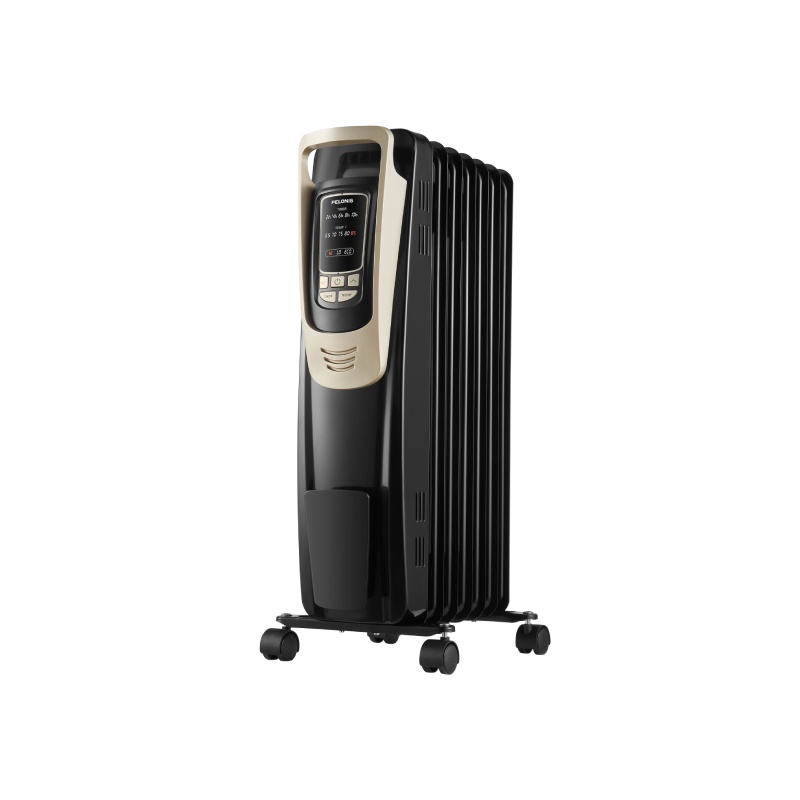
Image source and model notes
A remote-controlled radiator with a useful schedule
Pelonis describes a fan-free digital radiator with a front LED display, remote, ECO mode, adjustable thermostat and tip-over and overheat protection. The linked manual supports the main practical controls: a temperature setting from 65°F to 85°F, a remote whose keys mirror the panel, and a timer that can start the heater from standby or stop it while it is operating. The timer offers 2-, 4-, 6-, 8- or 10-hour settings. That makes the PH-14A different from a basic dial radiator and more useful when a timed start or shutoff is part of the routine.
There is one model-specific caution in the controls description. Pelonis’s product page advertises three heat modes at 600, 900 and 1,500 watts, but the exact manual describes HI and LO settings plus ECO, which automatically switches between HI and LO to maintain the chosen temperature. It does not assign those wattage values to the named manual settings. I would therefore treat 1,500 watts as the published maximum, but would not rely on a precise low-stage wattage or a three-level minimum until the manufacturer clarifies the difference. A product-page bullet is not a substitute for reconciled manual behavior.
The manual does support 120 volts, 60 hertz, 1,500 watts and 12.5 amps. It describes the unit as supplemental or finite-space heat rather than a replacement for the main winter heat source. No independent heat-output measurement, verified room-size figure or exact body dimensions are available here. The page’s energy-efficiency language is a manufacturer description, not a measured promise about the cost of operating the radiator.
Place it like a hot, corded appliance
The manual requires the caster assemblies to be attached before use and the heater to sit upright on a firm, level indoor floor. Keep combustible materials at least three feet from the front, and keep objects away from the sides and rear. The heater is not intended for outdoor use, bathrooms, laundry areas or similar spaces; do not place it where it could fall into a bathtub or contact water. The instructions warn against unattended use and recommend a direct wall outlet, not an extension cord or power strip. The 12.5-amp load should not share an already occupied circuit.
Tip-over and overheat protection are valuable, but they do not make the PH-14A a wet-room or leave-it-running appliance. The thermostat cycles the heater around its setpoint; the timer is an operating convenience, not permission to leave it unattended. If children are around, follow the exact instructions and supervise them around the hot radiator; the reviewed material does not establish a dedicated control lock.
Who should shortlist the PH-14A?
Choose it if you want fanless radiator warmth with a remote, a digital temperature setting and a timer that can be set for either start or stop. The PSHO06MR6ASB is the stronger timing option when a longer 24-hour schedule and finer one-hour increments matter. The basic PHO15A2AGB/PHO15A2AGW is easier to operate with mechanical knobs, but the exact manual does not document its timer or remote. The PSHO07JR4AGB adds a named Sleep mode and a 24-hour shutdown timer; the PH-14A’s schedule tops out at 10 hours and its instructions make the start feature clearer.
In the finder, the PH-14A can meet a 120-volt supply, fanless heat, remote, later-start and up-to-10-hour shutdown need. Do not count it as a verified three-wattage-step heater: the manufacturer’s sales page and operating manual are not aligned on the exact stages. It also does not meet bathroom, near-water, outdoor or unattended requirements. For a dry indoor space where the remote and delayed-start timer solve a real problem, its controls are meaningful; if a precise low-wattage stage is essential, choose a model whose exact manual states it.
Pelonis PH-14A product page · Pelonis PH-14A owner’s manual · Pelonis PSHO06MR6ASB review · Pelonis PHO15A2AGB/AGW review
Key details at a glance
| Maximum listed input | 1500 W |
|---|---|
| US supply voltage | 120 V |
| Installation form | Floor-standing and movable |
| Exact manual permits bathroom use | No |
| Separate fan-only mode | No |
| Documented fan-only speeds | 0 |
More specifications and setup details
| Maximum documented horizontal sweep | 0° |
|---|---|
| Temperature setting range | [65, 85] |
| Timer behavior | The exact manual provides 2/4/6/8/10-hour timer choices for both a later start from standby and a timed stop during operation; the product page calls this a 10-hour timer. |
| Can the heater start on a timer? | Yes |
| Fanless convection heating | Yes |
| Heated-air direction | |
| Manual vertical outlet tilt | No |
| Powered outlet louvers | No |
| Heating element description | oil-filled radiator with fanless radiant warmth and natural convection |
Use the exact model’s instructions for operating limits, supplied equipment and version differences.
Sources for this assessment
Check whether the room and routine line up.
Check room restrictions and full wall clearances first, then compare fan-only versus fanless heat, fit, app controls and the timer behavior the exact manual describes.