
On this page
Your needs, this model
Does it fit your priorities?
Do you want warmth distributed around the heater rather than aimed at one seat?
Pelonis describes the PH-17P as a 360-degree surround heater. That is a fixed surrounding outlet pattern, not powered oscillation or a room-performance measurement.
Explore this need in the finder →Would a separate fan-only position be useful between heating sessions?
The exact PH-17P manual lists Fan Only separately from Low and High heat. It moves room air but does not cool it.
Explore this need in the finder →Do you need a compact floor unit with simple mechanical controls?
Pelonis lists a 12.01-inch body height; its PH-17P manual shows a three-position mode selector and a separate thermostat knob. Its title says programmable, but no timed program is defined in the manual.
Explore this need in the finder →The Pelonis PH-17P is a small floor heater built around an unusual fixed 360-degree outlet: it sends heat around its body instead of aiming a single front grille at one seat. The U.S. product page calls it “programmable,” but the exact PH-17P owner’s manual describes a simple rotary heat selector and thermostat. It does not explain a clock, scheduled start, or timed shutoff. Treat the mode knob—not the listing adjective—as the useful control evidence.
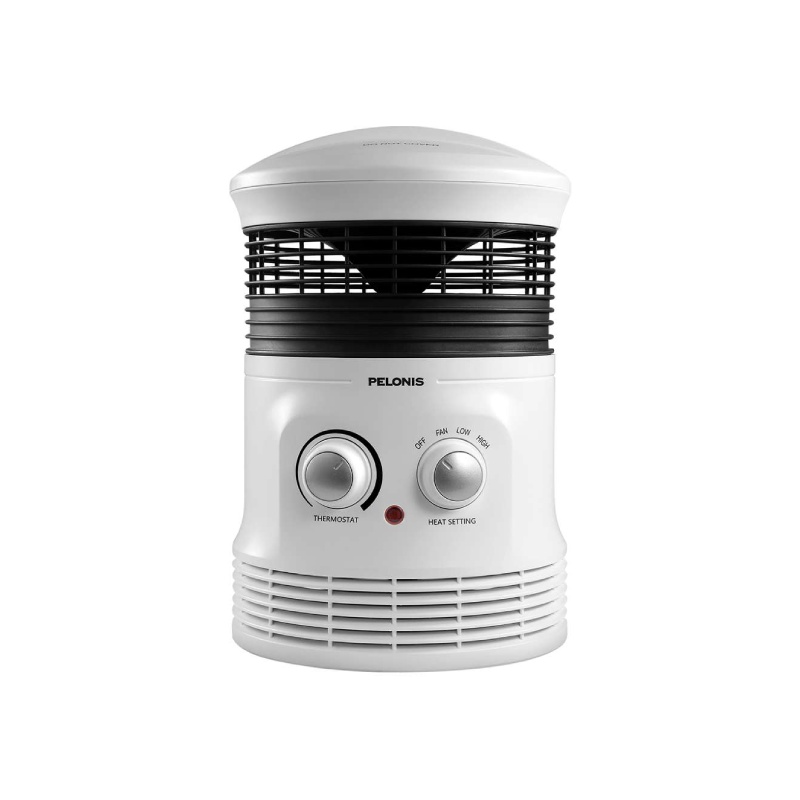
Image source and model notes
Surrounding heat, not a powered sweep
Pelonis describes warmth from all sides of the unit. That is different from a heater that swings left and right: the PH-17P manual and product page document no oscillation control or angle. The 360-degree claim describes the outlet pattern, not a measured promise that every corner of a room reaches the same temperature. It is most meaningful when people or workstations are arranged around the heater with open space on every side. If the heater must warm one specific spot from a corner, a directional ceramic model may be easier to position.
The manual lists three selector positions: Fan Only, Low at 750 watts, and High at 1,500 watts. A separate thermostat knob cycles heat around its chosen setting, but Pelonis does not give a Fahrenheit range or accuracy tolerance. Fan Only moves existing room air; it is not air conditioning and does not lower room temperature. The two heat inputs provide a lower draw option and a full 1,500-watt setting, not a verified room-size rating or a forecast of heating cost.
Compact body for a central floor position
The exact U.S. page lists a body 12.01 inches high, 8.07 inches wide and 7.87 inches long, with a 4.94-pound net weight and a carrying handle. That makes the shape relatively easy to place in a small room, but the useful footprint is larger than the cabinet: its outlet surrounds the unit, and safety spacing still needs to be reserved. The manual says to keep combustibles at least three feet in front and away from the sides and rear. It does not give a separate numeric distance for each side, so do not turn the small body measurements into a clearance estimate.
Keep the controls simple—and the safety limits visible
This is a mechanical setup rather than a remote-first or connected appliance. The page identifies an adjustable thermostat, tip-over shutoff and overheat protection; the manual supplies the PH-17P model identity and explains the selector. Neither source documents an app, remote, control lock, sleep setting, or fan-speed menu. The PH-17P manual’s generic caution says to use extreme care near children and when a heater is left operating unattended; it does not expressly permit unsupervised use. If permission for unattended operation is essential, this model does not clear that requirement.
Use the manual’s 120-volt household supply instructions and plug the heater directly into a wall receptacle; the manual warns against an extension cord or power tap. It also excludes outdoor and damp locations such as bathrooms and laundry areas. A tip-over switch is a backup, not a reason to place a live heater where it can be knocked over or contact water. The manual does not establish a bathroom approval or a safe near-sink position.
Who should compare it?
Shortlist the PH-17P if you want a light, compact heater with a fan-only position, two selectable heat inputs and an around-the-unit outlet pattern, and can place it centrally with the required clearance. It is a poor fit if “programmable” means a verified schedule, if a timed shutoff is mandatory, or if the heater must oscillate toward one side. Pelonis’s PSH17PF2HDB is the closest comparison: it is another 360-degree black model with the same three selector positions documented in its manual, and its page gives a 160-square-foot coverage figure. That number is a manufacturer claim, not a room-heating test; the PH-17P page does not publish the same coverage claim. Compare exact dimensions, documentation and the model label rather than assuming the near-identical shape makes the two listings interchangeable.
For a focused desk or bedside stream, choose a directional heater instead. For a room where quiet, fanless warmth is the priority, compare an oil-filled radiator—but it will not provide fan-only airflow. Neither alternative removes the need to check its own manual, electrical instructions and placement clearances.
Pelonis PH-17P product page · Pelonis PH-17P owner’s manual · Pelonis PSH17PF2HDB review
Key details at a glance
| Maximum listed input | 1500 W |
|---|---|
| US supply voltage | 120 V |
| Published body height | 12.01 in |
| Published body width | 8.07 in |
| Published body depth | 7.87 in |
| Published body weight | 4.94 lb |
More specifications and setup details
| Installation form | Floor-standing and movable |
|---|---|
| Exact manual permits bathroom use | No |
| Power-heat levels | 2 |
| Listed wattage values | 750 / 1500 W |
| Separate fan-only mode | Yes |
| Documented fan-only speeds | 1 |
| Timer behavior | The exact manual documents rotary Fan Only / Low / High selection and a separate rotary thermostat, but no countdown shutoff or delayed-start schedule. For PH-17P the product title says “programmable,” but the exact manual does not define a time program. Timer and schedule requirements remain unknown and fail closed. |
| Fanless convection heating | No |
| Heated-air direction | Panoramic 360 |
| Heating element description | Fan-forced electric heater; the exact sources do not identify the element material. |
Use the exact model’s instructions for operating limits, supplied equipment and version differences.
Sources for this assessment

Check whether the room and routine line up.
Check room restrictions and full wall clearances first, then compare fan-only versus fanless heat, fit, app controls and the timer behavior the exact manual describes.