
Your needs, this model
Does it fit your priorities?
Do you need at least three selectable heat levels rather than a two-level heater?
The exact CT22850 manual names High, Medium and Low, so it meets a three-level minimum. The product’s 900–1,500 W range is not a wattage map for those settings; a four-level minimum or an exact lower-mode draw remains unmet or unknown.
Explore this need in the finder →Can an included remote and off countdown support a supervised room routine?
Yes. The listing/manual document a physical remote and an off countdown up to 12 hours. Two AAA batteries are not included, app control is not listed, and the manual still says not to leave the heater unattended.
Explore this need in the finder →Does the 12-hour timer turn on the heater later?
No later start is documented. The timer is for switching a running heater off after a selected elapsed time; it does not meet a scheduled-start requirement.
Explore this need in the finder →Is qualitative side-to-side movement enough, or do you need a stated sweep angle?
The exact manual confirms base oscillation, but neither the page nor manual states a degree range. It can meet a qualitative horizontal-movement need; an essential numeric minimum remains unknown and fails closed.
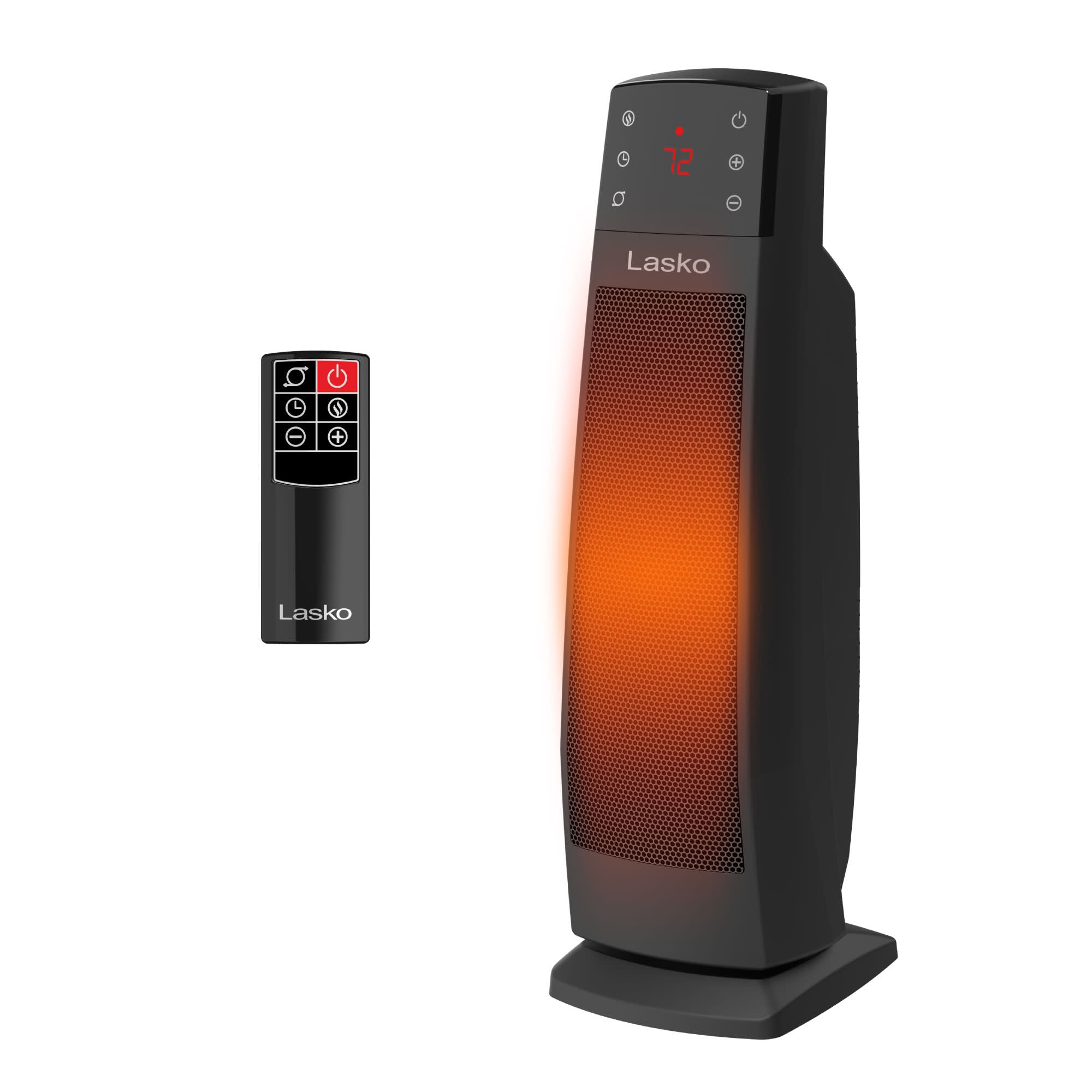
Explore this need in the finder →The Lasko CT22850 is a 22-inch, fan-forced ceramic tower for dry indoor use. The current U.S. Lasko All Heaters row identifies one Black finish and one SKU, CT22850. Its feature set includes three heat levels, Auto Eco temperature control, base oscillation, a physical remote and a 12-hour shutoff countdown. Those controls make it more specific than a basic two-setting tower, but they do not override the manual’s placement rules or its warning not to leave the heater operating unattended. This is an assessment of the documented model, not a hands-on heating test.
Three heat levels, without an exact wattage map
The product page lists an output range of 900 to 1,500 watts at 120 volts. The manual names High, Medium and Low, but neither source assigns an exact wattage to each of those three selections. If an exact low-mode draw is essential for your electrical or operating plan, treat it as unknown instead of assuming that Low equals 900 watts or that Medium has a particular draw. The 1,500-watt figure is the documented maximum.
Auto Eco is a temperature-control routine rather than a fourth, fixed heat level. Set the desired room temperature with the plus/minus controls and the heater uses High while the sensed room temperature is below that setting. Once it reaches the target, the unit changes to Low; the heating element switches off when the room rises more than about two degrees above the set point, while the fan continues for roughly 15 seconds. The display in this mode reports room temperature, not the temperature of the outlet air. Lasko does not publish a thermostat range or an independent sensor-accuracy result, so this is a convenience control rather than a precision room monitor.
A useful off countdown, not a timed start
The timer is an elapsed auto-off countdown of up to 12 hours. It can end a period of supervised use, but the instructions do not describe a schedule that starts the heater later. A countdown and Auto Eco should not be treated as permission to leave the appliance running unattended: the CT22850 manual explicitly says not to do that. If a later start is a hard requirement, this model does not meet it.
The included remote operates the same functions as the manual controls except changing the temperature display between Fahrenheit and Celsius. It needs two AAA batteries, which are not included. The display automatically dims after 10 seconds and any button restores its full brightness. Those details may matter when you want controls from a chair or prefer less light after setting the heater. The listing does not document app control; a physical remote is not phone access.
Movement and the room-size claim
The manual has a button to start and stop base oscillation, and the listing calls the movement widespread. Neither source gives a numeric arc or a selectable sweep angle. That supports a qualitative side-to-side preference, not a minimum-angle requirement or a promise of 360-degree distribution. The current listing gives a maximum coverage figure of 300 square feet. That is the manufacturer’s claim, not a comparative room-heating test: insulation, ceiling height, drafts, outdoor conditions and the home’s main heating system all influence comfort.
Lasko lists a 21.6-inch body height, 7.1-inch width, 7.9-inch depth and 6-pound weight. It has a carry handle and a base, so it can be repositioned between rooms, but first measure more than the body: the manual requires at least three feet of clearance from combustibles at the front and one foot at the sides and rear. It needs a stable, flat, level surface. Tip-over and overheat protection are listed, but they do not shrink the clearance area or make an unsuitable location acceptable.
Outlet, location and upkeep requirements
The manual requires a direct 120-volt wall outlet. Do not use an extension cord, power strip, surge protector or similar cord-connected device, and do not share the outlet or circuit with multiple devices. Keep the power cord uncovered and out of traffic. The heater is for residential indoor use; the manual rules out bathrooms, laundry rooms, wet or damp spaces, outdoor use, hazardous locations and agricultural settings. It also says not to operate it unattended. A timer, thermostat or safety shutoff does not change those conditions.
For maintenance, unplug the unit and vacuum its intake grills with a brush attachment every two weeks; the manual says not to disassemble it. If the thermal-overload protector shuts the heater down, unplug it and wait 10 minutes to cool before following the reset instructions. Lasko describes a three-year limited warranty for the original purchaser with proof of purchase; read the warranty terms for what it covers and excludes.
Who should shortlist the CT22850?
Consider it if you want three named heat settings, an Auto Eco target routine, a remote, a 12-hour off countdown and qualitative base oscillation in a dry indoor floor heater, and you can provide the required direct outlet and clearance. A minimum of three documented heat levels, an included remote or a shutoff countdown can change a shortlist in its favor. A requirement for four levels, app access, a later scheduled start, a confirmed numeric sweep, bathroom use or unattended operation should reject it or leave the feature unconfirmed.
For another 22-inch, three-level Lasko tower, compare CT22495 and CT22498. Their own model manuals document a child lock, and their remote-control details differ: CT22495 names a Night Mode, while CT22498 documents display dimming and beep mute. CT22850 has its own automatic display dimming, but those sibling controls should not be transferred to it. The exact sources also list different dimensions and remote battery inclusion. Check the SKU and manual before choosing by color or shared tower styling.
Compare CT22850 with CT22495 and CT22498 · Lasko CT22850 product page · CT22850 instruction manual
Key details at a glance
| Maximum listed input | 1500 W |
|---|---|
| US supply voltage | 120 V |
| Published body height | 21.6 in |
| Published body width | 7.1 in |
| Published body depth | 7.9 in |
| Published body weight | 6 lb |
| Installation form | Floor-standing and movable |
| Exact manual permits bathroom use | No |
| Power-heat levels | 3 |
| Listed wattage values | W |
| Separate fan-only mode | No |
| Documented fan-only speeds | 0 |
| Timer behavior | The exact CT22850 manual documents an auto-off countdown up to 12 hours; it does not document a delayed start. The three named heat levels are High, Medium and Low, but the 900–1,500 W product-page range is not mapped to individual modes. In Auto Eco, the heater uses High while room temperature is below its set point, Low from the set point through about 2 °F above, then turns off the heating element; its fan continues for about 15 seconds. The manual gives no thermostat range. It also says not to leave the heater operating unattended. |
| Can the heater start on a timer? | No |
| Phone-app control | No |
| Fanless convection heating | No |
| Heated-air direction | |
| Manual vertical outlet tilt | No |
| FortPlug plug-area overheat cutoff | No |
| ALCI leakage-current plug | No |
Use the exact model’s instructions for operating limits, supplied equipment and version differences.
Sources for this assessment
Check whether the room and routine line up.
Check room restrictions and full wall clearances first, then compare fan-only versus fanless heat, fit, app controls and the timer behavior the exact manual describes.