
Your needs, this model
Does it fit your priorities?
Would you accept horizontal movement without a published swing angle, or is a numeric minimum essential?
The CT14101 is documented to oscillate side to side, but the exact model page and manual state no angle. A qualitative sweep is documented; a numerical minimum is not.
Explore this need in the finder →Do you need separate fan-only air when you do not want heat?
The exact model provides High, Low and Auto-Eco heat; no fan-only position is documented.
Explore this need in the finder →Are two heat levels sufficient, or do you need at least three selectable levels?
Lasko names High and Low. Auto-Eco changes output automatically; it is not a third fixed heat level. The Low wattage is unresolved.
Explore this need in the finder →Will the 14.13-inch body fit your space once the full clearances are considered?
The page lists a 14.13-inch body height; the manual separately requires 3 feet in front and 1 foot at the sides and rear.
Explore this need in the finder →Would you require a countdown that turns the heater off automatically?
No auto-off timer is documented. The instructions instead require the user to turn it off and unplug it before leaving the area.
Explore this need in the finder →Is an included remote essential, or are controls at the heater acceptable?
The exact CT14101 page states no remote; its electronic controls are on the unit.
Explore this need in the finder →Is phone-app control essential for this heater?
The CT14101 page lists no smart technology or app compatibility. A separate app-controlled DREO model uses a different wall-mounted plan.
Explore this need in the finder →Will the heater be used in a dry indoor residential room with supervision?
The model-specific instructions prohibit bathroom, laundry, wet/damp, outdoor and hazardous-location operation and say not to leave the heater operating unattended.
Explore this need in the finder →What the CT14101 actually adds
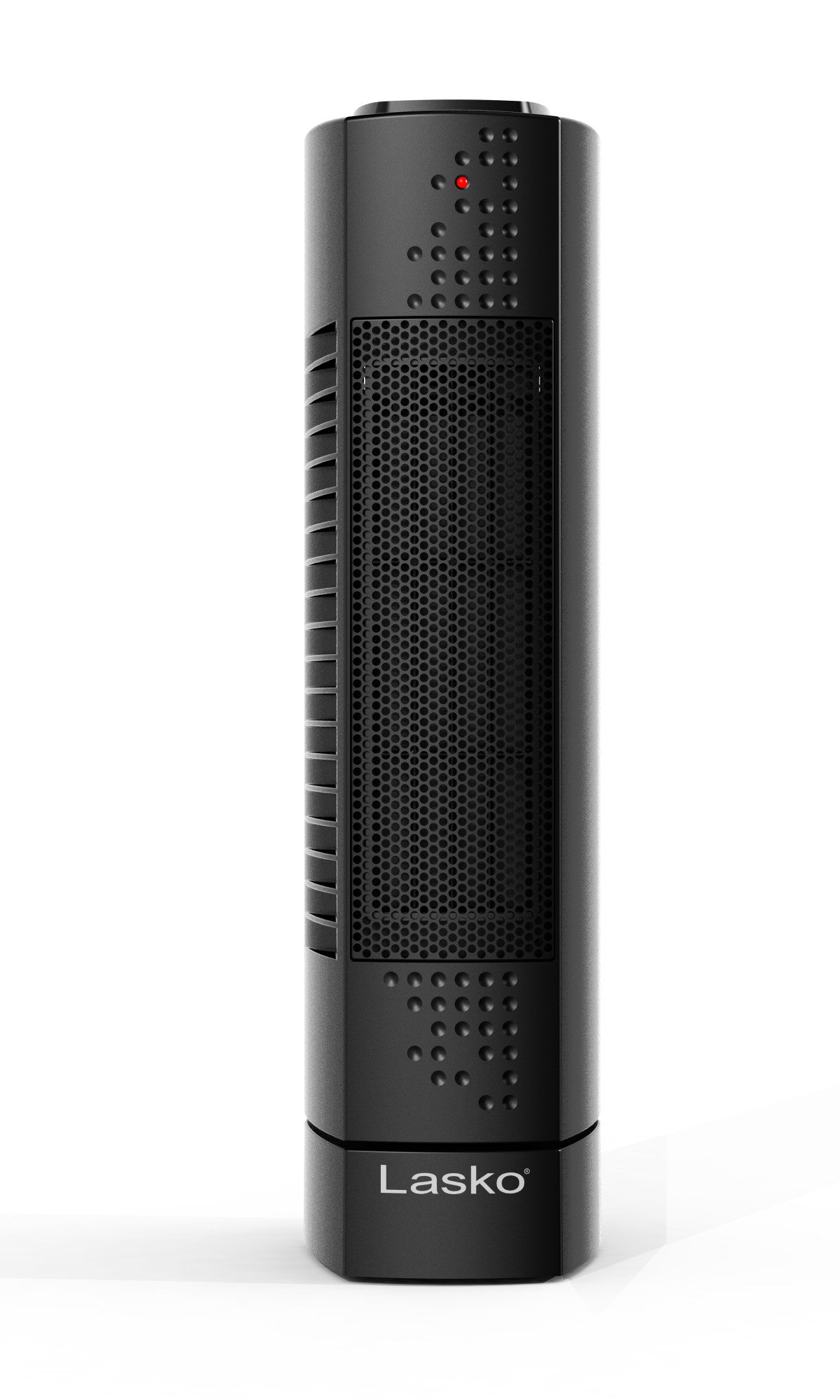
The Lasko CT14101 is a very narrow, black ceramic fan heater with two heat selections and a button for left-to-right oscillation. Its official page lists a body only 4 inches wide and 5.5 inches deep, at 14.13 inches high. That tall, thin shape makes it a different kind of compact heater from Lasko’s short, broad 5919 utility heater: the CT14101 sweeps sideways while it runs; the 5919 can be manually aimed up or down and has a separate fan-only position.
This is a supplemental, residential heater—not a replacement for a building’s primary heat. Lasko lists a maximum coverage figure of 150 square feet, but that is a manufacturer claim, not an independently measured room result. A heater’s actual comfort depends on room insulation, drafts, ceiling height, placement and the person using it. The small published footprint does not eliminate the manual’s required clear space around the appliance.
Controls: two heat levels plus an automatic mode
The operating manual identifies High, Low and Save-Smart, cycled by one power button, plus a separate oscillation button. High is stated as 1,500 watts. Save-Smart is an automatic control mode rather than a third fixed heat level: the manual describes a default 75°F threshold, starting on High below that point, switching to Low when its thermostat reaches it, and turning off above it. The page calls the thermostat adjustable, but the manual does not give a selectable temperature range or accuracy, so a precise user-set thermostat should not be assumed.
There is a wattage mismatch in the manufacturer’s own materials. One feature bullet calls Low 900 watts, while the page’s specification table lists an overall energy-output range of 750 to 1,500 watts. The linked manual states High at 1,500 watts but does not assign a wattage to Low. Treat Low’s exact draw as unresolved rather than relying on either conflicting page figure.
Oscillation is useful when one fixed forward outlet would leave the heat too concentrated in one direction. Lasko and the manual describe back-and-forth movement, but neither specifies an angle. The CT14101 can meet a preference for documented horizontal sweep; it cannot be confirmed for someone who needs a minimum numerical arc. It has no documented fan-only mode, remote, app operation, automatic shutoff countdown or delayed start. If you want air movement without heat, a separate fan-only heater such as the 5919 is a better documented fit. For remote adjustment or an off timer, compare the taller CT22835.
Placement matters more than the slim profile
The model is listed for 120-volt household power. Its manual says to use a firm, flat, level surface and plug directly into a wall outlet: no extension cord, power strip, surge protector, adapter or multiple connected device. Keep the cord out of walking paths and uncovered by rugs. The manual calls for at least 3 feet of clearance in front and 1 foot at the sides and rear. It also says not to leave the heater operating unattended, to turn it off and unplug it before leaving the area, and not to use it in bathrooms, laundry areas, wet or damp rooms, outdoors, agricultural facilities or hazardous locations.
That guidance is especially important when assessing the “small footprint” pitch. A narrow body can be easier to place beside a chair, but the unit still needs its full clearance envelope and must sit on a stable surface. Do not treat a marketed bedroom or small-room setting as permission to run it unattended while sleeping. The manual describes it as residential supplemental heat and explicitly warns that the plastic or rubber feet can stick to or mark some furniture and hardwood finishes.
Who should consider it—and who should keep looking
The CT14101 is most relevant when a shopper wants a narrow, lightweight tower body with two heat levels, one automatic 75°F Save-Smart cycle and qualitative side-to-side sweep, and can supervise its operation. The page lists 3.58 pounds and a 6-foot cord, but the Shopify variant record reports a different weight with no shipping-versus-product basis; this review does not use weight as a fit threshold. The official page says it is ETL listed and lists overheat protection and a cool-touch housing; those are manufacturer claims, not independent safety tests. The manual additionally describes a tip-over switch and thermal-overload shutoff with an unplugged 10-minute reset. Those built-in features do not replace safe clearance, direct-wall use or attendance.
Choose another configuration if your essential need is fan-only circulation, a remote, an app, a timer, a bathroom-approved heater, a numerical oscillation arc or unattended use. The shorter 5919 offers manual upward/downward aiming and fan-only operation, but no powered sweep. The CT22835 is a taller tower with a listed remote and up-to-eight-hour off timer, but it does not establish a numerical oscillation angle either. Before buying, confirm that the exact model is CT14101, the actual product dimensions work with the manual’s clearances, and the manufacturer’s Low-wattage discrepancy is acceptable for your use.
Key details at a glance
| Maximum listed input | 1500 W |
|---|---|
| US supply voltage | 120 V |
| Published body height | 14.13 in |
| Published body width | 4 in |
| Published body depth | 5.5 in |
| Installation form | Floor-standing and movable |
| Exact manual permits bathroom use | No |
| Power-heat levels | 2 |
| Listed wattage values | 1500 W |
| Separate fan-only mode | No |
| Timer behavior | The exact page states no auto-shutoff timer and no timer; delayed start is not documented. The operating manual instead instructs the user not to leave the heater unattended and to turn it off and unplug before leaving the area. |
| Can the heater start on a timer? | No |
| Phone-app control | No |
| Fanless convection heating | No |
| Heated-air direction | focused |
| Manual vertical outlet tilt | No |
| FortPlug plug-area overheat cutoff | No |
| ALCI leakage-current plug | No |
Use the exact model’s instructions for operating limits, supplied equipment and version differences.
Sources for this assessment
Check whether the room and routine line up.
Check room restrictions and full wall clearances first, then compare fan-only versus fanless heat, fit, app controls and the timer behavior the exact manual describes.