
Your needs, this model
Does it fit your priorities?
Can a low horizontal body fit on your floor without treating its clearance zone as optional?
CL22100 is listed 8.99 inches high and 22.6 inches wide. It is a floor heater, not a tabletop model, and the manual separately requires 36 inches in front and 12 inches at sides and rear from combustibles.
Explore this need in the finder →Do you want three heat stages with automatic lower-stage temperature control?
The manual lists H1 Low, H2 Medium and H3 High. Auto Eco uses High below the set point, then Low through roughly two degrees above it before heat shuts off; these settings do not disclose stage wattages or thermostat accuracy.
Explore this need in the finder →Is powered movement of the outlet louvers useful even when the sweep angle is not specified?
A control starts or stops powered louver oscillation. The manual gives no angle or named sweep axis, so this is not proof of whole-heater horizontal oscillation or a numeric arc.
Explore this need in the finder →Would an off countdown and a physical remote meet your control need?
The remote is included and the manual describes a shutoff countdown to 12 hours. Two AAA batteries are required; the current manual says they are not included, despite a conflicting general accessory line on the page. Timer operation does not permit unattended use.
Explore this need in the finder →Do you want a removable filter for regular cleaning?
The product page describes a removable filter. The manual tells owners to vacuum intake grilles every two weeks; the filter is not an air-purification claim.
Explore this need in the finder →Is an indoor, supervised routine compatible with your location and controls?
The manual permits this residential heater only in dry indoor placement, says not to leave it operating unattended, and excludes bathrooms and wet/damp areas. It has a physical remote but no documented app control.
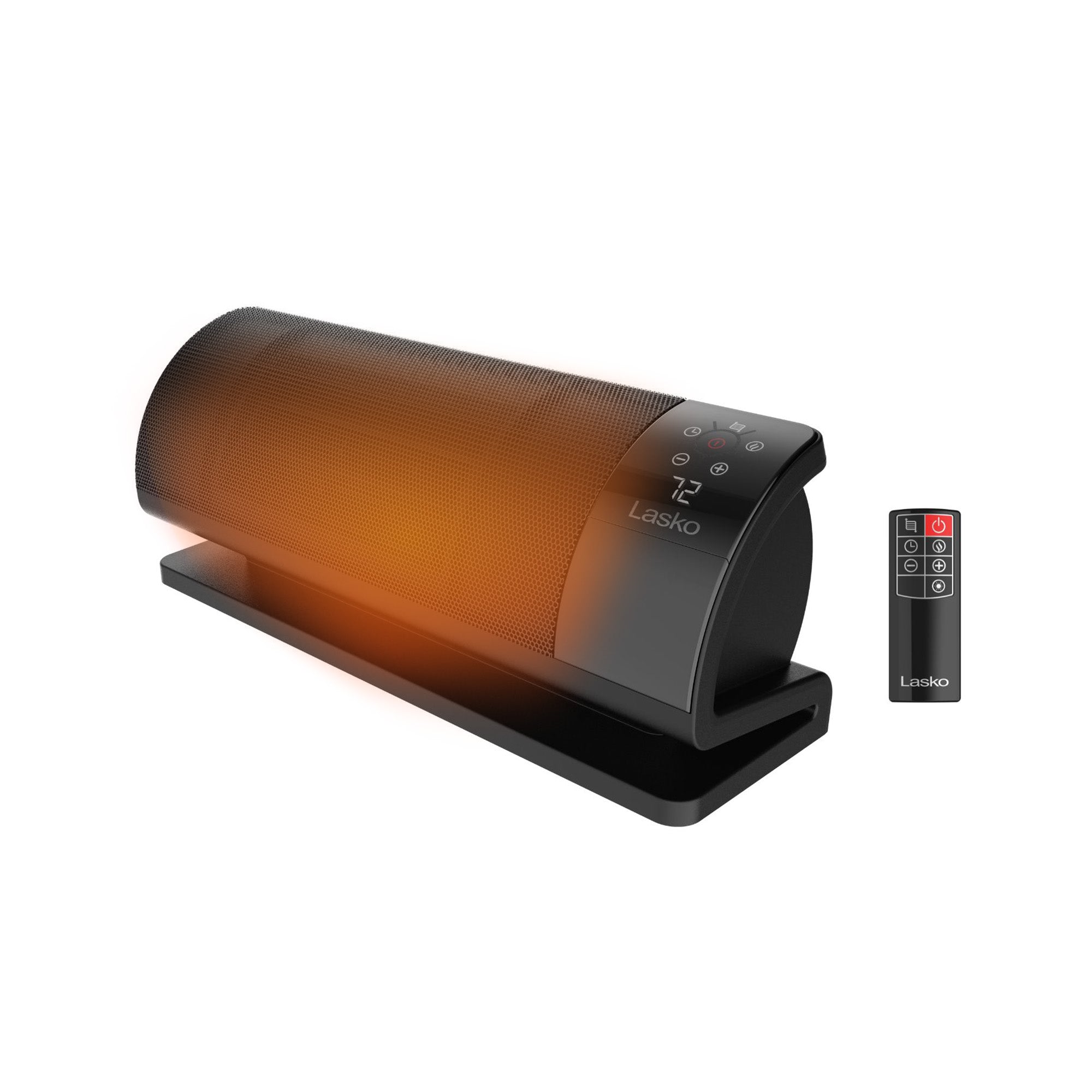
Explore this need in the finder →The Lasko CL22100 is a low-profile, horizontal ceramic heater for a floor spot where a nearly 23-inch-wide body can fit. It adds three heat levels, Auto Eco temperature control, powered outlet louvers, a remote and an off timer; it is not a fan-only appliance or a heater for unattended use.
Low height does not mean a small placement zone
The body measures 22.6 inches across, 7.05 inches deep and 8.99 inches high in Lasko’s listing. Its long, low shape can be easier to fit below a sill than a tall tower, but it still needs a stable, flat, level floor and unblocked air intake and outlet. “Baseboard” is a shape description, not permission to press it against curtains or furniture: the manual calls for combustibles at least 36 inches in front and 12 inches at the sides and rear. Measure those clearances as well as the heater body before choosing a spot.
The exact instructions require a direct 120-volt wall receptacle. Do not use an extension cord, power strip, surge protector, multiple-outlet adapter or cord reel, and do not plug other devices into the same outlet or circuit. Keep the cord out of foot traffic and never under a rug. If the room cannot provide both the clearance zone and a suitable outlet, the low profile does not make this a safe fit.
Three heat levels and Auto Eco are different controls
Lasko lists a 900-to-1,500-watt output range at 120 volts and three heat settings, H1 Low, H2 Medium and H3 High. It does not map a wattage to each setting, so do not treat Low or Medium as a known electrical draw. The ceramic element uses two blowers to move heated air; there is no separate fan-only mode. If you want air circulation without adding heat, compare a model with a documented fan-only setting.
Auto Eco adjusts heat around a selected room-temperature target. The manual says it runs on High below the target, changes to Low from the target through about two degrees above it, then turns the heating element off when the room goes above that band; the fan continues for about 15 seconds. That is the maker’s described control sequence, not a test of thermostat accuracy or proof that every corner of a room will reach the displayed temperature. The listing’s “up to 300 square feet” is likewise a manufacturer coverage claim with no stated room or test conditions.
Powered louvers are not a documented sweep angle
A control starts or stops the outlet-louver oscillation, letting the heater vary the direction of its discharge. The manual does not give an angle or name a horizontal or vertical sweep axis. That is why powered louver movement should not be confused with turning the whole heater side to side or with a guaranteed heating pattern. The manual describes the outlet movement; it does not establish a quantified arc.
Lasko advertises a removable filter and says it is easy to clean. The manual’s specific maintenance step is to vacuum the intake grilles every two weeks. Unplug before moving or cleaning, do not take the heater apart and keep its intake and outlet clear. A filter in a heater is not an air-cleaning rating.
Remote, timer and protection still have boundaries
The manual lists a remote and a display-snooze button on that remote. Two AAA batteries are required. The current manual says they are not included, and the product page’s battery-specific fields also say not included, although a general accessory line lists two AAA batteries; treat them as an extra unless the package is confirmed. The timer is an automatic shutoff countdown of up to 12 hours, not a scheduled start. Neither the remote nor the thermostat changes the manual’s warning not to leave the heater operating unattended.
The manual describes a tip-over switch and a thermal-overload protector. After an overheat shutdown, it directs the user to unplug the heater and wait 10 minutes before resetting it. Those cutoffs are not substitutes for stable placement, clearance, a sound outlet or supervision. Lasko lists a three-year limited warranty. Its page also claims cool-touch housing and quiet operation, but this review has no independent temperature or noise measurements; the page’s zero-dBA field is not a usable acoustic result.
Who should choose it—and who should compare another form
CL22100 fits a supervised, dry indoor routine when a wide, low floor heater, adjustable heat, a remote, a short off countdown and powered outlet louvers solve the actual problem. It is a poor choice for a desk or tabletop, a damp room, a position near water, an outdoor setting, a tightly blocked corner or a routine that depends on leaving heat unattended. The listed 5.8-pound weight conflicts with the native variant record’s 4,989-gram value, so weight is best treated as unknown rather than a portability advantage.
For a tower layout with a separate fan-only mode, compare Lasko’s CT22520 or the shorter CT18950/CT18951 family; their reviewed manuals document fan-only operation, unlike this baseboard-style CL22100. Those models have different body shapes and their own placement rules. If a later start or a precise louver angle is essential, this model’s documentation does not establish either one.
See Lasko’s CL22100 product page and its New 4/26 instruction manual for the exact setup, safety and care instructions.
Key details at a glance
| Maximum listed input | 1500 W |
|---|---|
| US supply voltage | 120 V |
| Published body height | 8.99 in |
| Published body width | 22.6 in |
| Published body depth | 7.05 in |
| Installation form | Floor-standing and movable |
| Exact manual permits bathroom use | No |
| Power-heat levels | 3 |
| Separate fan-only mode | No |
| Documented fan-only speeds | 0 |
| Timer behavior | Exact manual documents automatic shutoff countdown to 12 hours (half-hour steps through 2 hours, then hourly steps); it does not document a scheduled start. Unattended operation is prohibited. |
| Can the heater start on a timer? | No |
| Phone-app control | No |
| Fanless convection heating | No |
| Heated-air direction | focused |
| FortPlug plug-area overheat cutoff | No |
| ALCI leakage-current plug | No |
| Powered outlet louvers | Yes |
| Control lock | No |
Use the exact model’s instructions for operating limits, supplied equipment and version differences.
Sources for this assessment
Check whether the room and routine line up.
Check room restrictions and full wall clearances first, then compare fan-only versus fanless heat, fit, app controls and the timer behavior the exact manual describes.