
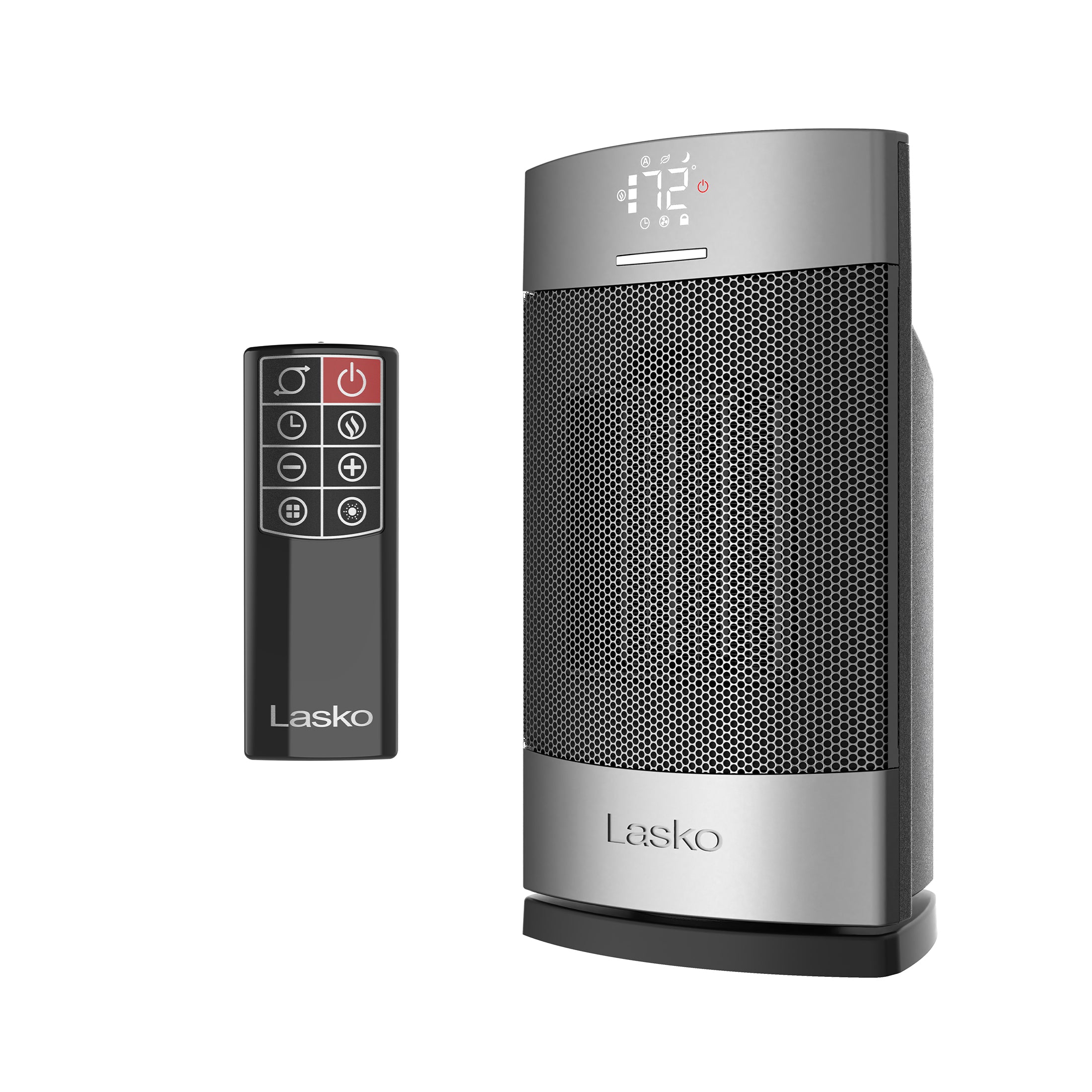
Your needs, this model
Does it fit your priorities?
Can your intended desk or tabletop provide the full manual clearance zone, rather than just fit the small heater body?
Both finish variants are marketed for tabletop placement and the manual requires a stable, flat, level surface; it also calls for 3 feet in front and 1 foot at the sides and rear from combustible material. If a crowded desk cannot provide that space, the tabletop label does not make the spot suitable.
Explore this need in the finder →Do you need a physical remote and a 12-hour shutoff countdown, or is a longer scheduled start essential?
The exact manual supports an included remote and an off-countdown up to 12 hours. It documents no later-start schedule, and it says not to leave the heater operating unattended; timer convenience does not grant unattended-use permission.
Explore this need in the finder →Will a separate fan-only mode with two speed choices meet your airflow need?
The exact manual labels F1 and F2 fan-only and separately lists three heat levels. It moves existing air rather than cooling a room. A three-speed minimum is not documented.
Explore this need in the finder →Is a remote Sleep Mode useful, while understanding it does not permit leaving the heater unattended?
The manual says the remote can select Sleep Mode: it holds the present setting for an hour, then changes to low-heat automatic temperature control for a 68°F target. The same manual prohibits unattended operation, so the mode is not permission to run the heater while asleep or away.
Explore this need in the finder →Do you need the manual to confirm an exact side-to-side sweep angle?
The manual names a base-oscillation control and the product page says wide-angle oscillation and 120-degree heat distribution, but neither establishes a mechanical sweep axis or arc. An essential side-to-side or numeric-sweep requirement therefore remains unconfirmed for these exact variants.
Explore this need in the finder →Lasko’s Ellipse CD12950 (Black) and CD12951 (Silver) are finish variants of one 12-inch tabletop ceramic heater, not two different control packages. The shared design combines three heat levels, two fan-only speeds, a thermostat, base oscillation, a 12-hour shutoff timer and an included remote. Its compact body is useful only if the whole safe operating area fits: the manual calls for a stable, level surface and at least 3 feet in front and 1 foot at the sides and rear from combustible material.
Small body, surprisingly large placement zone
The official product page lists a body just under 12 inches tall, with a 6.11-inch width and 4.86-inch depth. That can sit on a suitably broad desk, counter or bedside table, but tabletop size alone is a poor fit test. Lasko’s instructions require clear air intakes and exhaust, a stable flat surface and the full combustible-material clearances. In a crowded office, paper piles, curtains, bedding and nearby furniture may make the proposed spot unsuitable even though the heater itself is small. The manual says not to set it on a soft surface such as a bed.
There is also a practical electrical constraint. Plug it directly into a 120-volt wall receptacle; do not use an extension cord, power strip, surge protector or multi-outlet adapter, and do not share the circuit with other devices. The manual asks owners to check that the plug fits firmly and is not overheating. That makes a clear, reachable wall outlet part of the layout—not an accessory detail. Lasko markets the heater for small and medium rooms and lists coverage up to 200 square feet, but that is a maker claim, not a room-heating result we independently measured.
Three heat levels and two fan-only speeds
The exact CD12950/CD12951 manual labels high, medium and low heat, plus separate F1 and F2 fan-only settings. Fan-only moves existing room air; it does not cool it. The manufacturer page lists a 750–1,500-watt overall range and a 1,500-watt maximum, but the sources do not assign a wattage to each of the three heat levels, so a buyer should not treat the selector as a precise wattage scale.
An automatic thermostat can cycle heat around the temperature displayed for the room: the manual says the heater switches off about 2 degrees above the set temperature and resumes about 1 degree below it. Auto and Eco modes behave differently; Eco uses the lower heat setting for temperature control. The display reports room temperature, not the temperature of the outlet air. Lasko’s page describes wide-angle oscillation and 120-degree heat distribution. The manual confirms a base-oscillation control, but the cited sources do not establish a numeric sweep arc. If a minimum number of degrees is essential, do not translate the 120-degree distribution wording into an oscillation measurement.
Remote conveniences, with important limits
The supplied remote can change heat and fan settings, temperature, oscillation and the timer; it also selects Auto, Eco or Sleep and can turn the display off. It requires two AAA batteries that are not included. The top display automatically dims after ten seconds. A three-second child-lock hold disables the heater’s functions except Power, and settings already active remain on. That is a useful control limitation to understand, not a childproofing substitute or a way to prevent the heater from being powered down or operated.
The countdown can be set for up to 12 hours. It switches the heater off; it is not a delayed-start schedule. Sleep Mode turns the display off, keeps the current setting for an hour and then moves to low-heat automatic temperature control at the manual’s stated 68°F sleep target. Do not read “Sleep” as permission to leave the unit operating while you are away or asleep: the manual says the heater should not be left operating unattended. A timer, thermostat, sleep sequence and control lock do not override that instruction.
Keep it dry, attended and clear
The instructions prohibit bathroom use, wet or damp locations, outdoor use and positioning where the heater could fall into water. They also say to keep combustible materials at least 3 feet in front and 1 foot from the sides and rear, to keep the intake and exhaust unobstructed, and to unplug the heater before moving or cleaning it. The manual describes a tip-over switch and thermal-overload protector; if overload shuts it down, unplug it and allow a ten-minute cool-down before following the reset steps. Intake grilles should be vacuumed with a brush attachment about every two weeks. These are exact-model operating instructions, not guarantees that any placement is safe.
Who should choose it—and when to pick another style
Choose the Ellipse if you have a spacious, stable dry-indoor surface, a direct outlet, and want a tabletop heater with fan-only airflow, more than one heat level, a thermostat and remote adjustments. The Black CD12950 and Silver CD12951 are distinguished by finish in Lasko’s native product record; the shared New 1/25 manual identifies both models. A current manufacturer listing and its native option record disagree on product weight, so weight is left unreported rather than guessed from the color or a neighboring listing. The product page’s “under 40 dB” wording also lacks a measurement protocol; it is a manufacturer claim, not an independent noise result.
If you want simpler local controls and do not need the remote or countdown, compare the reviewed Lasko CD09250 / 754200 9-inch tabletop heater. Its manuals describe two heat levels and no timer, while the Ellipse adds remote control, three heat levels and a longer shutoff countdown. Neither choice changes the basic placement rule: follow its own manual, keep the full clearance zone, and do not use a space heater as unattended or wet-area heat. See the Lasko model page and the CD12950/CD12951 New 1/25 manual for the complete current directions.
Key details at a glance
| Maximum listed input | 1500 W |
|---|---|
| US supply voltage | 120 V |
| Published body height | 11.65 in |
| Published body width | 6.11 in |
| Published body depth | 4.86 in |
| Installation form | Tabletop or desk placement |
| Exact manual permits bathroom use | No |
| Power-heat levels | 3 |
| Separate fan-only mode | Yes |
| Documented fan-only speeds | 2 |
| Timer behavior | The exact manual documents an off-countdown up to 12 hours, with 30-minute steps through two hours and one-hour increments thereafter. It does not describe a later scheduled start. The manual says not to leave the heater operating unattended; a countdown or Sleep Mode does not override that instruction. |
| Can the heater start on a timer? | No |
| Phone-app control | No |
| Fanless convection heating | No |
| Heated-air direction | |
| Manual vertical outlet tilt | No |
| Powered outlet louvers | No |
| Control lock | Yes |
Use the exact model’s instructions for operating limits, supplied equipment and version differences.
Sources for this assessment
- Lasko Ellipse 12-inch Ceramic Space Heater product page, CD12950 Black / CD12951 Silver
- Lasko native Shopify product record, product 9415099711765
- Previously archived complete page-one Lasko All Heaters collection snapshot, native row 9415099711765
- Lasko Use & Care Instructions, CD12950 and CD12951, New 1/25
- Lasko official exact Black CD12950 variant-linked product image
- Lasko official exact Silver CD12951 variant-linked product image
- Dated CPSC SaferProducts exact-model query for CD12950
- Dated CPSC SaferProducts exact-model query for CD12951


Check whether the room and routine line up.
Check room restrictions and full wall clearances first, then compare fan-only versus fanless heat, fit, app controls and the timer behavior the exact manual describes.