
On this page
Your needs, this model
Does it fit your priorities?
Would separate fan-only air and two heat levels fit your routine?
The HHF550 manual lists Fan Only, 750 W Low and 1,500 W High. The number of fan-only speeds is not stated.
Explore this need in the finder →Would a three-position adjustable head and horizontal sweep help aim warmth?
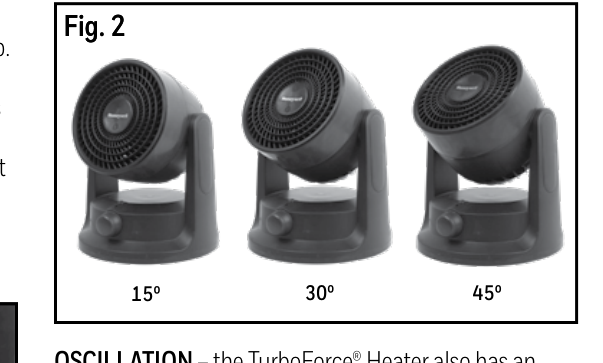
The HHF550 section describes discrete 15°, 30° and 45° positions and horizontal oscillation; it does not state a sweep angle.
Explore this need in the finder →Can you keep the heater attended and clear while using its manual controls?
The exact HHF550 instructions call for stable indoor placement, three-foot separation and direct wall connection, and prohibit unattended use.
Explore this need in the finder →Do you need fan patterns or a swing-angle measurement that the manual does not specify?
The HHF550 manual confirms fan-only and oscillation, but not Natural/Sleep/Auto patterns or a numeric oscillation arc. Unknown details cannot satisfy an essential choice.
Explore this need in the finder →The Honeywell Turbo Force Power Heat + Fan HHF550B is a fan-forced ceramic heater for someone who wants to aim warmth rather than rely on a tall tower sweeping from side to side. Its head tilts to three labeled positions, and a separate oscillation control spreads the airflow across a wider area. A mechanical knob selects fan-only, 750-watt Low or 1,500-watt High. This is a straightforward, attended-use heater, not a precise digital thermostat or a hands-off heating system.
Its strongest difference is how you can aim the air
The instructions describe three head angles: 15 degrees for a seated level, 30 degrees for a standing level and 45 degrees toward the ceiling. You can use that pivot with the oscillation switch, or leave the sweep off when you want a more direct stream. The maker presents the upward angle as a way to encourage room circulation, but that is not a measured whole-room performance claim. There is no stated square-foot coverage figure, and the unit still has the limited reach of a portable fan heater. Room shape, insulation and drafts will matter more than a promise based on the heater alone.
The fan-only setting is separate from the two heat settings, so the unit can move air without adding heat. The manual does not list a number of fan speeds. Nor should the three head positions be confused with three heat levels: the heat choices are Low and High. If you want a particular oscillation angle, that figure is not published; the documentation confirms that it oscillates but not a degree sweep.
Know which TurboForce manual section applies
Honeywell’s owner manual covers both HHF550 and HHF565 series products. The HHF550 section describes the manual Power Knob and the fan, Low and High options. Elsewhere the same booklet has a separate HHF565 Digital section with digital controls and an eight-hour Auto-Off mode. Those HHF565-only features should not be carried over to the HHF550B just because the products share a booklet. For this exact model, I find no documented digital controls, thermostat or timer; if one of those is essential, choose a model whose own instructions specify it.
Low uses 750 watts, while High uses up to 1,500 watts at 120 volts. The manual lists 12.5 amps. Low is a smaller continuous heat setting, not a guarantee of a particular room temperature or lower bill: actual electricity cost depends on run time and your local rate. The Power Knob is easy to understand, but it does not offer a displayed temperature target or remote operation.
Fit and safe placement need more room than the body alone
There is a real size discrepancy in the source material. The product page lists 10.4 inches wide, 12.5 high and 10.4 long; the linked HHF550-series manual lists 10.1 by 10.1 by 12.6 inches. I would not use either set as a definitive fit measurement. If a shelf, storage bin or narrow space has a strict limit, verify the exact unit’s body before relying on it. Its required operating clearance is separate from its footprint: the manual calls for a firm, level, open surface and at least three feet between the heater and combustibles, with the cord kept out of walkways.
Use a direct wall receptacle, not an extension cord or power strip. The manual says not to use it outdoors, in bathrooms or laundry areas, or where it could fall into water, and it says not to leave the heater operating unattended. It also lists a 360-degree tip-over switch, a high-temperature safety sensor and a thermal cutoff fuse. Those protections are not a substitute for supervision, clear space or a suitable circuit.
Who should consider it?
Consider the HHF550B if you want a fan-only setting, two plainly selected heat levels and a head that can be aimed up or down while the heater remains on a stable surface. Compared with the Honeywell HHF250, the HHF550B has the higher 1,500-watt maximum and the documented three-angle pivot plus oscillation; the HHF250 peaks at 1,100 watts, has a manual thermostat and can operate upright or on its side. The HCE317B tower is another distinct route if an 80-degree sweep and an eight-hour auto-off matter more than a tilting head. These are different operating choices, not a performance ranking.
Skip this model if you need a numeric thermostat setting, an automatic shutoff countdown, confirmed fan-speed choices, bathroom approval, or permission to run it unattended. The three-year limited warranty and official HHF550B product page are useful to review before purchase. The linked HHF550/HHF565 owner manual is especially important because it separates the HHF550 mechanical model from the HHF565 digital controls.
Key details at a glance
| Maximum listed input | 1500 W |
|---|---|
| US supply voltage | 120 V |
| Installation form | Floor-standing and movable |
| Exact manual permits bathroom use | No |
| Power-heat levels | 2 |
| Listed wattage values | 750 / 1500 W |
More specifications and setup details
| Separate fan-only mode | Yes |
|---|---|
| Timer behavior | HHF550 mechanical section does not document a timer; HHF565 Auto-Off belongs to a separate digital model. |
| Fanless convection heating | No |
| Heated-air direction | focused |
| Manual vertical outlet tilt | Yes |
| Documented electrical connection | Plug-in connection |
| Heating element description | Fan-forced ceramic heater; the reviewed manufacturer materials state no numeric square-foot coverage. |
Use the exact model’s instructions for operating limits, supplied equipment and version differences.
Sources for this assessment
Check whether the room and routine line up.
Check room restrictions and full wall clearances first, then compare fan-only versus fanless heat, fit, app controls and the timer behavior the exact manual describes.