
On this page
Your needs, this model
Does it fit your priorities?
Would upright or sideways placement and fan-only operation suit the space?
The HHF250 manual allows the heater upright or on its side and lists a separate Fan Only setting; both positions need a firm, level, open surface.
Explore this need in the finder →Do you want the thermostat to cycle a selected lower heat mode?
The manual describes choosing Low or High at the power knob and then using the thermostat dial to cycle that selected operation around a comfort point. There is no numeric display.
Explore this need in the finder →Is a maximum input below 1,500 watts useful to your decision?
The HHF250 manual lists 1,100 W maximum at 120 V and a 550 W Low mode; this is electrical input, not a room-warming test.
Explore this need in the finder →Can a manual thermostat replace an automatic off countdown in your routine?
The HHF250 manual documents temperature cycling but no countdown timer. It can fit when a timer is not essential; if you require a shutdown countdown, unknown or absent documentation cannot pass.
Explore this need in the finder →The Honeywell HHF250 Two Position Heater and Fan is a simple fan-forced ceramic model with a practical twist: the manufacturer documents operation upright or on its side. A mechanical power knob gives you fan-only, 550-watt Low and 1,100-watt High, while a separate thermostat dial cycles the selected heat setting on and off as the room reaches the temperature you want. It suits a shopper who values simple physical controls and a lower maximum draw than a 1,500-watt heater, and who is willing to follow its placement and supervision rules.
Two orientations, but always a firm and open surface
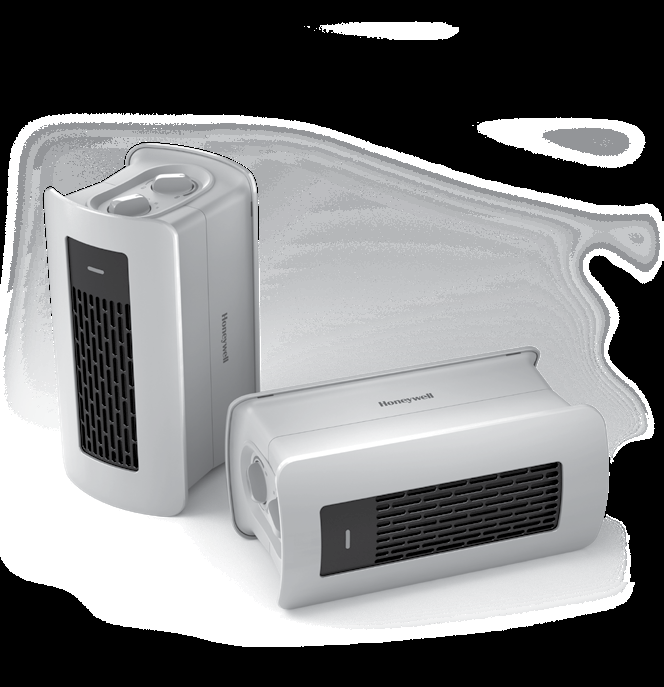
The manual says the HHF250 can run upright or on its side. Honeywell’s manual cover shows both orientations, which explains the product name better than a generic “portable heater” label. It is not a wall-mounted appliance and the two positions are not separate heat modes. The manual still requires a firm, level, open surface, away from bedding and deep carpeting. The side orientation should be treated as a second stable operating position, not permission to place the heater on a sofa, a soft bed or an uneven surface.
The three power-knob choices make the main tradeoff easy to see. Fan-only moves air without heat; Low is 550 watts; High is 1,100 watts. The instructions call the Low setting the lower electrical draw. That may be useful when full output is unnecessary, but it does not establish how quickly a room warms or how much the unit will cost to run in your home. Honeywell publishes no square-foot coverage figure in the reviewed materials.
A real thermostat dial, not a displayed temperature
After choosing a heat mode, you set the thermostat control. The manual describes turning it high, waiting for the room to feel comfortable, then lowering the dial until the heating element switches off. It will cycle the heater on and off to maintain that selected comfort point. The dial does not present a numeric Fahrenheit target, and Honeywell gives no calibrated temperature range. This is different from the HCE870, whose manual lists four displayed setpoints, and from a heater that simply runs continuously until switched off.
The instructions do not document an automatic shutoff timer or delayed start for this HHF250. Do not mistake the thermostat cycling for a timer: it responds to room temperature and is not a scheduled off time. If you need a specific countdown as an essential feature, an unlisted timer cannot satisfy that requirement.
Size, electrical setup and safety limits
The page and manual conflict on dimensions. The product page lists 6.1 inches wide, 11 high and 5.5 long; the manual lists 5.4 long, 9.8 wide and 11.3 high. Those values do not line up, so I leave the body dimensions unresolved rather than choose the more convenient measurement. If you are deciding whether it fits in a tightly measured location, check the actual HHF250 dimensions from the seller or the physical unit. The image here is taken from Honeywell’s manual cover and shows the two operating positions; it is not a claim about the current finish.
The owner’s manual rates the heater for 120 volts, 60 Hz, 9.17 amps and a maximum 1,100 watts. It says to plug directly into a wall outlet rather than an extension cord or power strip. Keep at least three feet between the heater and combustible material, leave the air openings clear and keep the cord out of walking paths. The manual rules out outdoor, bathroom and laundry use, warns against placing the unit where it can fall into water, and says never to leave it operating unattended.
Its documented safety features include a high-temperature safety sensor, a thermal cutoff fuse, cool-touch housing and handle, and insulated wiring with reinforced connections. I do not find a tip-over switch identified in the HHF250 manual, so a shopper who requires one should select a model whose own instructions expressly document it. That distinction matters: overheating protection and tip-over protection are not interchangeable claims.
Where it fits in a Honeywell comparison
Choose the HHF250 if the manual thermostat and upright-or-side operation match your routine and you do not need a digital display, remote, timer or confirmed tip-over switch. The HHF550B provides a higher 1,500-watt maximum, three-angle head pivot and oscillation instead of the HHF250’s thermostat dial. The HCE317B tower adds a documented 80-degree sweep and up-to-eight-hour auto-off, but uses a 1,500-watt High setting and cannot be treated as the same compact two-position configuration. No model should be left unattended just because its controls can cycle or a separate heater offers a timer.
The HHF250 carries a three-year limited warranty. See the official HHF250 product page and its directly linked owner manual for the exact operating directions. If your requirements include a precise setpoint, timer, digital operation, bathroom approval or automatic unattended use, this is not the right choice on the evidence available.
Key details at a glance
| Maximum listed input | 1100 W |
|---|---|
| US supply voltage | 120 V |
| Installation form | Floor-standing and movable |
| Exact manual permits bathroom use | No |
| Power-heat levels | 2 |
| Listed wattage values | 550 / 1100 W |
More specifications and setup details
| Separate fan-only mode | Yes |
|---|---|
| Timer behavior | Exact manual documents manual thermostat and power controls, not a shutdown countdown. |
| Fanless convection heating | No |
| Heated-air direction | |
| Documented electrical connection | Plug-in connection |
| Heating element description | Fan-forced ceramic heater; the reviewed manufacturer materials state no numeric square-foot coverage. |
Use the exact model’s instructions for operating limits, supplied equipment and version differences.
Sources for this assessment
Check whether the room and routine line up.
Check room restrictions and full wall clearances first, then compare fan-only versus fanless heat, fit, app controls and the timer behavior the exact manual describes.