
On this page
Your needs, this model
Does it fit your priorities?
Do fan-only circulation and an auto-off timer fit better than an oscillating tower?
The 870-series manual lists Fan Only and two-, four- or eight-hour auto-off choices; it does not document an oscillation arc.
Explore this need in the finder →Do you prefer four temperature presets even though thermostat operation uses High?
The manual lists 65°, 70°, 75° and 80°F targets. Automatic control runs High until the selected room target is reached; heat settings remain Low and High.
Explore this need in the finder →Can the attached-base floor setup meet your clearances and attended-use routine?
The manual recommends floor placement for convection and requires a firm level open surface. A timer does not waive its no-unattended-use warning.
Explore this need in the finder →Would a lower-stage thermostat or a wide documented swing arc be essential?
The manual says thermostat operation uses High and does not document oscillation. Unknown lower-stage or sweep behavior cannot meet an essential constraint.
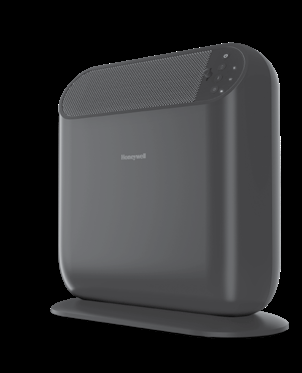
Explore this need in the finder →The Honeywell ThermaWave 6 HCE870 is a floor-oriented ceramic heater for a shopper who wants fan-only airflow, a manual air-direction louver, thermostat presets and a selectable auto-off timer in one unit. The U.S. HCE870 family is shown in black HCE870B and white HCE870W on the manufacturer’s instructions; their shared 870-series manual covers the same operating controls. The useful distinction is digital temperature selection and a timer, not a promise that the heater will warm a particular room size. Honeywell gives no numeric coverage area in the reviewed page and manual.
Separate heat modes from temperature presets
The Settings button selects Fan Only, Low heat or High heat. Low is 900 watts and High is 1,500 watts; fan-only uses very little power but does not heat. The 120-volt manual lists 12.5 amps at maximum. The separate adjustable thermostat button offers four preset targets—65, 70, 75 or 80 degrees Fahrenheit. The manual says automatic temperature control operates on High until the selected target is reached, then the fan runs for a 60-second cool-down and stops until the room drops below the target.
That distinction prevents a common misunderstanding: four temperature targets are not four continuous power levels. There are two selectable heat levels, plus fan-only; the thermostat has four room-temperature presets. If you specifically need the thermostat to use a lower heating stage automatically, the HCE870’s documented behavior does not meet that need. Its louver can be adjusted to direct the warm air, but the instructions do not give a louver angle or an oscillation sweep.
A timer helps end a session, not supervise it
The timer button selects two, four or eight hours. The owner’s manual says the eight-hour auto-off is the default when the heater is powered on. That is more useful for a planned, attended heating session than the HHF250’s manual thermostat alone, but it is still only an automatic shutoff. The manual explicitly says not to leave the unit unattended; a timer does not change that rule. The 60-second fan run-on after switching off is a cooling step for the heating element, not an extra period of heat.
Before use, the main body must be fitted to the included base with a no-tool snap assembly. Honeywell recommends floor placement for room convection. The instructions require a firm, level, open location and at least three feet from walls or combustible material; they caution against unstable surfaces such as bedding or deep carpeting. This is a portable floor unit, not a wall heater or a tabletop space-saver.
Placement, safety and the unresolved size conflict
The page lists dimensions of 18.11 inches wide, 18.54 high and 7.75 long. The manual gives an assembled 870-series size of 17.8 wide, 18.31 high and 7.75 long. Because the width and height differ, I leave numeric body dimensions unknown instead of presenting a false fit guarantee. The three-foot clearance is an operating requirement and cannot be subtracted from the unit’s footprint or treated as a substitute for measuring your intended location.
The exact manual documents a 360-degree tip-over switch, two high-temperature safety sensors, thermal-insulated wiring, reinforced wire connections and a cool-touch housing and handle. It also directs users to plug the heater into a wall outlet, not an extension cord or power strip; do not use it outdoors, in a bathroom or laundry area, near a water container, or unattended. Keep combustible objects at least three feet away. These restrictions apply even when using the timer or thermostat.
Which Honeywell model matches the routine?
Consider the HCE870 if four preset room-temperature targets and a two-, four- or eight-hour auto-off are more useful than a moving head. The HHF550B instead combines 750/1,500-watt settings with a three-angle pivot and oscillation, but its HHF550 instructions do not document the HCE870’s digital thermostat or timer. The HHF250 has a lower 550/1,100-watt pair and a mechanical thermostat, plus upright-or-side placement, but no documented countdown. Those differences may matter more than a generic claim that one heater is “stronger.”
Choose another configuration if a lower-stage thermostat is essential, you need a documented oscillation arc, or you need body dimensions that fit a tight clearance. The HCE870 carries a three-year limited warranty. The black and white manual-cover images below are manufacturer illustrations, not evidence of a photograph or of different hardware; review the official HCE870 product page and its linked 870-series owner manual for current configurations and instructions.
Key details at a glance
| Maximum listed input | 1500 W |
|---|---|
| US supply voltage | 120 V |
| Installation form | Floor-standing and movable |
| Exact manual permits bathroom use | No |
| Power-heat levels | 2 |
| Listed wattage values | 900 / 1500 W |
More specifications and setup details
| Separate fan-only mode | Yes |
|---|---|
| Temperature setting range | Four presets: 65, 70, 75 and 80°F |
| Timer behavior | Selectable 2/4/8-hour auto-off; 8 hours is default when powered. Timer does not permit unattended use. |
| Fanless convection heating | No |
| Heated-air direction | focused |
| Powered outlet louvers | No |
| Documented electrical connection | Plug-in connection |
| Heating element description | Fan-forced ceramic heater; the reviewed manufacturer materials state no numeric square-foot coverage. |
Use the exact model’s instructions for operating limits, supplied equipment and version differences.
Sources for this assessment
Check whether the room and routine line up.
Check room restrictions and full wall clearances first, then compare fan-only versus fanless heat, fit, app controls and the timer behavior the exact manual describes.