
Your needs, this model
Does it fit your priorities?
Is an included remote plus an object-proximity shutoff sensor essential?
The linked manual identifies the HCE323/HCE353 series as the only versions with both: a remote controls the heater and the enabled Safeguard sensor can stop heat for an unresolved nearby obstruction.
Explore this need in the finder →Do the documented sweep and timer fit a supervised heating session?
The HCE323V manual documents 80-degree oscillation and 1/2/4/8-hour auto-off; timer availability does not permit unattended use.
Explore this need in the finder →Can you keep it attended and clear rather than relying on its sensor as a safety substitute?
The manual says never leave the heater operating unattended and requires three-foot clearances; its sensor is a switchable response to a nearby object, not an occupancy sensor.
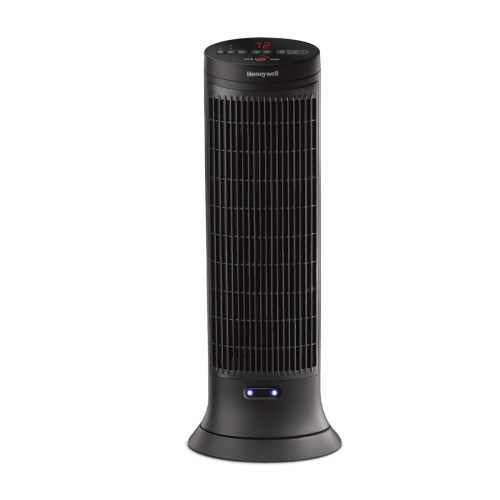
Explore this need in the finder →The Honeywell Safeguard Motion Sensor Ceramic Heater HCE323V is the feature-rich tower in Honeywell’s HCE311/HCE322/HCE323 family. It combines two heat levels, a thermostat, an 80-degree oscillation sweep, a one-to-eight-hour auto-off timer, a physical remote, and a sensor that shuts the heater down when an object is too close. That last feature is the model’s clearest distinction, but it is an obstruction response—not a person detector, room-occupancy sensor, or permission to leave a running heater unattended. This is a candidate for someone who wants those extra controls and can still follow the manual’s placement and supervision rules.
What the Safeguard sensor actually does
Honeywell describes an indicator that blinks when an object is too near the sensor. If the obstruction is not removed, the heater switches off until the object is removed, then restarts after a few seconds. The manual says that this Safeguard feature can be turned on or off. That is a useful model-specific distinction from the HCE311V and HCE322V, which do not have the feature. It is not a guarantee that every hazard will be sensed, and the manufacturer does not describe it as detecting a person entering the room. If a child, pet, curtain, or piece of furniture could approach the heater, the sensor should not replace the required three-foot clearance and active supervision.
The HCE323V also includes a physical remote that controls the heater’s functions, with a button-cell battery supplied. Keep the coin cell and remote out of children’s reach and handle the battery according to its safety instructions. A remote can make ordinary adjustments easier from a chair, but it does not convert this portable unit into an app-connected heater; app control is not documented. The HCE300-series manual identifies the HCE323/HCE353 as the only models in that manual’s family with the motion sensor, and the product page links to that manual.
Tower size and day-to-day heat settings
The product page lists the HCE323V at 6.70 inches wide, 23.20 inches high and 8.70 inches long; the manual’s series table gives approximately 6.69 by 23.15 by 8.74 inches and 4.56 pounds. It is the tallest of the three HCE311/HCE322/HCE323 bodies, so measure floor and storage space rather than assuming the slim base means a short appliance. It is rated for up to 1,500 watts at 120 volts and 12.5 amps. The manual describes Low at up to 900 watts and High at up to 1,500 watts, with thermostat-controlled heating, plus an 80-degree horizontal oscillation arc. Honeywell gives no numeric coverage area for this exact configuration.
The timer can be set for 1, 2, 4 or 8 hours and automatically shuts the heater off when that countdown ends. It is not a delayed-start timer. The page calls the heater digital and lists two heat settings; the manual explains continuous or thermostat-controlled operation, but the exact product sources do not establish a numeric thermostat range. The unit moves warm air with a ceramic element and fan; the manual does not document a fan-only mode. Oscillation changes direction side to side, not through 360 degrees, and is not a promise of uniform temperatures around a room.
Safety features are not operating permission
Honeywell’s instructions require a firm, level, open surface, clear air openings and at least three feet of separation from walls and combustible materials. Connect the heater directly to a wall outlet; do not use an extension cord or power strip, and do not share a circuit with another operating appliance. The manual says the heater is not intended for bathrooms or laundry areas, must not be used outdoors, and should never be left operating unattended. The timer and sensor do not override those directions. The HCE323V also has a 360-degree tip-over switch, a high-temperature safety control, a thermal cutoff fuse, cool-touch housing and handle, and a removable cleanable filter. Treat these as layers of protection, not as substitutes for clear placement and supervision.
How it compares with the HCE322 and HCE311
The HCE322 is the middle-height tower at about 21.6 inches and has the same two-level 1,500-watt class, thermostat, oscillation, countdown timer and basic safety instructions, but its manual does not identify a remote or Safeguard sensor. The HCE311 is shorter at about 12.8 inches and also has the family’s 80-degree oscillation and timer. If the sensor and remote are not essential, those two alternatives preserve much of the operating routine in a shorter housing. If the extra sensor is essential, verify that the listing says HCE323V rather than choosing by a similar tower photograph or family name. No reviewed page gives this exact model a numeric room-size rating, measured noise level, or verified energy-saving comparison.
Bottom line: Choose the HCE323V for its combination of remote control and switchable obstruction shutoff, not because the sensor guarantees safety or because a taller tower promises more coverage. It makes sense for a supervised indoor session where its 23-inch-plus body and required clearances fit comfortably. Pass if you need app control, unattended operation, bathroom approval, fan-only air movement, a compact body, or a documented square-foot performance claim.
Key details at a glance
| Maximum listed input | 1500 W |
|---|---|
| US supply voltage | 120 V |
| Published body height | 23.15 in |
| Published body width | 6.69 in |
| Published body depth | 8.74 in |
| Published body weight | 4.56 lb |
| Installation form | Floor-standing and movable |
| Exact manual permits bathroom use | No |
| Power-heat levels | 2 |
| Listed wattage values | 900 / 1500 W |
| Separate fan-only mode | No |
| Maximum documented horizontal sweep | 80° |
| Timer behavior | Owner manual documents 1-, 2-, 4- and 8-hour auto-off countdown choices. This is a shutoff timer, not delayed start; it does not permit unattended use. |
| Fanless convection heating | No |
| Heating element description | Ceramic heating element with fan-forced warm-air output, as identified in the Honeywell product page and series instructions. |
Use the exact model’s instructions for operating limits, supplied equipment and version differences.
Sources for this assessment
- Honeywell Plugged In U.S. heater category
- Safeguard Motion Sensor Ceramic Heater, HCE323V — Honeywell Plugged In
- page-linked HCE300 Series manual (official text-rendered content inspected; binary archive blocked)
- Official Honeywell product-page image
- CPSC bounded exact model-string recall search: HCE323
- Honeywell Ceramic Digital Tower Heater HCE311/HCE322/HCE323 Series Owner’s Manual (corroborating U.S. manufacturer source)

Check whether the room and routine line up.
Check room restrictions and full wall clearances first, then compare fan-only versus fanless heat, fit, app controls and the timer behavior the exact manual describes.