
Your needs, this model
Does it fit your priorities?
Would a 21.65-inch tower fit where a compact personal heater will not provide the shape you want?
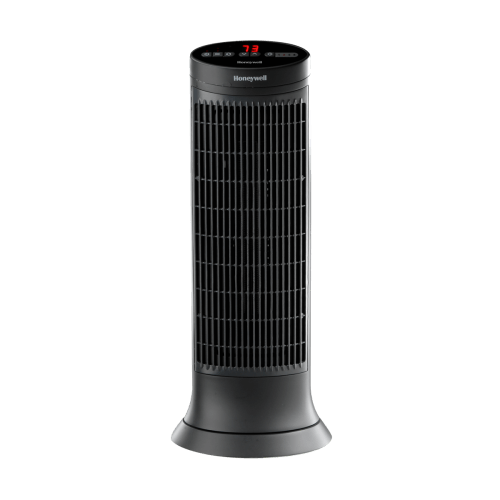
Honeywell lists the HCE322V as a slim tower at approximately 21.6 inches high; its exact manual lists a 4.41-pound unit with the same 1,500-watt maximum as the shorter HCE311.
Explore this need in the finder →Do you want the HCE322’s timer and oscillation without requiring the HCE323 remote and sensor?
The HCE322 manual documents 1/2/4/8-hour auto-off and 80-degree sweep; it reserves the remote and Safeguard obstruction sensor for the HCE323/HCE353 family.
Explore this need in the finder →Can an 80-degree sweep meet your need, or do you need a wider documented arc?
The exact HCE300 manual documents 80 degrees; it does not establish a 90-degree arc or a room-coverage outcome.
Explore this need in the finder →The Honeywell Digital Ceramic Heater HCE322V is a slim, 21.6-inch tower for shoppers who want a more upright footprint than a short personal heater. Its practical feature set includes two heat levels, an adjustable thermostat, side-to-side oscillation, and a one-to-eight-hour automatic shutoff timer. The exact manual calls for a direct wall outlet, substantial clearance, and supervision while it operates. If you want a remote or the Safeguard motion-sensor shutoff, the HCE322 is not the model to choose: Honeywell identifies those features as belonging to the HCE323/HCE353 series instead.
A tall format without a larger published wattage
Honeywell lists the HCE322V at 8.7 inches wide, 21.6 inches high, and 6.7 inches long; the HCE300-series manual lists dimensions of 8.74 by 6.69 by 21.65 inches and a 4.41-pound weight. It is much taller than the HCE311V personal-format heater, but the published maximum is still 1,500 watts at 120 volts and 12.5 amps. The manual describes Low at up to 900 watts and High at up to 1,500 watts. A taller housing and oscillation may change where the outlet is aimed, but neither establishes that the unit will heat a larger room than another 1,500-watt heater. Honeywell provides no numeric square-foot promise for the HCE322V.
The product page promotes a dual-motor system and describes whole-room heating. That is Honeywell’s marketing language, not an independently measured comparison or a reason to disregard the same output rating and clearance rules. If your decision depends on noise level, room coverage, or an exact heat-up time, those numbers are not supplied in the reviewed documentation. The useful confirmed differences are the tower shape, two selectable levels, adjustable temperature control, an 80-degree horizontal sweep, and an automatic countdown timer.
Controls for a supervised session
The HCE322 uses digital controls and allows the heater to operate continuously or under its thermostat, which cycles heating around a selected room temperature. Its timer offers 1, 2, 4, or 8 hours and turns the heater off after the chosen period. It is an auto-off countdown, not delayed start. The instructions describe an initial High setting, separate Low/High selection, and thermostat controls, but they do not establish a numeric thermostat range for this exact model. Nor does the owner’s manual list fan-only operation. If you need a particular temperature step, a fan-only mode, or remote operation, verify those exact features before treating the HCE322 as a match.
Horizontal oscillation is documented at 80 degrees. That can move the warmed-air direction side to side while the heater runs, but it is not a full-circle outlet and does not mean heat reaches every corner evenly. The HCE311V shares this basic tower family behavior in a shorter body. The HCE323V adds the remote and closeness sensor, not a higher published wattage. These differences are more useful to compare than broad claims about “whole-room” performance.
Placement and circuit requirements matter
The manual requires a firm, level, open surface and at least three feet between the heater and walls or combustible materials. Do not block the air openings or place it on bedding or deep carpet. Plug it directly into a wall receptacle; do not use an extension cord or relocatable power tap, and do not operate another appliance on the same circuit. Honeywell says not to use the heater in a bathroom, laundry area, outdoors, or any place where it could fall into water. It also says never to leave the heater unattended. The 360-degree tip-over switch, high-temperature sensor, thermal cutoff fuse, cool-touch housing and handle, and cleanable filter are useful protections and maintenance features, but none removes those instructions. The timer is for managing a supervised heating session, not permission to run the heater while away or asleep.
Who should consider the HCE322?
It fits a shopper who has floor space for a narrow tower, wants two heat levels and thermostat cycling, and values an automatic shutoff countdown while staying present. The HCE311 may suit a low-clearance location better because its body is much shorter. The HCE323 is the natural comparison if an included remote or its Safeguard obstruction sensor is a must-have; it is taller and adds those features, not a different published wattage. For a simpler, shorter heater with mechanical controls, the HCE210 is another Honeywell alternative, though it lacks a documented timer. All of these are portable indoor heaters, so none is a sound choice for a bathroom, an extension-cord setup, an outdoor location, or an unattended-use requirement.
Bottom line: The HCE322V’s case is its upright space-saving form combined with a thermostat, 80-degree oscillation and up-to-eight-hour auto-off. Buy it only if those are the features you need and the required 36-inch clearance, dedicated circuit and supervision are practical in your room. Its appearance and “dual motor” wording should not be mistaken for a published coverage rating or a verified performance advantage.
Key details at a glance
| Maximum listed input | 1500 W |
|---|---|
| US supply voltage | 120 V |
| Published body height | 21.65 in |
| Published body width | 6.69 in |
| Published body depth | 8.74 in |
| Published body weight | 4.41 lb |
| Installation form | Floor-standing and movable |
| Exact manual permits bathroom use | No |
| Power-heat levels | 2 |
| Listed wattage values | 900 / 1500 W |
| Separate fan-only mode | No |
| Maximum documented horizontal sweep | 80° |
| Timer behavior | Owner manual documents 1-, 2-, 4- and 8-hour auto-off countdown choices. This is a shutoff timer, not delayed start; it does not permit unattended use. |
| Fanless convection heating | No |
| Heating element description | Ceramic heating element with fan-forced warm-air output, as identified in the Honeywell product page and series instructions. |
Use the exact model’s instructions for operating limits, supplied equipment and version differences.
Sources for this assessment
- Honeywell Plugged In U.S. heater category
- Digital Ceramic Heater, HCE322V — Honeywell Plugged In
- page-linked HCE300 Series manual (official text-rendered content inspected; binary archive blocked)
- Official Honeywell product-page image
- CPSC bounded exact model-string recall search: HCE322
- Honeywell Ceramic Digital Tower Heater HCE311/HCE322/HCE323 Series Owner’s Manual (corroborating U.S. manufacturer source)

Check whether the room and routine line up.
Check room restrictions and full wall clearances first, then compare fan-only versus fanless heat, fit, app controls and the timer behavior the exact manual describes.