
On this page
Your needs, this model
Does it fit your priorities?
Would a roughly 22-inch floor tower with side-to-side movement fit your space?
The HCE300 manual lists the HCE317 tower at 21.65 inches high and documents an 80-degree sweep; the manual still requires a three-foot separation from walls and combustibles.
Explore this need in the finder →Are two settings enough if the lower continuous stage is 750 watts?
The HCE317-series instructions give Low up to 750 watts and High up to 1,500 watts; thermostat cycling is a separate operating mode, not a third fixed heat level.
Explore this need in the finder →Would an eight-hour maximum auto-off suit a supervised heating session?
The exact series manual lists 1-, 2-, 4- and 8-hour countdown choices, while separately saying not to leave the unit unattended.
Explore this need in the finder →Can you accept a tower with no removable intake filter?
The HCE300 manual expressly excludes HCE317 from its permanent-filter and filter-cover cleaning routine; the body still needs periodic external cleaning.
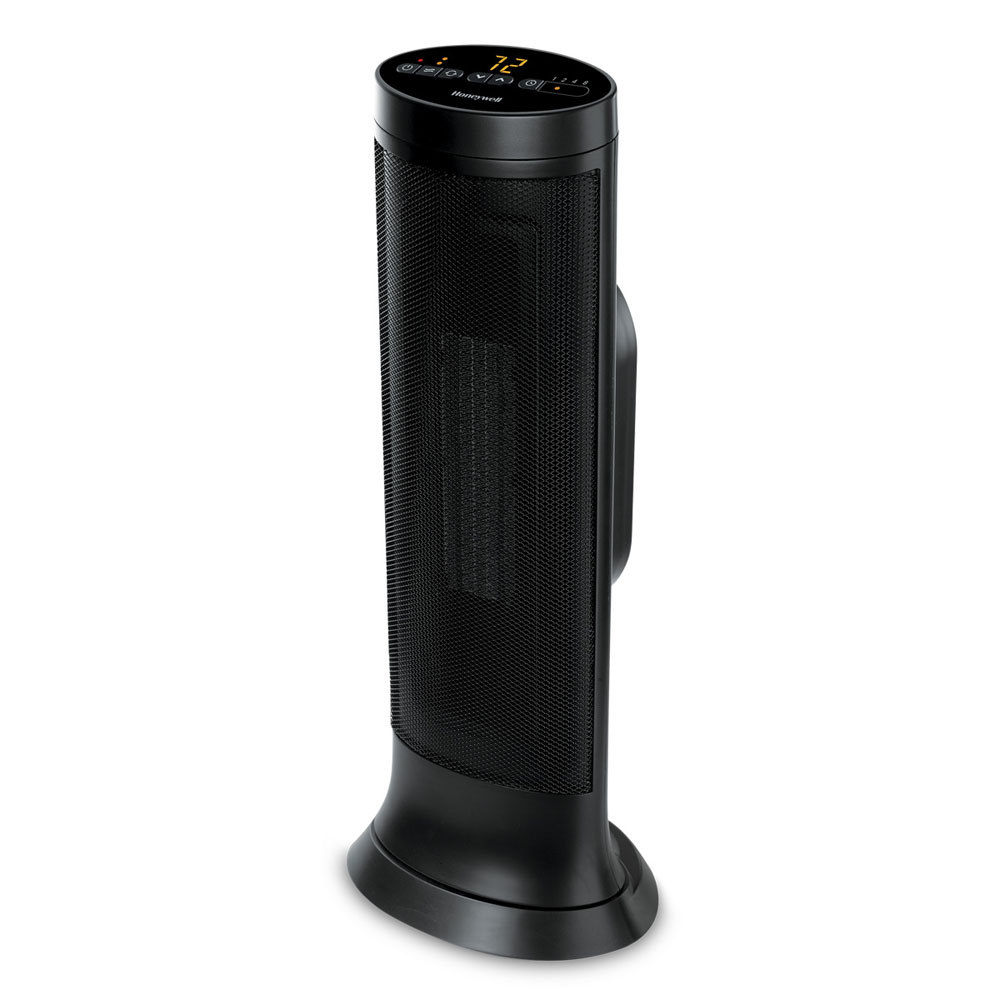
Explore this need in the finder →The Honeywell Slim Ceramic Tower HCE317B is a floor-standing ceramic heater for someone who wants a taller, oscillating body but would rather keep its lower continuous-heat setting modest. Its exact series instructions identify a 750-watt Low setting and a 1,500-watt High setting, rather than the 900/1,500-watt pair used by some neighboring HCE300 models. Honeywell also lists an adjustable programmable thermostat, an 80-degree side-to-side sweep, and an auto-off countdown. The trade is a straightforward tower configuration: this HCE317 series does not include a removable filter, and its manual does not permit leaving it running unattended.
What the tall, narrow form buys you
The manufacturer lists the HCE317B as a roughly 22-inch tower and recommends it for medium or larger rooms. The HCE300 manual gives a more precise height of 21.65 inches and a weight of 4.41 pounds. Its dimensions table lists the other axes as 8.74 by 6.69 inches, while the current product page labels the rounded horizontal dimensions in the opposite width/length order. The overall footprint is small compared with the height, but if a particular side must fit exactly between furniture, check the unit and site clearance before choosing an orientation. Honeywell provides no square-foot coverage figure here; its room-size language is guidance, not a measured performance rating.
This is a portable floor heater, not a tabletop personal unit. At 12.5 amps and 120 volts, it draws close to the capacity of an ordinary household branch circuit at full output. The manual calls for a direct wall receptacle and says not to share an operating circuit with another appliance. It also prohibits extension cords and power strips. The stated 3-foot separation from walls and combustible materials can take more room than the heater itself, so the slim footprint should not be mistaken for permission to tuck it into a narrow gap.
Two continuous heat levels and a thermostat
Low uses up to 750 watts on the HCE317 series; High reaches 1,500 watts. That lower setting is the model’s clearest distinction from the HCE322 digital tower, whose series manual lists 900 and 1,500 watts. If you want a gentler continuous output or want a lower setting that draws less power than a 900-watt stage, the HCE317 is the better match on paper. If two levels are too coarse, or a 750-watt stage is still more heat than you need, choose a different product rather than treating the thermostat as an additional fixed power level.
The product page describes a programmable thermostat. The HCE300 instructions distinguish continuous Low/High operation from thermostat operation, where the heater cycles on and off around a selected temperature. They do not establish a numeric thermostat range or confirm that the thermostat automatically shifts to a lower heat stage. In other words, the HCE317 gives you both a selectable lower setting and temperature control, but those are not the same promise. The manual also describes a brief cool-down after shutoff; let that sequence finish before unplugging the heater.
The timer offers 1-, 2-, 4-, or 8-hour shutoff choices, while the 80-degree oscillation sweeps the outlet side to side. The countdown can help end a supervised session at a chosen time, but it does not authorize overnight or unattended heating. Honeywell’s instructions say never to leave an operating unit unattended. If leaving a heater on while away or asleep is essential, this is the wrong operating plan even with its timer.
What it does not include
The HCE317 series is the exception in the HCE300 manual’s filter-cleaning section: it has no permanent intake filter or filter cover. That removes filter removal and washing from routine care, but it is not an air-cleaning feature and there is no filter to add. The manual still recommends periodic cleaning, using a dry cloth on the exterior, and warns not to use water or chemical cleaners. It also says the heater does not disassemble, so do not treat the grille as a user-serviceable filter bay.
The manual reserves the remote and Safeguard object-proximity sensor for HCE323/HCE353 units. Neither feature is documented for the HCE317. It is a fan-forced ceramic heater, not a fan-only appliance, and the manufacturer does not publish a separate fan-only mode, an app feature, a numeric thermostat span, or a sound measurement for this model. Its documented safety systems include a 360-degree tip-over switch, over-temperature protection, a thermal cutoff, cool-touch housing, and reinforced wiring; those protections do not remove the clearance and supervision rules.
How it compares with related Honeywell towers
The HCE311V is much shorter at 12.8 inches and is the more compact choice if you can give up the HCE317’s taller tower format; its listed heat settings are 900 and 1,500 watts. The HCE322V is also 21.65 inches high but offers a 900-watt Low setting and a removable filter. For a documented remote and an object-proximity shutoff feature, look at the HCE323V instead, while remembering that its 23.15-inch body is taller and its sensor is not occupancy monitoring. The HCE317 is the one to consider when a tall but slim footprint, 750-watt Low setting, two heat levels, horizontal sweep, and no-filter maintenance fit your priorities.
Bottom line: Choose the HCE317B if you want a simple 120-volt oscillating tower with a comparatively low 750-watt continuous setting and an eight-hour maximum auto-off timer for supervised use. Pass if you need a shorter heater, a removable filter, a remote, a Safeguard sensor, fan-only airflow, verified unattended permission, or exact width/depth orientation without checking the manufacturer dimensions. Its published maximum is 1,500 watts, its manual calls for three-foot clearance and a dedicated direct outlet, and its medium/large-room description is not a quantified coverage guarantee.
Key details at a glance
| Maximum listed input | 1500 W |
|---|---|
| US supply voltage | 120 V |
| Published body height | 21.65 in |
| Published body weight | 4.41 lb |
| Installation form | Floor-standing and movable |
| Exact manual permits bathroom use | No |
More specifications and setup details
| Power-heat levels | 2 |
|---|---|
| Listed wattage values | 750 / 1500 W |
| Separate fan-only mode | No |
| Maximum documented horizontal sweep | 80° |
| Timer behavior | The manual documents 1-, 2-, 4- and 8-hour auto-off choices. The timer is a shutoff countdown, not permission for unattended use. |
| Fanless convection heating | No |
| Heating element description | Ceramic element with fan-forced warm-air output, as described in the HCE300-series instructions. |
Use the exact model’s instructions for operating limits, supplied equipment and version differences.
Sources for this assessment
- Honeywell Plugged In U.S. heater category
- Slim Ceramic Tower, HCE317B — Honeywell Plugged In
- Heater Support — Honeywell Plugged In
- Ceramic Tower Heaters (HCE300 Series) Owner’s Manual, A000555R8 r4 13OCT23
- CPSC SaferProducts bounded recall query: HCE317
- Honeywell Store retailer-hosted product image for HCE317B

Check whether the room and routine line up.
Check room restrictions and full wall clearances first, then compare fan-only versus fanless heat, fit, app controls and the timer behavior the exact manual describes.