
Your needs, this model
Does it fit your priorities?
Do you need app control but want to stay at or below 1,000 watts?
This is the Wi-Fi WX: the exact listing and manual identify app operation and 500/1,000 W heat levels; it is a fixed wall installation.
Explore this need in the finder →Can this WX Wi-Fi run as a floor portable heater?
No. Its support manual labels wall installation required, so floor placement is not a documented operating plan.
Explore this need in the finder →Can it use a delayed timer as well as its app?
The linked manual describes both delay-on and delay-off timer settings in hour increments, and the Smart Life connection requires a 2.4 GHz network.
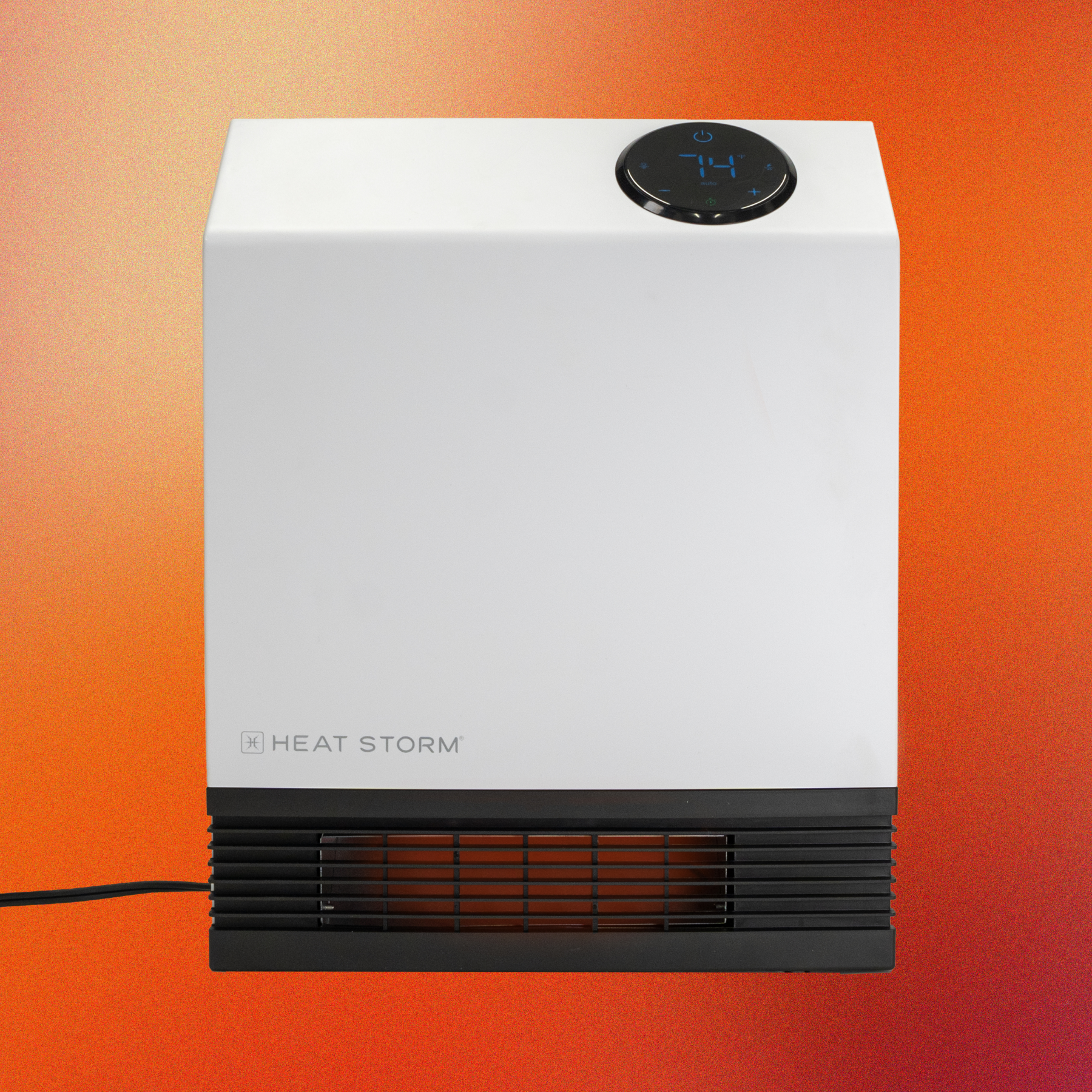
Explore this need in the finder →The Heat Storm WX Wi-Fi Wall Heater is a small, fixed-wall infrared appliance with a 1,000-watt maximum, Smart Life app access and a remote. It suits a dry room where a wall location is already available and the owner values phone scheduling without needing the Phoenix’s 1,500-watt output. The low profile does not make it a portable heater or a bathroom-safe unit.
What the Wi-Fi WX adds—and what it does not
The U.S. product page gives the retail configuration as A-1000-WX-WiFi; the official manual directory links its support guide as the HS-1000-WX-WIFI family. The PDF cover prints HS-1000-WX-WI. Those support and retail strings differ, but the maker links the manual from the exact product family and its first page identifies the Wi-Fi WX housing. The separate standard WX listing carries A-1000-WX and A-1000-WXG and has a different non-Wi-Fi manual; do not collapse the connected and non-connected product records just because their representative image is the same.
This heater offers 500 and 1,000 watts plus an Eco mode, a digital thermostat, a child lock and an included remote. The product page lists 13 × 4 × 17 inches, 6.1 pounds, 120-volt operation and 40–44 dB. The manual describes the infrared element with forced-air circulation, two heat levels and a 1,000-watt maximum. That is a modest heater for a small area or supplemental warmth, not a replacement for correctly sized whole-room heating. Its 100-square-foot primary and 500-square-foot supplemental figures are manufacturer estimates; they are not lab-tested room guarantees.
The wall-only installation is the key constraint
The support manual labels wall installation required and says not to prop the unit against an object or run it with its grille vertical. Installation involves marking and drilling, wall anchors and enough space around the body. It asks for at least 4½ inches to nearby walls, ceiling and floor, and three feet clear in front of the outlet from draperies, cords and furnishings. The page and manual describe a three-foot cord; choose a position close enough to a suitable receptacle without routing the cord under rugs or furniture.
The electrical instructions matter: 120 V, up to 8.3 A at 1,000 watts, direct connection to a wall outlet, no extension cord, surge protector or relocatable power tap, and a separate circuit for each appliance. A room with an existing high-load device on the same circuit may not be the right location. The manufacturer’s manual also excludes outdoors, closets, flammable-vapor locations and wet or moist locations. Despite a product-page mention of bathrooms, I do not match it to an essential bathroom or near-water need; the manual restriction is the safer exact-model boundary.
App setup and control are not the same as portability
The connected feature uses Smart Life. The manual’s original setup pages require a 2.4 GHz Wi-Fi network, with Wi-Fi and Bluetooth enabled on the phone; some dual-band routers may need a separate 2.4 GHz network. It describes app schedules and temperature control. Separately, the on-unit timer permits delay-on and delay-off in hour increments. That makes scheduled start a documented feature, but the instructions inspected here do not specify a total timer maximum. The included handheld remote and touchscreen provide local alternatives if the phone or router is unavailable, while the app does not change the heater’s maximum 1,000-watt input.
One claim needs a careful reading: the page describes the exterior and grille as cool to the touch and lists a tip-over switch, yet the manual states that the heater becomes hot and warns against contact. It also requires the unit to be secured on a wall. I leave the conflicting touch claim out of any safety recommendation; keep the specified clearance and supervise children rather than relying on marketing language or a switch. The manual does document a control lock, but it is not a physical guard.
Choose the right WX variant
The Wi-Fi WX is the right member of this pair only if app access or the documented Wi-Fi setup is worth the setup work. The standard A-1000-WX/A-1000-WXG keeps the same wall-mounted 1,000-watt class, remote, timer and thermostat without documented app control; compare it if you prefer direct controls. For a 1,500-watt heater that can also sit on the floor, compare the conventional Phoenix instead. For a wall heater and a 1,500-watt maximum with app scheduling, the Phoenix Wi-Fi is the stronger output option, but it still requires wall mounting.
Heat Storm’s collection feed marked the WX Wi-Fi variant available while the captured product page showed sold-out text; treat availability as changeable and search the exact retail SKU, not a color or family nickname alone. The family image used on this review also appears on the maker’s non-Wi-Fi WX page. It is a representative white WX view: connectivity is not visible, and it is not evidence that the two models have identical controls. The useful buying decision is whether a fixed wall installation, 1,000-watt ceiling, 2.4 GHz network and manual clearances all fit your actual room.
Key details at a glance
| Maximum listed input | 1000 W |
|---|---|
| US supply voltage | 120 V |
| Published body height | 17 in |
| Published body width | 13 in |
| Published body depth | 4 in |
| Published body weight | 6.1 lb |
| Installation form | Fixed wall installation |
| Exact manual permits bathroom use | No |
| Power-heat levels | 2 |
| Listed wattage values | 500 / 1000 W |
| Separate fan-only mode | No |
| Can the heater start on a timer? | Yes |
| Phone-app control | Yes |
| Fanless convection heating | No |
| Control lock | Yes |
Use the exact model’s instructions for operating limits, supplied equipment and version differences.
Sources for this assessment
- Heat Storm WX Wi-Fi Wall Heater product page
- Heat Storm U.S. Indoor Heaters native collection page 1
- Heat Storm official manual directory
- Heat Storm 2024 HS-1000-WX-WI user manual
- Heat Storm official WX-family product image shared on both WX listings
- Bounded exact-string CPSC recall search receipt (not a safety clearance)

Check whether the room and routine line up.
Check room restrictions and full wall clearances first, then compare fan-only versus fanless heat, fit, app controls and the timer behavior the exact manual describes.