
On this page
Your needs, this model
Does it fit your priorities?
Do you want a tripod heater with a remote for a supervised indoor area?
The exact TT-M page includes the tripod and remote. Outdoor permission and the exact motion timeout remain unresolved.
Is a 1,500-watt maximum acceptable?
The exact product is rated at 1,500 watts. It cannot meet a 1,000-watt cap.
Does the indoor-only evidence meet your location choice?
Indoor tripod use is documented, but the manual contradicts itself about outdoor operation; outdoor use is not treated as confirmed.
Can the branch circuit meet the exact manual's dedicated 20-amp requirement?
The exact TT-M manual specifies a 20 A outlet and dedicated circuit; a 15 A circuit does not meet that manual requirement. Voltage remains uncertain because the collection listing says 110 V while the manual says 120 V.
Do you require a documented tip-over shutdown?
The exact TT-M manual says the heating element shuts off when the heater tilts more than 45 degrees. That is separate from its motion sensor, which is not an object-proximity cutoff.
Can you keep the TT-M on your shortlist if its supply voltage still needs nameplate confirmation?
Yes only when voltage is not a hard filter. The collection row says 110 V but the exact manual says 120 V, so a required 120 V match fails closed until the nameplate and supply are confirmed.
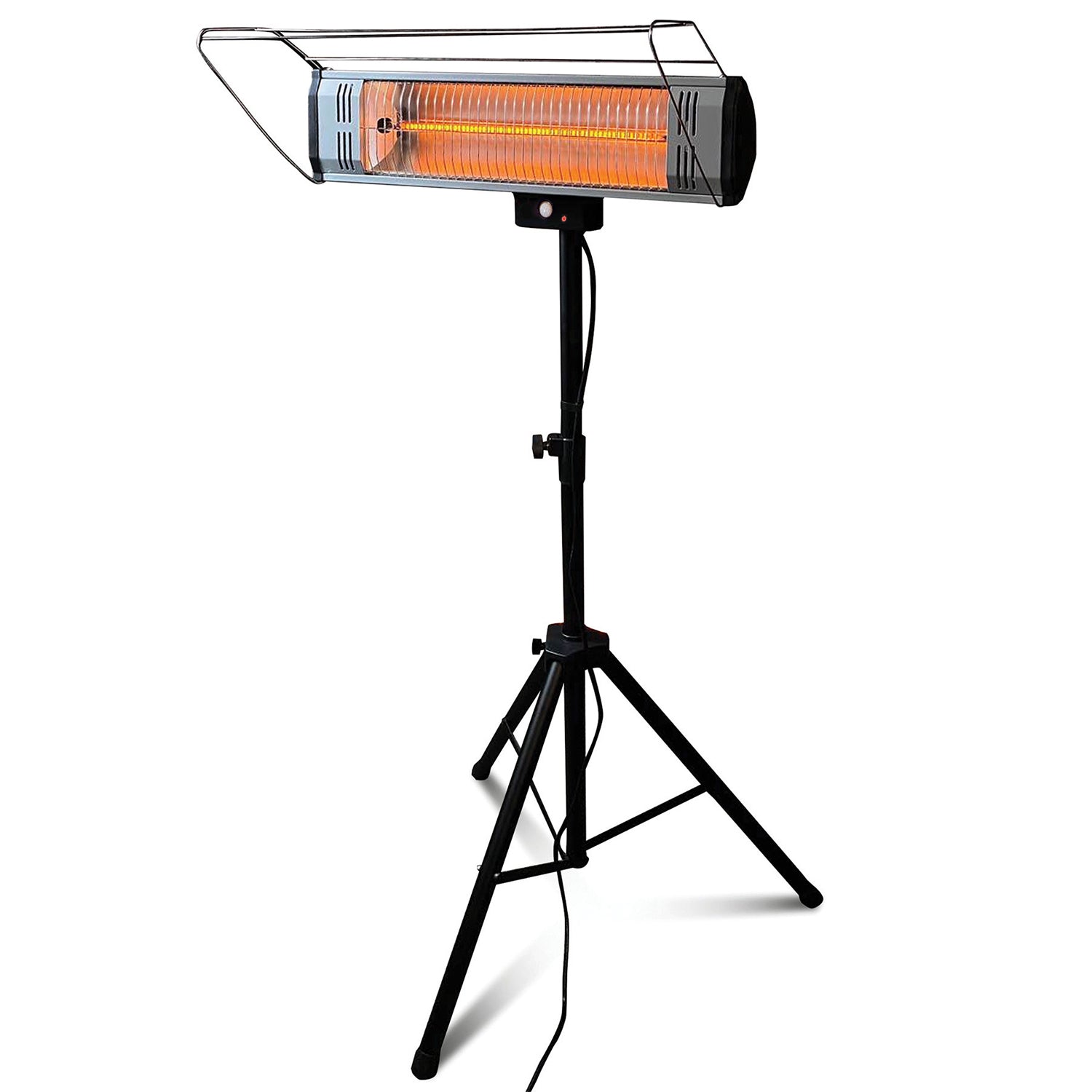
The Heat Storm HS-1500-TT-M is the tripod-and-remote configuration that adds a motion-sensing mode. Its 1,500-watt infrared bar is designed to be aimed at a particular area, while the sensor can turn the heater on when movement is detected and off after movement stops. That is an occupancy convenience, not a proximity safety sensor and not permission to leave a portable heater unattended.
What the motion feature does—and does not establish
Heat Storm's exact product page lists a tripod, remote and built-in motion sensor. The manufacturer manual describes an automatic mode and a 24-hour maximum run feature, but the sensor timing is inconsistent in the same manual: one passage references fifteen minutes without movement, and another gives fifteen or thirty minutes. The useful conclusion is that motion affects operation; the exact shutoff interval is not verified. Do not choose this heater if an exact occupancy timeout is an essential requirement.
The sensor detects people moving through its field; that is not the same as an object-proximity guard that shuts off when a blanket, furniture or another item approaches the heater. It is also not a tip-over substitute or a guarantee that a room is unoccupied. Treat the product as a supervised electric heater and follow the warnings about hot surfaces, combustible clearance and stable placement. If you want a plain tripod and no automatic activation, the HS-1500-TT is the simpler package. If a known one-to-nine-hour off countdown is more important than motion detection, compare the HS-1500-TT-R.
Stand, output and location limits
The unit is rated at 1,500 watts and is supplied with a tripod that can be adjusted for aim. The page calls out an eight-foot cord and weather-resistant IPX4 construction. The manual's cover labels the model indoor-outdoor, but its safety text says not to use it outdoors. That conflict is material: an outdoor use choice remains unknown and cannot be used to recommend this exact model for a patio. For the current decision, plan it only indoors in a dry location, with the stand secure, the cord out of walkways and the full manual clearance maintained.
The maker's Outdoor Heaters collection row describes a standard 110-volt outlet, but the exact TT-M manual's electrical section specifies a 120-volt, 20-amp outlet and says each heater should have its own dedicated circuit. The manual's grounding and plug descriptions also vary between sections. That is a material supply ambiguity, not a detail to settle by assuming that nominal household voltage makes the statements interchangeable. If a 120-volt supply is an essential filter, this model does not pass on the available conflicting text. Check the actual heater nameplate and have a qualified electrician confirm the receptacle and branch circuit before connection; the manual's 20-amp dedicated-circuit requirement remains the conservative planning threshold.
Electrical fit, clearances and safety
The same manual says to plug the heater directly into a wall receptacle, not an extension cord, surge protector or relocatable power tap. It warns to stop using a loose or hot-feeling receptacle and to keep the cord out of rugs, furniture paths and other high-traffic routes. Its safety section calls for at least three feet of open space in front and says to keep combustibles away from the sides and rear; it does not give a numeric side or rear distance. Those conditions make the tripod less forgiving in a cluttered walkway or where a cord has to cross the floor.
Heat Storm's instructions document separate overheat protection and a tip-over response: the element shuts down when the temperature probe exceeds 90°C and when the unit tilts more than 45 degrees. Those are useful safeguards, but neither makes a covered heater safe, provides the object-proximity shutoff some shoppers require, or replaces the manual's stable-stand, guard and clearance directions. The motion feature still detects people, not nearby objects. Assemble the tripod with its locking screws, mount the heater and guard as directed, secure the cord to the stand, and switch off and let it cool before moving it. The manual also identifies a CR2025 remote battery and gives specific child-safety warnings for coin cells, a practical detail if the remote will be kept in a shared workshop.
Heat Storm's coverage language is a manufacturer claim rather than an independent test. Radiant comfort depends on aim and line of sight; this is a focused, fanless arrangement, not an oscillating heater that circulates warmth evenly through a whole room. A clear, stable, supervised indoor work area is a better fit than a cramped corner, a route people cross repeatedly, or a patio whose outdoor status cannot be confirmed.
Questionnaire tradeoffs
Choose the TT-M if you want the tripod package, included remote, a motion-responsive mode and a documented maximum run period, and can accept that the sensor interval and outdoor permission are unresolved. Do not select it for a must-have proximity-sensor shutoff, exact fifteen-minute occupancy cutoff, confirmed outdoor use, Wi-Fi app control or unattended operation. If the location is a workshop where people move in and out, the sensor may be convenient; if you need a controlled session with predictable off timing, the TT-R's stated countdown is easier to reason about.
Because the manual's 24-hour power-off is a ceiling on operation rather than a precisely chosen short countdown, it should not be treated as equivalent to a configurable sleep timer. Keep the heater accessible enough to switch off manually. Before using it, read the exact TT-M instructions and check the physical unit's control response; do not transfer sensor settings from a different Heat Storm model.
Sources: Heat Storm HS-1500-TT-M product page; Heat Storm Outdoor Heaters collection; manufacturer manual directory; HS-1500-TT-M manual.
Key details at a glance
| Maximum listed input | 1500 W |
|---|---|
| Installation form | Floor-standing and movable |
| Exact manual permits bathroom use | No |
| Heated-air direction | focused |
| Heating element description | Carbon-fiber infrared; radiant, fanless heating |
| Minimum branch-circuit rating | 20 A |
Use the exact model’s instructions for operating limits, supplied equipment and version differences.
Sources for this assessment
- Heat Storm Tradesman 1500-Watt Infrared Heater with Tripod, Remote & Motion Sensor (Heat Storm U.S. product page)
- Heat Storm U.S. Outdoor Heaters native collection page 1
- Heat Storm official manual directory
- Heat Storm Tradesman HS-1500-TT-M 1,500-Watt Infrared Heater with Tripod, Remote and Motion Sensor official manufacturer manual
- CPSC exact-string recall query for HS-1500-TT-M
- Heat Storm manufacturer first-gallery image

Check whether the room and routine line up.
Check room restrictions and full wall clearances first, then compare fan-only versus fanless heat, fit, app controls and the timer behavior the exact manual describes.