
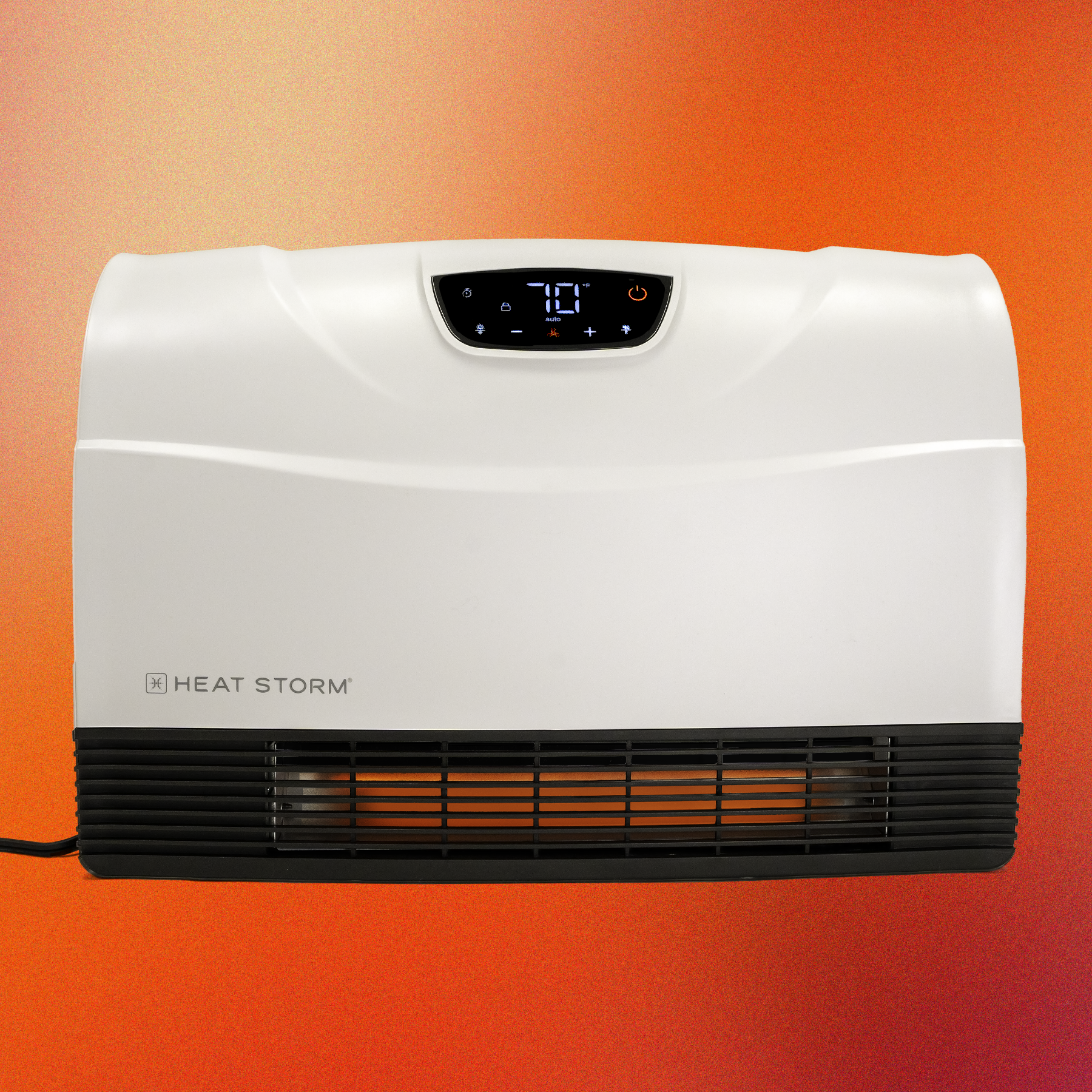
Your needs, this model
Does it fit your priorities?
Do you want a 1,500-watt wall heater with phone-app control?
Yes; this exact Phoenix listing pairs 1,500 W maximum input with Wi-Fi/Smart Life control, but it must be mounted on a wall.
Explore this need in the finder →Can the Wi-Fi Phoenix stand on the floor with the included base?
No. The Wi-Fi page says wall mount only and that feet are not included; the conventional Phoenix is the floor-capable alternative.
Explore this need in the finder →Does its app need a particular home network setup?
The linked manual directs Wi-Fi setup through a 2.4 GHz network with phone Wi-Fi and Bluetooth enabled; the maximum heat input remains 1,500 W.
Explore this need in the finder →The Phoenix Wi-Fi is the wall-mounted member of Heat Storm’s Phoenix family: a 1,500-watt quartz-infrared heater with a thermostat, remote and Smart Life app scheduling. It suits a dry small room where you can mount the unit securely and want phone adjustment. Do not mistake it for the separate non-Wi-Fi Phoenix, whose included feet allow floor use.
The exact Phoenix Wi-Fi configuration
The U.S. Indoor Heaters listing identifies White SKU A-1500-PHX-WIFI and Grey SKU A-1500-PHXG-WI under one product record. The official support directory links a Wi-Fi Phoenix manual for both support labels; the PDF cover prints the grey-family code HS-1500-PHXG-WI, while the retailer listing supplies the exact A-prefix SKUs. The manufacturer page describes these as the same Wi-Fi model in different finishes, with the same stated power, controls and contents. I treat finish as a choice of appearance, not a difference in heater capability. The pictured White unit is a family view, not an exact-Grey photograph.
Heat Storm lists 750- and 1,500-watt settings plus Eco, where the heater adjusts between those levels around its thermostat target. The product page gives a 40–99°F set range, a 19-by-4-by-16-inch body, 8.45-pound weight, 120-volt supply and a three-foot cord. That is a compact wall appliance, not a high-output substitute for a home’s main heating system. The manufacturer’s square-foot figures are estimates, not measured promises: insulation, air leakage, ceiling height and room layout will change what a single heater can maintain.
Mounting changes the buying decision
This exact Wi-Fi listing is wall-mount only. The product page says its feet are not included, and the linked manual labels wall installation required. The mounting plan needs a suitable wall, safe clearances and an outlet within cord reach. The manual calls for at least 4½ inches between the heater and nearby walls, ceiling and floor, plus three feet clear in front of the grille from cords, curtains, furnishings and other combustibles. It also directs users to plug the appliance directly into a proper 120-volt outlet, not an extension cord, power strip or surge protector, and says each appliance should have its own circuit.
The manual describes this unit as an indoor appliance for dry locations; it rules out wet or moist locations, closets, outdoors and areas with flammable vapors. Although the retail page mentions bathrooms among possible rooms, its own manual’s restriction is the useful boundary: do not treat an ordinary bathroom as approved without confirming that the specific placement is dry and permitted by the manufacturer. This is not a suitable answer to a need for a heater next to water. If you need to move a heater between rooms or use it on the floor, choose the non-Wi-Fi Phoenix, which has a separate documented base, or a portable model such as the Mojave.
App convenience has a network requirement
The connected control is through Heat Storm’s Smart Life app. The manual’s setup requires a 2.4 GHz Wi-Fi network and asks for Wi-Fi and Bluetooth on the phone. The app can change settings and create schedules; the heater also has an onboard timer for a timed run and an included handheld remote with batteries. These are three different controls: app access is not the same as a remote, and a timed shutoff is not proof of an exact maximum scheduling window. If you do not want to create an account, configure a network or depend on phone software, the standard Phoenix keeps the same 1,500-watt output without documented Wi-Fi.
There is a source conflict worth taking seriously. The product page calls the grille safe to touch, while the linked manual warns that the heater becomes hot and says to avoid direct contact. The same page also lists a tip-over shutoff even though the Wi-Fi configuration must be mounted to a wall. I therefore do not use “cool touch” as an essential safety feature or treat a switch as a substitute for careful installation, clearances and supervision around children or pets. The manual does document child lock, which prevents control changes until unlocked.
Who should compare another model?
Choose the Phoenix Wi-Fi when app scheduling matters, 1,500 watts is appropriate for the circuit and the planned wall location meets the manual. Choose the WX Wi-Fi instead if you want the same connected approach at 1,000 watts and can accept its wall-only form; choose the standard WX if app control is unnecessary and a 1,000-watt maximum is enough. For genuine floor portability, the regular Phoenix is the closer sibling, but its product page and manual disagree about body height, so leave a height-constrained opening uncommitted until Heat Storm clarifies the figure.
The current collection record says both Phoenix Wi-Fi colors were available while the captured product page displayed sold-out text. Stock is changeable and is not the reason to include or exclude this model; search by the exact SKU and confirm the seller’s model when shopping. The practical decision is the fixed wall installation and its 2.4 GHz app requirement—not the retailer’s broad coverage language or a claim that a particular room will feel warm.
Key details at a glance
| Maximum listed input | 1500 W |
|---|---|
| US supply voltage | 120 V |
| Published body height | 16 in |
| Published body width | 19 in |
| Published body depth | 4 in |
| Published body weight | 8.45 lb |
| Installation form | Fixed wall installation |
| Exact manual permits bathroom use | No |
| Power-heat levels | 2 |
| Listed wattage values | 750 / 1500 W |
| Separate fan-only mode | No |
| Temperature setting range | {'min': 40, 'max': 99} |
| Phone-app control | Yes |
| Fanless convection heating | No |
| Control lock | Yes |
Use the exact model’s instructions for operating limits, supplied equipment and version differences.
Sources for this assessment
- Heat Storm Phoenix Infrared Heater with Wi-Fi product page
- Heat Storm U.S. Indoor Heaters native collection page 1
- Heat Storm official manual directory
- Heat Storm 2024 Phoenix Wi-Fi heater user manual
- Heat Storm official Phoenix Wi-Fi product image
- Bounded exact-string CPSC recall search receipt (not a safety clearance)

Check whether the room and routine line up.
Check room restrictions and full wall clearances first, then compare fan-only versus fanless heat, fit, app controls and the timer behavior the exact manual describes.