
Your needs, this model
Does it fit your priorities?
Do you have a recessed wall opening and a 120-volt supply?
The A-1500-WALL-R page and HS-1500-WALL-R manual describe a 120-volt in-wall 750/1,500-watt heater.
Explore this need in the finder →Could a hardwired or direct plug-in in-wall option work?
The manual permits direct plug-in or hardwired connection for the 120-volt model. Use only its specified connection and never an extension cord.
Explore this need in the finder →Would a built-in fan-only setting and phone schedule be useful?
The manual documents fan-only operation and the product page confirms Wi-Fi schedules for this exact in-wall model.
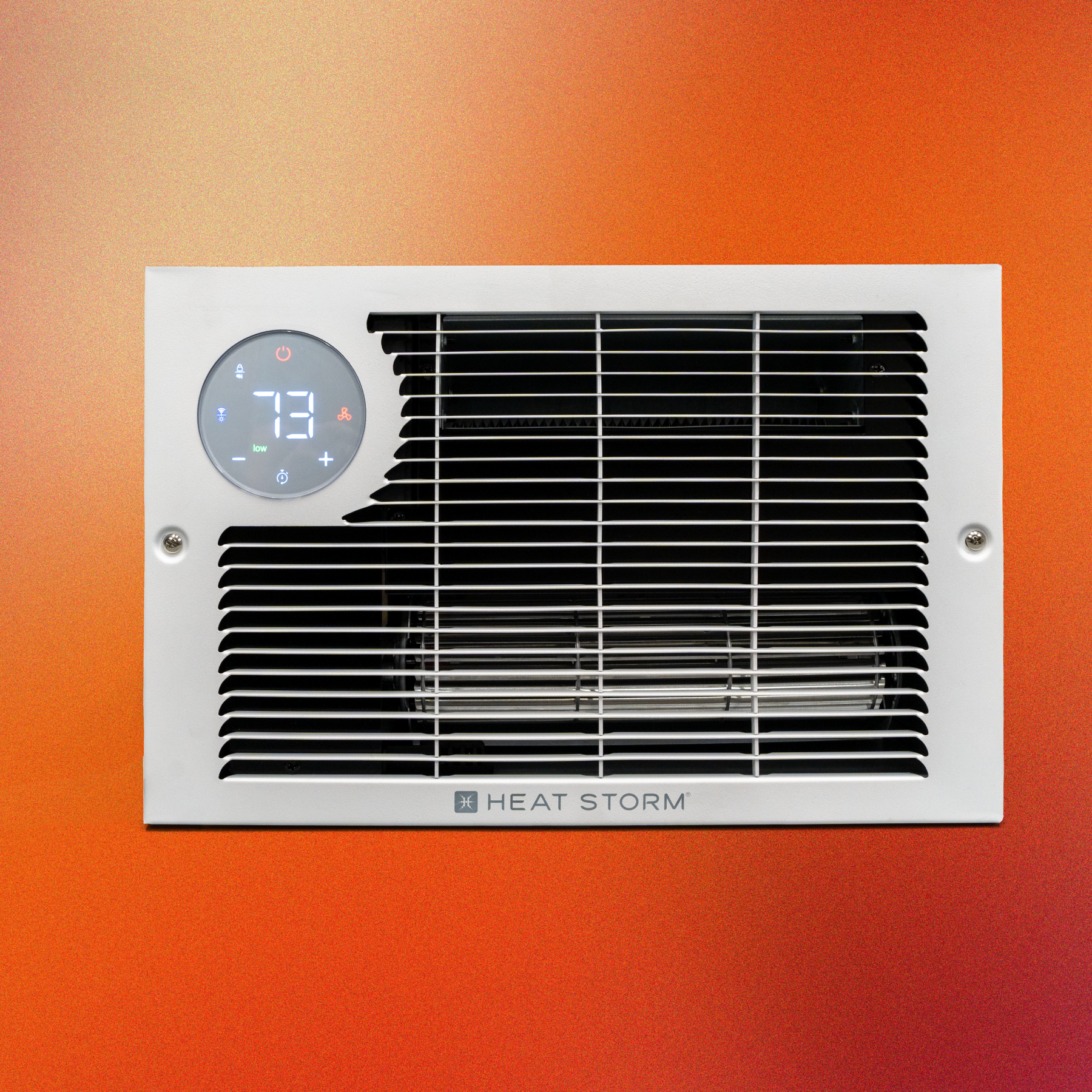
Explore this need in the finder →The A-1500-WALL-R is a Wi-Fi 1,500-watt in-wall heater for a dry room where a built-in, recessed installation is more useful than a portable body. It runs on 120 volts and offers a 750-watt lower setting, app scheduling and a separate fan-only mode; the installation form, not its smart controls, is the deciding tradeoff.
Read the model code and mounting type carefully
Heat Storm’s current U.S. collection lists product 7040898334781 as “In-Wall Electric Heater with Wi-Fi,” SKU A-1500-WALL-R. Its matching manual cover names HS-1500-WALL-R. The product page and manual both describe an in-wall smart heater, so this should not be conflated with the surface wall-mounted Sedona, Phoenix or ceramic PTC models. It is an installation project, not a heater that can be hung on any open wall or carried to another room. A wall cavity and the correct mounting method need to be available before this form is a practical choice.
The maker lists 750- and 1,500-watt outputs, 120-volt operation, a 6-foot cord and an approximate 15-by-4-by-10-inch body weighing 9.04 pounds. It also advertises 42–47 dB, a digital thermostat, touchscreen, Wi-Fi schedules, child lock and overheat protection. The manual identifies a forced-air in-wall heater and describes direct plug-in or hardwired installation options. Either way, use only the connection the exact unit and local requirements permit: the manual prohibits extension cords, power strips and surge protectors. The product-page room-area figures—up to 150 square feet primary, or up to 750 supplemental in an R-24 insulated room—are maker estimates, not independent coverage measurements.
Built-in placement does not remove operating limits
Before choosing this heater, confirm the space for the cutout, framing, cord or wiring route and service access against the manual. The manufacturer calls the configuration wall-mounted only in the product-page feature list, while its page title and manual call it in-wall; taken together, those sources support a fixed wall-cavity installation, not the floor or tabletop choices in a general heater quiz. I classify the plan as recessed/in-wall so it does not match a buyer who specifically needs a surface-mounted heater. The distinction avoids sending someone to an unsuitable product just because both descriptions contain the word “wall.”
The manual calls for at least three feet of clear space in front and warns that the appliance becomes hot. It also excludes wet or moist locations, outdoor use and extension connections. That means the page’s broad language about household comfort does not establish bathroom approval. The grille and fan outlet must remain unobstructed; do not bury the unit behind furniture, bedding or stored items. Wi-Fi lets you set schedules, but it does not certify unattended use or excuse clearances. The manual’s child-lock instructions are useful for limiting accidental control changes, not a substitute for safe placement.
What the controls add—and what they do not
The manual confirms both a lower heat level and fan-only mode, while the page supports Wi-Fi setup through the maker’s app. This combination is more versatile than a simple fixed-output wall convector, but it does not make the room larger, quieter or easier to retrofit. The published sound range is not an independent laboratory comparison. App schedules may be valuable when a permanent installation has a predictable work or sleep schedule; they are irrelevant if the home network is unreliable or the heater location cannot be reached for local service.
Shortlist this model when a verified wall cavity, a 120-volt supply, app scheduling and a modest 1,500-watt ceiling all suit the room. If you want an installation that visibly sits on the wall, compare the Sedona or ceramic PTC. If you need the higher 3,000-watt configuration, the separate HS-3000-WALL-R is a 240-volt hardwired product and is not interchangeable. The exact product page was marked sold out in the captured view; stock status may change, but a temporary listing change does not turn an in-wall appliance into a portable one. Check the A-1500-WALL-R listing and HS-1500-WALL-R instructions before planning the opening or electrical work.
Key details at a glance
| Maximum listed input | 1500 W |
|---|---|
| US supply voltage | 120 V |
| Published body height | 10 in |
| Published body width | 15 in |
| Published body depth | 4 in |
| Published body weight | 9.04 lb |
| Installation form | Recessed or in-wall installation |
| Exact manual permits bathroom use | No |
| Power-heat levels | 2 |
| Listed wattage values | 750 / 1500 W |
| Separate fan-only mode | Yes |
| Phone-app control | Yes |
| Fanless convection heating | No |
| Control lock | Yes |
| Documented electrical connection | Plug-in or hardwired (as documented) |
| Heating element description | Forced-air electric |
Use the exact model’s instructions for operating limits, supplied equipment and version differences.
Sources for this assessment
- Heat Storm 1,500-Watt In-Wall Wi-Fi Heater official product page
- Heat Storm U.S. Indoor Heaters native collection page 1
- Heat Storm official manual directory
- Heat Storm In-Wall Electric Heater with Wi-Fi retail SKU A-1500-WALL-R; matching manual HS-1500-WALL-R official user manual
- Heat Storm 1,500-Watt In-Wall Wi-Fi Heater manufacturer product-page image

Check whether the room and routine line up.
Check room restrictions and full wall clearances first, then compare fan-only versus fanless heat, fit, app controls and the timer behavior the exact manual describes.