
Your needs, this model
Does it fit your priorities?
Do you need a fixed Wi-Fi wall heater for a 120-volt circuit?
The exact model is wall-mounted, 120 V, Wi-Fi controlled and has 750/1,500-watt settings.
Explore this need in the finder →Would separate fan-only airflow be useful without calling it fanless heat?
The matching manual documents a fan-only mode. Heating itself is forced air, so it does not meet a fanless-convection need.
Explore this need in the finder →Is a 750-watt lower heat setting important?
The maker lists 750- and 1,500-watt heat settings; the 120-volt wall plan remains fixed and does not become portable.
Explore this need in the finder →The A-1500-PTC-WI is a compact ceramic wall heater with 750- and 1,500-watt settings, Wi-Fi schedules and documented fan-only operation. It is a dry-room, fixed-wall option for shoppers who want phone control without dedicating floor space; its 120-volt plug and wall-only manual rule out both 240-volt wiring needs and portable use.
Exact model and what changes from infrared panels
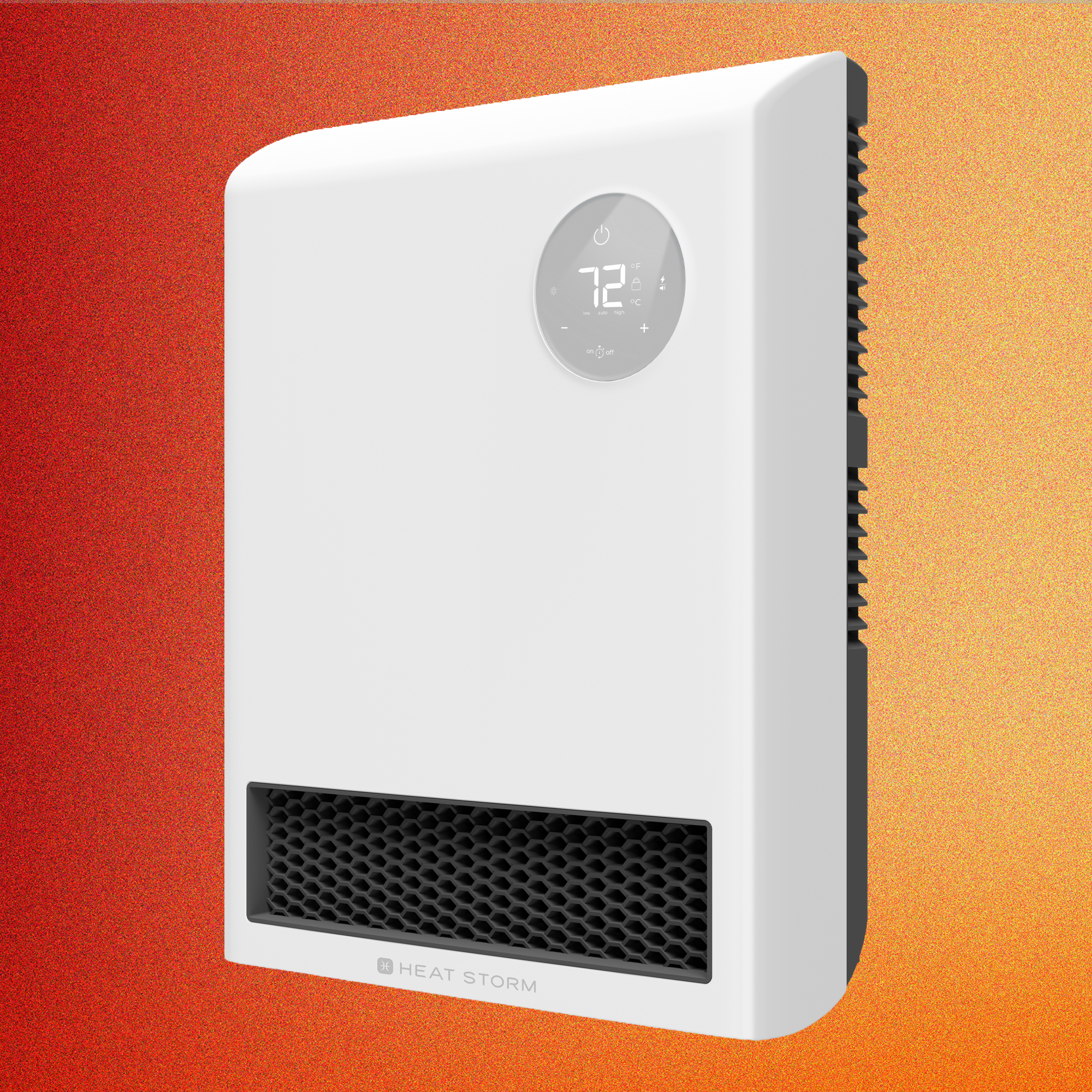
The Heat Storm Indoor Heaters collection identifies native product 7767914676285 as “Ceramic Wall Heater with Wi-Fi 1500 Watt,” SKU A-1500-PTC-WI. The manual cover explicitly names both HS-1500-PTC-WI and A-1500-PTC-WI, directly bridging the retail and support codes. Heat Storm describes a ceramic element, forced-air operation, 750- and 1,500-watt heat levels, built-in thermostat, Wi-Fi and schedules, child lock and touchscreen. The manual also documents a separate fan-only mode. That makes it a different choice from the similarly sized quartz infrared Phoenix/Sedona family, even though all can be used as fixed wall heaters.
The listing gives 120-volt operation, a three-foot cord, 5,200 BTU, a 42–47 dB sound range and up to 150 square feet as primary heat or 750 square feet as supplemental. These are manufacturer-listed values, not independent measurements. The page lists body dimensions of 12 by 4.5 by 15.5 inches and a 5.7-pound weight; the manual differs slightly on one side dimension. Since that width disagreement matters for tight placement, the fact sheet does not use a width-based fit limit. Check the current unit’s physical measurements if the installation site is constrained.
Wall use only, not a portable ceramic heater
The product page emphasizes a wall mount, and the manual identifies a wall-mounted smart heater. It should not be matched to a floor, tabletop or movable-room request. Wall placement saves floor space only after a stable, appropriate mounting point has been selected; it does not make the heater suitable for every wall. The manual calls for clearances around the appliance and three feet in front, and excludes outdoors and wet or moist locations. Its short cord also makes the outlet position important, since an extension cord, strip or surge protector is not an acceptable workaround under the manual’s instructions.
Heat Storm’s page uses a “cool-touch grill” claim, but the linked manual warns that hot surfaces may burn. I would not promise that the grille stays cool in operation or treat the marketing phrase as permission to touch it. Keep it away from fabrics, bedding and furniture, and follow the manual’s clearance directions. A Wi-Fi schedule or child-lock feature is not a replacement for good placement or supervision. Likewise, the page’s general room coverage figures are not a guarantee in a room with high ceilings, drafts or poor insulation.
Who benefits from its controls
This configuration makes sense if you want a fixed wall appliance, a 1,500-watt ceiling, two heat levels and app schedules, with a fan available when heat is not wanted. The lower 750-watt setting gives a smaller heat level; fan-only is a separate operating choice, not the same as running at low heat. If you prefer infrared radiant heating, compare the Wi-Fi Sedona or Phoenix. The 1,500-watt in-wall A-1500-WALL-R has a different installation form and can support an in-wall plan, while this PTC model is wall mounted. If you require 240 volts or 3,000 watts, the separate HS-3000-WALL-R has a much larger electrical requirement.
Current product-page text showed sold-out language while the collection’s variant was marked unavailable; this is still a documented model, not an endorsement of a seller’s stock status. The manufacturer’s first-gallery image is used here; its photography-versus-render status is not identified. For the exact model and instructions, see the A-1500-PTC-WI product page and HS-1500-PTC-WI / A-1500-PTC-WI manual.
Key details at a glance
| Maximum listed input | 1500 W |
|---|---|
| US supply voltage | 120 V |
| Published body height | 15.5 in |
| Published body width | 12 in |
| Published body weight | 5.7 lb |
| Installation form | Fixed wall installation |
| Exact manual permits bathroom use | No |
| Power-heat levels | 2 |
| Listed wattage values | 750 / 1500 W |
| Separate fan-only mode | Yes |
| Phone-app control | Yes |
| Fanless convection heating | No |
| Control lock | Yes |
| Documented electrical connection | Plug-in connection |
| Heating element description | PTC ceramic, forced air |
Use the exact model’s instructions for operating limits, supplied equipment and version differences.
Sources for this assessment
- Heat Storm Ceramic Wall Heater with Wi-Fi official product page
- Heat Storm U.S. Indoor Heaters native collection page 1
- Heat Storm official manual directory
- Heat Storm Ceramic Wall Heater retail SKU A-1500-PTC-WI; manual models HS-1500-PTC-WI / A-1500-PTC-WI official user manual
- Heat Storm Ceramic Wall Heater with Wi-Fi manufacturer product-page image

Check whether the room and routine line up.
Check room restrictions and full wall clearances first, then compare fan-only versus fanless heat, fit, app controls and the timer behavior the exact manual describes.