
Your needs, this model
Does it fit your priorities?
Does the 725 heat in a full-circle pattern without offering a separate fan-only breeze?
Yes. DREO lists a 360-degree-only heated-air direction and no fan mode; this is not fanless convection.
Explore this need in the finder →Can the 725 timer start the heater later?
No. The US manual describes an on-unit countdown that stops an operating heater; it does not document a timer start.
Explore this need in the finder →Will the 725 fit within a body-height limit I set?
The US manual and product specifications inspected do not publish overall body dimensions, so a height cap cannot be confirmed from this assessment.
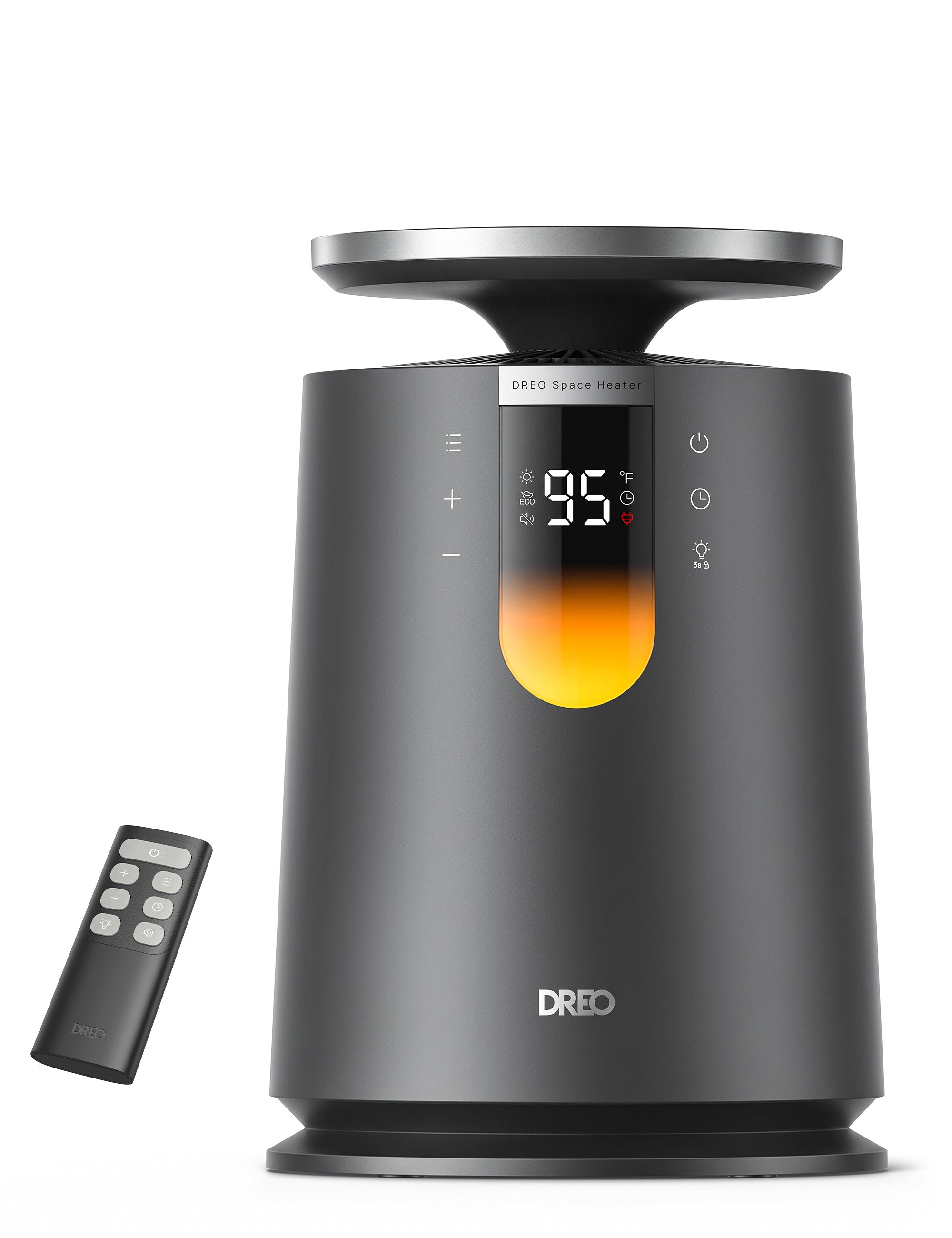
Explore this need in the finder →The DREO Whole-Room Heater 725 sends heated air in a fixed 360-degree pattern; the 720 adds focused output and a Fan mode. The official US support record identifies model DR-HSH035. The collection lists Gray 10-040351-001 and Black 10-040351-002; Gray was available and Black unavailable in the October 23, 2026 snapshot. Availability can change.
Three heat steps and an ECO target
The US manual identifies a PTC ceramic heater with three output choices: 900, 1,300 and 1,500 watts. ECO mode lets you set a target from 41°F to 95°F. That range is a control setting, not a promise that the heater can maintain the temperature in every room; drafts, insulation, room volume and the home's main heat all matter. DREO's low-noise language is a manufacturer claim, not an independent room measurement.
The outlet direction is a defining difference: the maker's comparison page lists 360-degree-only airflow for the 725. There is no selectable focused direction or oscillation sweep in the materials reviewed. The 720's separate Focused setting is more relevant if you want to aim heat toward a chair or desk. The 725 uses fan-forced PTC heating and has a 30-second fan cooldown after heat stops. It is therefore not a fanless convection heater, even though it lacks an independent fan-only mode. The DREO 711 and wall-mounted 711S are the genuinely fanless alternatives; they warm by convection but do not blow unheated air.
Controls are clear about stopping, not scheduling a start
The DR-HSH035 US manual describes a 0–12-hour countdown used while the heater is operating; when the countdown ends, the heater shuts off. It separately describes a 24-hour continuous-use auto-off function that is disabled by default. Neither is a scheduled start. If you want a heater to begin after it has been off for a set interval, do not infer that from the word “timer.” The 711 and 711S manuals specify an on/off countdown, and the MC706 manual says its timer can turn the appliance on or off.
The 725 includes a remote, child lock and manufacturer-listed tip-over and overheat protections. These controls help with operation but do not remove placement obligations or make unattended operation an appropriate default. A remote does not imply an app; phone control is not established for this US model. The Smart Convection Heater 711S has documented DREO app controls, but it requires wall installation and produces fanless heat rather than forced airflow.
Give the manual's clearance room
The 13-page US DR-HSH035 guide calls for a stable, level floor surface and at least three feet between the heater and a wall or combustible materials. It warns against bedding and deep carpet and says to keep flammable items away. That rule is a meaningful space requirement: a compact-looking tower still needs an open location, and its operating zone cannot be judged from a product image. Place it where the cord reaches an appropriate wall receptacle without running under a rug or across a walking path; do not cover the inlet or outlet.
For cleaning, switch off, unplug and let the heater cool, then wipe it with a dry cloth. Do not spray liquid into the grille or dismantle the unit. A damaged plug or repeated overheat shutdown is a reason to stop and follow DREO's troubleshooting instructions, not to improvise; the protections do not justify crowded placement.
What the published pages leave open
The inspected US sources do not publish body dimensions, weight or supply voltage. Studio renderings are not a scale guide. If a counter, doorway or narrow floor space matters, ask DREO for exact dimensions and then reserve the manual's full clearances. Check the unit rating label rather than borrowing electrical details from another heater.
The US manual does not establish app control or delayed start. Its timer is explicitly a shutoff countdown. Also, do not classify the 725 as fanless simply because it lacks a Fan mode: forced air is used during heating and the fan continues briefly afterward. That matters if you specifically want still-air convection or airflow without heat.
Who should consider the 725?
The 725 suits someone who wants three power steps, ECO, remote operation and 360-degree direction, and has room for the clearance it requires. It is not a fit if focused output, fan-only airflow, a later start, a known height cap, phone control or fanless heat is essential. The 720 adds Focused and Fan modes, but its US manual remains unresolved. The 718 has listed oscillation and dimensions; MC706 has richer fan-speed details. Match the operating plan to the room rather than relying on broad coverage claims.
This is a document-based assessment of exact model DR-HSH035, not a hands-on test. DREO's manufacturer manual and US product/support records support the controls and safe-use details above. Noise, heating speed, energy savings and room coverage were not independently measured.
DREO US product page · DREO model support page
Key details at a glance
| Maximum listed input | 1500 W |
|---|---|
| Installation form | Floor-standing and movable |
| Power-heat levels | 3 |
| Listed wattage values | 900 / 1300 / 1500 W |
| Separate fan-only mode | No |
| Documented fan-only speeds | 0 |
| Maximum documented horizontal sweep | 0° |
| Temperature setting range | 41–95°F in 1°F increments |
| Timer behavior | US manual: while heating, set a 0–12h countdown; when it ends, the heater turns off. The separate 24-hour continuous-operation auto-off is not enabled by default. The fan continues for 30 seconds after the heater is switched off. No delayed start is documented. |
| Can the heater start on a timer? | No |
| Fanless convection heating | No |
| Heated-air direction | panoramic_360 |
| Control lock | Yes |
Use the exact model’s instructions for operating limits, supplied equipment and version differences.
Sources for this assessment
- DREO US Whole-Room Heater 725 product page
- DREO US heater collection row for Whole-Room Heater 725
- DREO Whole-Room Heater 725 native Shopify product data
- DREO official Whole-Room Heater 725 support page
- DREO Whole-Room Heater 725 user manual, US, DR-HSH035 Rev_EN_RTL_1.1
- DREO official heater series comparison page
- Official CPSC exact-model recall query for DR-HSH035
- Official CPSC exact Gray SKU query for 725
- Official CPSC exact Black SKU query for 725
Check whether the room and routine line up.
Check room restrictions and full wall clearances first, then compare fan-only versus fanless heat, fit, app controls and the timer behavior the exact manual describes.