
Your needs, this model
Does it fit your priorities?
Can the 720 send heated air toward a nearby spot or around the full circle?
DREO lists both focused and 360-degree airflow modes; the 725 is a different 360-degree-only model.
Explore this need in the finder →Does the 720 offer fan-only operation as well as heat?
Yes. DREO's US product comparison lists a fan mode in addition to Heating and ECO; fan-only speed count and pattern names are not established.
Explore this need in the finder →Can I rely on the 720 timer to start a US heater later?
No delayed-start behavior has been established for the US model. The product page lists a timer, but the only linked manual currently available through support is for Canada.
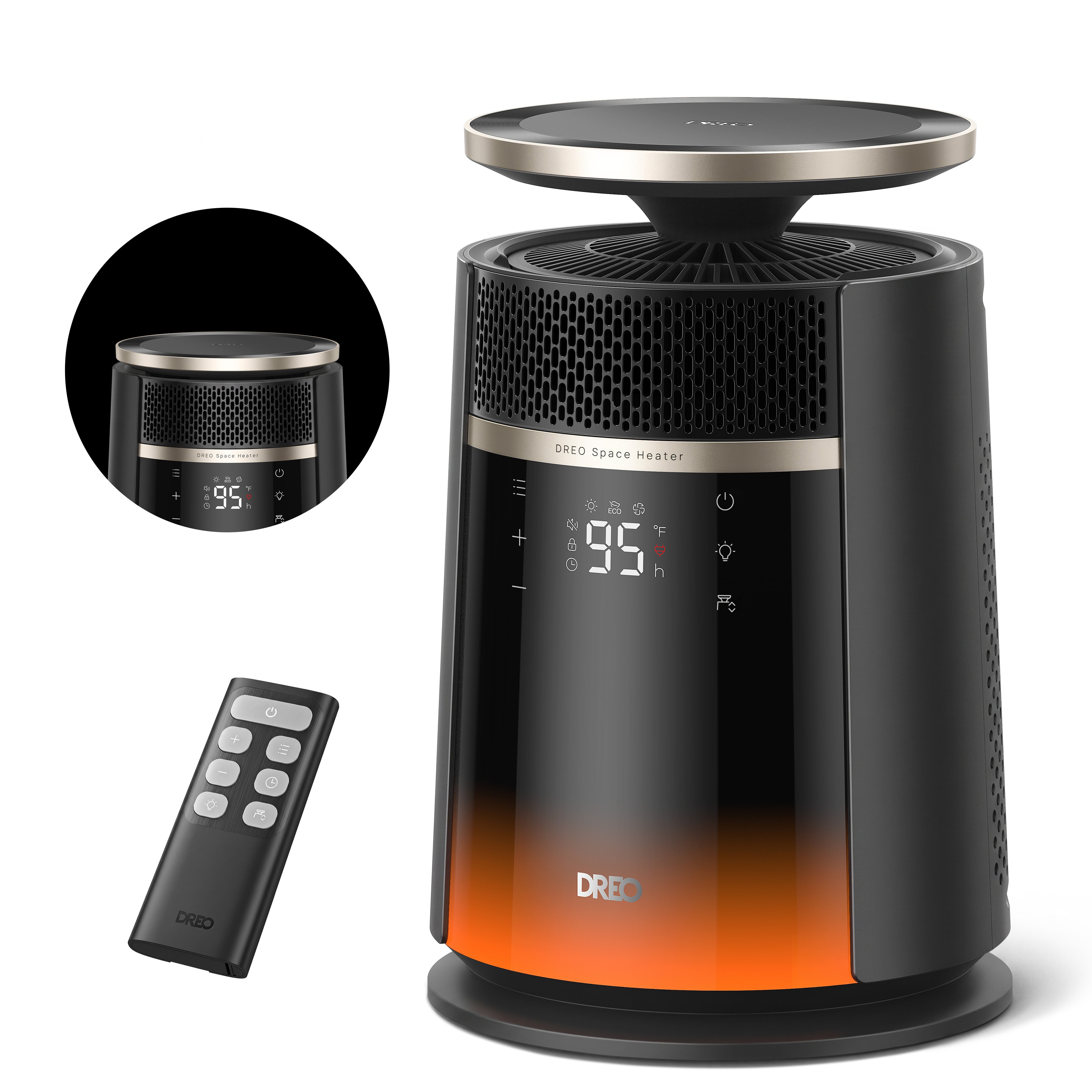
Explore this need in the finder →The DREO Whole-Room Heater 720 offers two outlet directions, focused or 360-degree, and a Fan mode as well as heating. Its US support model is DR-HSH040; the collection lists Silver 10-040401-001 and Black 10-040401-003. Both finishes were unavailable in the October 23, 2026 snapshot. Its distinction from the 725 is airflow choice, not higher heat output.
One heater, two airflow arrangements
DREO describes the 720 as a 1,500-watt PTC ceramic heater with three heat steps—900, 1,300 and 1,500 watts—and Heat, ECO and Fan modes. Its listed ECO target range is 41°F to 95°F in one-degree steps. These controls let you select fixed output or a target temperature, but the setpoint is not proof that the heater can bring every room to that temperature. The manufacturer comparison lists maximum airflow figures of 12.8 feet per second in Focused mode and 9.5 feet per second in 360-degree mode. These are manufacturer specifications, not independent measurements or a room-warming test.
The 360-degree setting and Focused outlet are distinct from oscillation: the official US comparison presents them as selectable airflow directions, not a motorized sweep angle. If you want a fan without heat, the US comparison also lists a Fan mode. The sources do not establish a count of fan-only speeds or named Natural/Sleep/Auto patterns, so a hard requirement for a particular number of speeds points instead to a model whose manual actually lists them, such as the MC706.
Choose it when direction matters more than documented body fit
The practical case for the 720 is an indoor spot where you may sometimes want broad distribution and sometimes want the heated stream aimed toward one part of the room. The 725 is the simpler counterpart: its US manual and product materials describe 360-degree-only output, no separate Fan mode and a 9.5-foot-per-second listed airflow figure. The difference is useful if focused heat is essential. It does not establish that either heater warms a room evenly, that the faster listed stream reaches a particular distance, or that the 720 produces a particular measured noise level.
Both US pages list the same three heat steps and 1,500-watt maximum. Both are fan-forced PTC heaters, not fanless convection panels. The 725's US manual cannot be borrowed for the 720: DREO's support page currently exposes only a Canada-labelled guide. Costco's US listing gives Silver DR-HSH040 body dimensions and a 120-volt listing, but it is not an operating manual and does not establish required clearances, exact timer behavior, frequency, all rating-label details or separate Black-SKU body dimensions; do not apply Canadian instructions to a US purchase.
Read “timer” cautiously for this US model
The US sales page lists a 12-hour timer. It does not establish whether the countdown stops a running heater, can start one from off, or behaves another way. If a scheduled start or a particular shutoff routine is essential, prefer a model whose US manual says what the control does. The 711 and 711S have documented 0–24-hour on/off countdowns; the 718's manual describes auto-off; and the MC706 manual says its timer can turn the appliance on or off. The 720 should not be treated as meeting one of those exact timer needs until its US instructions are available.
The listing shows a remote and ambient light, but does not establish phone-app control. A remote is not a connected control system. If app operation is essential, the wall-mounted Smart Convection Heater 711S has an explicit US manual basis for app use, but it is fanless and requires permanent mounting.
Check the missing fit and installation details first
Costco’s US listing identifies the Silver DR-HSH040 and gives an 8.66 × 8.66 × 11.81-inch body, 6.82-pound weight, 6-foot cord and 120 volts. These are retailer-listed specifications, not a manual or independent measurements; the page does not separately document the Black SKU’s dimensions. If a tight size limit is essential, verify the finish and unit you will buy. A short body still needs the manufacturer’s prescribed clearance. The DREO support route currently exposes only a Canada-labelled manual, so obtain the current US instructions before choosing a final position or relying on exact timer operation. Product availability is a dated snapshot and should be checked directly.
Where it fits among other DREO heaters
Choose the 720 if its two directions and Fan mode address a real need and you can confirm the exact US instructions before use. Choose the 725 if you prefer a fixed 360-degree outlet and value its available US manual, which explains three heat steps, ECO control, a shutoff countdown, a 30-second fan cooldown, safety protections and a three-foot clearance from walls or combustible materials. Consider the 718 for a shorter published body, simple three-speed fan-only controls and up to 120 degrees of oscillation, or the MC706 if twelve fan speeds and named airflow patterns matter. The 711 and 711S are genuinely fanless convection alternatives; the 711S must be mounted to a wall.
This is a document-based assessment, not a hands-on trial. Follow the current US DR-HSH040 manual and rating label; the Canada guide is not U.S. operating guidance. Coverage, warm-up time, savings, noise and customer experience were not independently tested.
DREO US product page · DREO model support page · Costco US DR-HSH040 listing (retailer physical specifications)
Key details at a glance
| Maximum listed input | 1500 W |
|---|---|
| US supply voltage | 120 V |
| Published body height | 11.81 in |
| Published body width | 8.66 in |
| Published body depth | 8.66 in |
| Published body weight | 6.82 lb |
| Installation form | Floor-standing and movable |
| Power-heat levels | 3 |
| Listed wattage values | 900 / 1300 / 1500 W |
| Separate fan-only mode | Yes |
| Maximum documented horizontal sweep | 0° |
| Temperature setting range | 41–95°F in 1°F increments |
| Timer behavior | US product pages list a 12-hour timer but the support route currently exposes only a Canada-labelled manual; the exact timer behavior of the US SKU, including any start-from-off behavior, is unresolved. Delayed start is therefore unknown, not a confirmed feature. |
| Fanless convection heating | No |
| Heated-air direction | panoramic_360 / focused |
Use the exact model’s instructions for operating limits, supplied equipment and version differences.
Sources for this assessment
- DREO US Whole-Room Heater 720 product page
- DREO US heater collection row for Whole-Room Heater 720
- DREO Whole-Room Heater 720 native Shopify product data
- DREO official Whole-Room Heater 720 support page
- DREO official heater series comparison page
- DREO official US 2026 winter launch comparison page
- DREO Tower Heater 720 manual, Canada, English/French
- Official CPSC exact-model recall query for DR-HSH040
- Official CPSC exact Silver SKU query for 720
- Official CPSC exact Black SKU query for 720
- Costco US DREO Whole-Room Heater 720 listing, model DR-HSH040
Check whether the room and routine line up.
Check room restrictions and full wall clearances first, then compare fan-only versus fanless heat, fit, app controls and the timer behavior the exact manual describes.