
Your needs, this model
Does it fit your priorities?
Can the 714 sweep horizontally and vertically with a 90° horizontal arc?
Yes. The US manual lists horizontal 30°/60°/90° and vertical 30°/60° choices with separate controls.
Explore this need in the finder →Can the 714 move air when you do not want heat?
Yes. The manual lists three fan-only levels, F1 through F3; this is separate from the fan used during heating.
Explore this need in the finder →Will the published 12.4-inch body fit a strict 13-inch height cap?
The product page publishes 12.4 inches of height, so the body fits that cap; the required operating clearance still needs much more space.
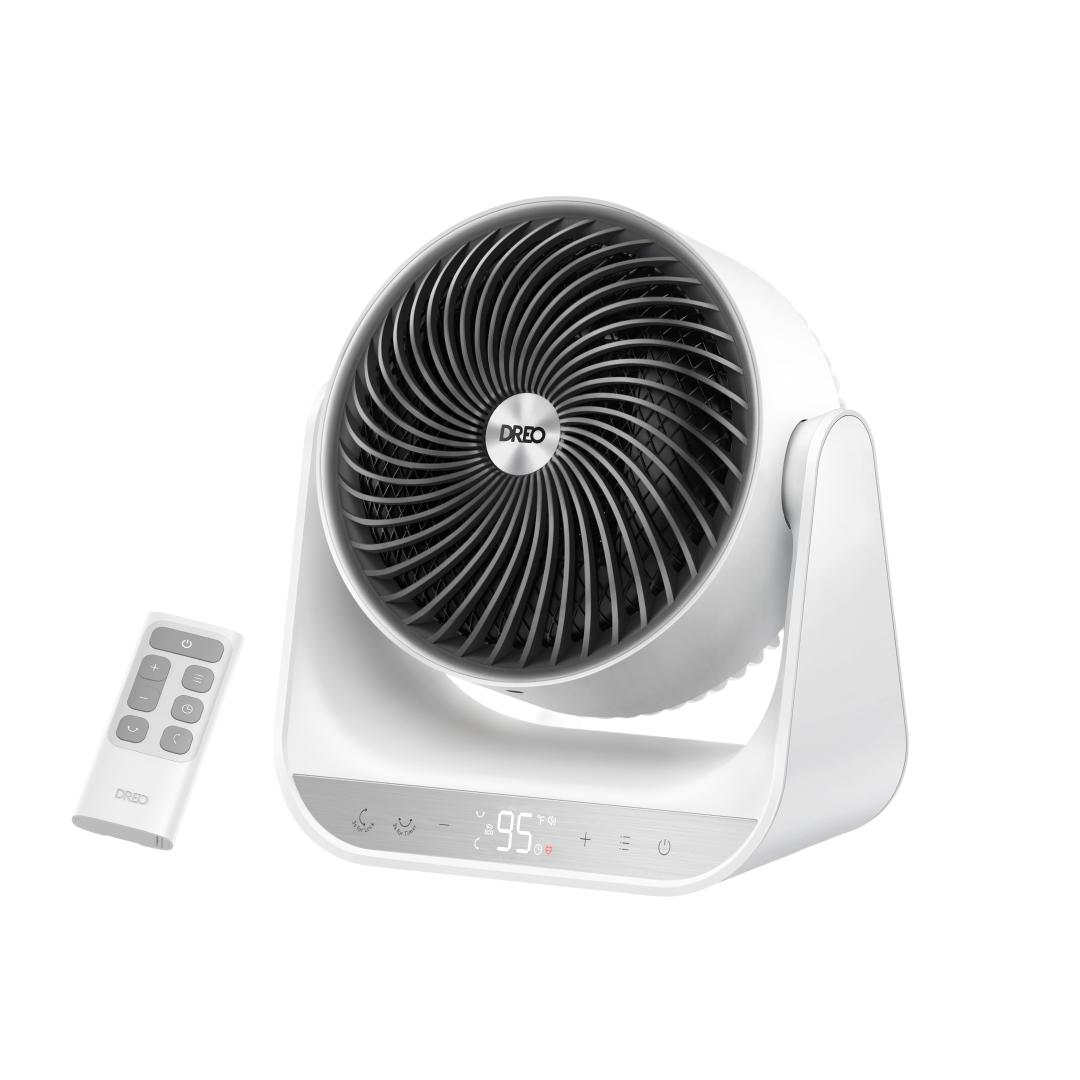
Explore this need in the finder →The DREO Whole-Room Heater 714 is a small, fan-forced PTC heater with two-axis oscillation, three heat levels, an ECO setpoint and a separate fan-only mode. Its exact US model is DR-HSH034. The DREO collection snapshot lists Black 10-04034-101 and Grey 10-04034-181 as unavailable, while White 10-04034-111 is available; those are finish variants, not different operating models.
What makes this model distinctive
The 714 moves its outlet in two directions. Its US manual lets you choose horizontal sweep of 30°, 60° or 90°, and vertical sweep of 30° or 60°; the two axes have separate controls, so the heater can sweep across a room, up and down, or stay fixed. That is more adjustable than a simple left-to-right oscillating fan. It is also not the same as a fixed 360-degree outlet: the moving head turns the stream through a selected arc rather than sending heat in every direction at once.
This is useful when furniture or a work area is arranged around one side of the heater and you want the airflow to pass through a defined zone. The front grille directs fan-forced air, so it can also run without heat. The manual calls the three fan-only settings F1, F2 and F3. During heating, choose H1 at 900 watts, H2 at 1,300 watts or H3 at 1,500 watts; ECO instead adjusts output around a target between 41°F and 95°F. Those are control choices, not an independent promise that a given room will reach or hold a temperature. Insulation, outdoor conditions, open doors and the central heating setting still matter.
A compact body still needs a clear operating zone
DREO publishes a body size of 11.02 inches deep by 7.09 inches wide by 12.4 inches high and a weight of 6.45 pounds. It is easier to move than a large floor tower, but those dimensions describe only the appliance. The US manual calls for a stable, dry, level surface and at least three feet in front of the heater, with the sides and rear kept clear of combustible items. Do not choose a shelf or narrow nook from the product picture alone; follow the complete manual clearances and check the outlet route before choosing a spot.
The manual rates the unit at 1,500 watts on 120V, 60Hz power. Plug it directly into a suitable wall outlet: DREO says not to use an extension cord or a relocatable power tap such as a power strip. A high-wattage heater can share a household circuit with other loads, so consider what else is running on that circuit rather than assuming a different plug or adapter makes the setup safe. The front surface gets very hot while running. The tip-over and overheat cutoffs are safeguards, not a reason to place the heater beside bedding, curtains, papers or a walking route.
Timer, memory and everyday controls
The remote and touch panel cover the same main controls. The timer is a 0–12-hour countdown that turns off a running heater; it is not a delayed start. A separate 24-hour continuous-operation shutoff exists but is disabled by default. After switching the heater off, its fan continues for 30 seconds to move out residual heat. The manual also says the unit resumes its previous settings after being switched off or unplugged, except for its timer setting. Use the child lock if you want to prevent button changes, but it is not a substitute for supervision around children.
DREO lists a 34 dB noise figure and a coverage range of 161–269 square feet on the US product information. Treat those as manufacturer claims, not measurements made for this review. The useful question is whether a compact fan heater with directional sweep fits the room and routine; a coverage number cannot account for a drafty doorway, a high ceiling or an open-plan layout. Phone-app control and a later start are not documented for this model, so neither should be treated as a confirmed feature.
Care and limits
For cleaning, switch off, unplug and let the heater cool. The US manual recommends a soft, dry cloth on the housing and a dry cloth or cotton-tipped swab for dust at the air inlet. Do not use sprays or abrasives, immerse the appliance or take it apart. It is for indoor household use; the manual excludes outdoor use and warns against bathrooms, laundry areas, damp locations and places where the unit could fall into water. If it tips, the display shows P4; overheat protection uses FF. Unplug it and follow DREO's instructions rather than repeatedly resetting a unit that continues to fault.
Who should choose the 714?
Consider the 714 if you want a compact portable heater that can run a fan without heat, offers explicit 30°/60°/90° horizontal and 30°/60° vertical movement, and publishes a body height that can be checked against a real space. Choose the related 715 only if its different fixed sweep range and unknown body dimensions work for you; its manual does not offer the same angle selections. If you want a stationary 360-degree outlet, compare the Whole-Room Heater 725. If you want focused or 360-degree output from one product, the 720 is the closer feature match, but the official support page currently links a Canada-labelled manual rather than a US guide. For fanless convection, look at the 711 or wall-mounted 711S instead; the 714's fan-only feature does not make its heat fanless.
This is a document-based assessment of model DR-HSH034, not a hands-on test. DREO's manual, US product listing and US support record support the model and operating details above. The maker's noise and coverage figures have not been independently measured, and room-heating performance was not tested.
DREO US product page · DREO model support page
Key details at a glance
| Maximum listed input | 1500 W |
|---|---|
| US supply voltage | 120 V |
| Published body height | 12.4 in |
| Published body width | 7.09 in |
| Published body depth | 11.02 in |
| Published body weight | 6.45 lb |
| Installation form | Floor-standing and movable |
| Power-heat levels | 3 |
| Listed wattage values | 900 / 1300 / 1500 W |
| Separate fan-only mode | Yes |
| Documented fan-only speeds | 3 |
| Maximum documented horizontal sweep | 90° |
| Temperature setting range | 41–95°F in ECO mode |
| Timer behavior | US DR-HSH034 manual: a 0–12h countdown stops a running heater; no delayed start is documented. Separate 24-hour continuous-run shutoff is disabled by default. After power-off, fan runs for 30 seconds. Previous settings are remembered except the timer. |
| Can the heater start on a timer? | No |
| Fanless convection heating | No |
| Control lock | Yes |
Use the exact model’s instructions for operating limits, supplied equipment and version differences.
Sources for this assessment
- DREO US native space-heater collection, page 1
- DREO US Whole-Room Heater 714 product page
- DREO Whole-Room Heater 714 native Shopify data
- DREO official Whole-Room Heater 714 support page
- DREO DR-HSH034 User Manual US
- CPSC official recall API query for DR-HSH034
- CPSC official recall API query for White SKU 10-04034-111
Check whether the room and routine line up.
Check room restrictions and full wall clearances first, then compare fan-only versus fanless heat, fit, app controls and the timer behavior the exact manual describes.