
Your needs, this model
Does it fit your priorities?
Can this heater move between rooms or sit on the floor?
No. The exact DR-HSH009BS manual requires wall installation and says not to prop up the heater or use it with the grille vertical.
Explore this need in the finder →Does the exact manual permit bathroom use?
No. It says the model is not intended for bathrooms, laundry areas, or similar locations and warns against locations where it could fall into water. FortPlug does not change that restriction.
Explore this need in the finder →Do you need FortPlug plug-area overheat protection, or an ALCI leakage-current interrupter?
The manual identifies FortPlug and a PP overheat trip. It does not document an ALCI TEST/RESET function for this model, so an essential ALCI requirement is not confirmed.
Explore this need in the finder →Must the exact documentation confirm a particular horizontal swing angle?
The manual lists 60, 90, 120 and oscillation outlet-angle controls without naming the axis. DREO’s page says top-to-bottom; a horizontal minimum remains unconfirmed.
Explore this need in the finder →Do you need a timed start rather than a shutoff countdown?
The local 0–24-hour countdown turns off a running heater. App scheduling is separate and provides planned heating periods.
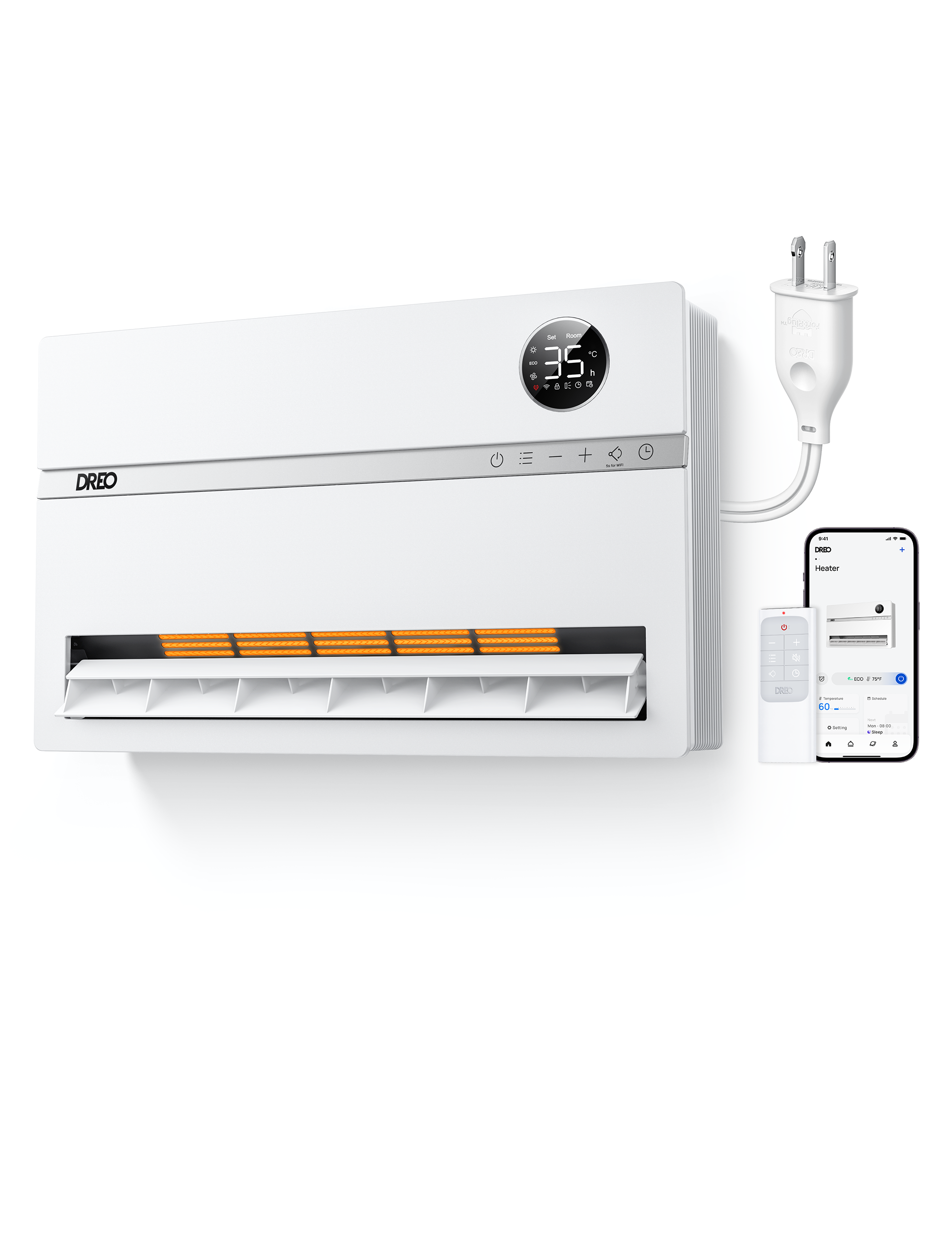
Explore this need in the finder →DREO’s Wall-mounted Heater 729BS is a fixed-wall, app-connected PTC fan heater, not a portable heater with an optional bracket. The current U.S. product record has one Default Title variant, SKU 10-04009-113. A DREO-branded manual copy identifies the appliance as DR-HSH009BS and tells the Wi-Fi setup flow to select WH729S. That bridge matters: 729BS is not the 739AS with its ALCI plug, nor the separate 517AS family.
Start with the wall and outlet, not the app
The exact DR-HSH009BS instructions require wall mounting before use and warn not to prop the heater up or run it with the grille vertical. Its package diagram shows a drilling guide, wall anchors, screws, and two base anchors. This is a permanent-location choice: skip it if you need to move heat between rooms or cannot drill and secure it appropriately. The installation diagram shows at least one foot above and below the unit and more than 0.65 foot at the sides; the safety pages keep combustibles three feet from the front and away from the sides and rear. Those constraints matter more than a slim-looking product image.
The rating page lists 1,500 watts at 120 volts and 60 hertz. The manual says to avoid a loose or aged receptacle, a shared outlet, and an extension cord; if FortPlug trips, its instructions say the supply current should exceed 15 amps. Household wiring and other loads vary, so ask a qualified electrician if you are unsure the circuit suits this heater. DREO describes it for indoor household use, and the manual says not to use it outdoors.
FortPlug is not bathroom approval
The 729BS’s distinctive plug feature is DREO’s FortPlug, described in its manual as restorable overheat protection at the plug. If the plug area overheats, the heater stops and the display shows “PP”; after unplugging, the instructions call for checking the receptacle and cord conditions before restoring power. That is a useful fault signal, not a promise that the outlet or wiring is safe in every installation. It is also not the same function as an appliance-leakage-current interrupter (ALCI) with TEST and RESET controls. The exact 729BS instructions do not document an ALCI feature, so do not pick it to meet an essential ALCI requirement.
More important, this feature does not make the heater suitable for a wet room. The exact manual says the heater is not intended for bathrooms, laundry areas, or similar indoor locations, and says never to place it where it could fall into a bathtub or other water container. Do not use it in a bathroom because it has a safety plug or because a retailer title sounds reassuring. If bathroom placement is non-negotiable, this is a no-fit; seek a heater whose exact instructions explicitly permit that setting.
Three heat levels, separate fan-only airflow
The manual gives three Power Heat steps: 900, 1,300, and 1,500 watts. ECO uses a 41–95°F target range, reducing or stopping heat as the sensed room temperature reaches the target. A separate Fan Only mode moves air without heat, so this is not a fanless convection panel. No independently tested room-coverage result is established here. Treat it as supplemental heat where a fixed wall position, safe clearances, and fan-forced airflow make sense—not a guaranteed replacement for primary heating.
DREO’s product page describes a 120-degree wide-angle flow from top to bottom. The manual’s own control panel calls the feature “Fan Angle” and lists 60°, 90°, 120°, and oscillation, without naming the motion axis. The evidence supports controllable outlet movement, but not a measured room-warming pattern or a specific horizontal sweep. If a particular side-to-side arc or a two-axis motion is essential, do not turn an ambiguous angle label into a match. The manual warns that manually moving the outlet fin can cause malfunction and fire risk; use the controls instead.
Schedules and everyday controls
The included remote and onboard panel cover basic operation. The manual also describes DREO app control, Wi-Fi setup, and links to Amazon Alexa or Google Assistant. App scheduling is separate from the local 0–24-hour countdown: the latter turns off a running heater; a schedule is the documented way to plan a later heating period. Do not expect the button timer alone to start the unit from off. Child lock and automatic dimming in low light are useful bedroom or family-room conveniences. DREO’s quietness and “fast heat” language remain maker claims, not independent measurements.
There is one practical documentation conflict worth checking before relying on spares: the manual’s rating panel identifies a CR2025, 3-volt remote battery, while the current DREO product-page box list says two AAA batteries. The remote itself is pictured in the manufacturer gallery, but the exact battery pack contents are not resolved by that mismatch. Confirm the remote and cell type supplied with the particular unit.
Who should shortlist it?
Consider the 729BS if you want dry-room wall heating, can install it securely with its listed clearances, and value app scheduling plus plug-area overheat protection. Pause if you need portability, fanless warmth, verified dimensions for a tight wall bay, a proven horizontal sweep, or an ALCI plug. Its sibling 739AS is a separate ALCI-equipped configuration, but its manual also warns against water; neither is a bathroom recommendation. Compare DREO’s 711S convection panel for fanless wall heat, or a floor-standing model if you need to move the heater.
This is a document-based assessment, not a hands-on test. It uses the DREO U.S. listing and native product data plus all 24 page scans of a DREO-branded DR-HSH009BS manual mirrored by ManualsFile; the manual host is not a DREO domain. For the plug distinction, read the 729BS vs 739AS comparison. Then consult the current DREO 729BS listing alongside the model-specific manual copy, and follow the printed instructions packaged with the exact heater you receive.
Key details at a glance
| Maximum listed input | 1500 W |
|---|---|
| US supply voltage | 120 V |
| Installation form | Fixed wall installation |
| Exact manual permits bathroom use | No |
| Power-heat levels | 3 |
| Listed wattage values | 900 / 1300 / 1500 W |
| Separate fan-only mode | Yes |
| Temperature setting range | 41-95 F in 1 F increments |
| Timer behavior | Manual describes local 0-24-hour countdown auto-off for an already-running heater. App schedule is separate and is the documented way to plan a later heating period; local timer alone is not a delayed start. |
| Can the heater start on a timer? | Yes |
| Phone-app control | Yes |
| Minimum wall clearance above | 12 in |
| Minimum wall clearance at each side | 7.8 in |
| Minimum wall clearance below | 12 in |
| Fanless convection heating | No |
| Heated-air direction | |
| Manual vertical outlet tilt | No |
| FortPlug plug-area overheat cutoff | Yes |
| Control lock | Yes |
Use the exact model’s instructions for operating limits, supplied equipment and version differences.
Sources for this assessment
- DREO U.S. Wall-mounted Heater 729BS product page
- DREO native Shopify JSON for Wall-mounted Heater 729BS
- DREO native U.S. heater collection row for Wall-mounted Heater 729BS
- DREO-branded DR-HSH009BS manual scan page 01 of 24
- DREO-branded DR-HSH009BS manual scan page 02 of 24
- DREO-branded DR-HSH009BS manual scan page 03 of 24
- DREO-branded DR-HSH009BS manual scan page 04 of 24
- DREO-branded DR-HSH009BS manual scan page 05 of 24
- DREO-branded DR-HSH009BS manual scan page 06 of 24
- DREO-branded DR-HSH009BS manual scan page 07 of 24
- DREO-branded DR-HSH009BS manual scan page 08 of 24
- DREO-branded DR-HSH009BS manual scan page 09 of 24
- DREO-branded DR-HSH009BS manual scan page 10 of 24
- DREO-branded DR-HSH009BS manual scan page 11 of 24
- DREO-branded DR-HSH009BS manual scan page 12 of 24
- DREO-branded DR-HSH009BS manual scan page 13 of 24
- DREO-branded DR-HSH009BS manual scan page 14 of 24
- DREO-branded DR-HSH009BS manual scan page 15 of 24
- DREO-branded DR-HSH009BS manual scan page 16 of 24
- DREO-branded DR-HSH009BS manual scan page 17 of 24
- DREO-branded DR-HSH009BS manual scan page 18 of 24
- DREO-branded DR-HSH009BS manual scan page 19 of 24
- DREO-branded DR-HSH009BS manual scan page 20 of 24
- DREO-branded DR-HSH009BS manual scan page 21 of 24
- DREO-branded DR-HSH009BS manual scan page 22 of 24
- DREO-branded DR-HSH009BS manual scan page 23 of 24
- DREO-branded DR-HSH009BS manual scan page 24 of 24
- DREO product-gallery rendering for Wall-mounted Heater 729BS
- CPSC ProductModel lookup for DREO 729BS DR-HSH009BS
- CPSC ProductModel lookup for DREO 729BS WH729S
- CPSC ProductModel lookup for DREO 729BS 10-04009-113


Check whether the room and routine line up.
Check room restrictions and full wall clearances first, then compare fan-only versus fanless heat, fit, app controls and the timer behavior the exact manual describes.