
Your needs, this model
Does it fit your priorities?
Will the Atom 416 move air without producing heat?
Yes. The US manual lists a separate Fan Only mode. It does not state a count of separately selectable fan-only speeds.
Explore this need in the finder →Will the listed heater body fit beneath a 10-inch height limit?
DREO lists 9.88 inches of body height, which is below a 10-inch cap. This does not include operating clearance.
Explore this need in the finder →Can its timer start the heater later, before I enter the room?
No later start is documented. The US manual describes a 0–12-hour countdown to turn off a running heater.
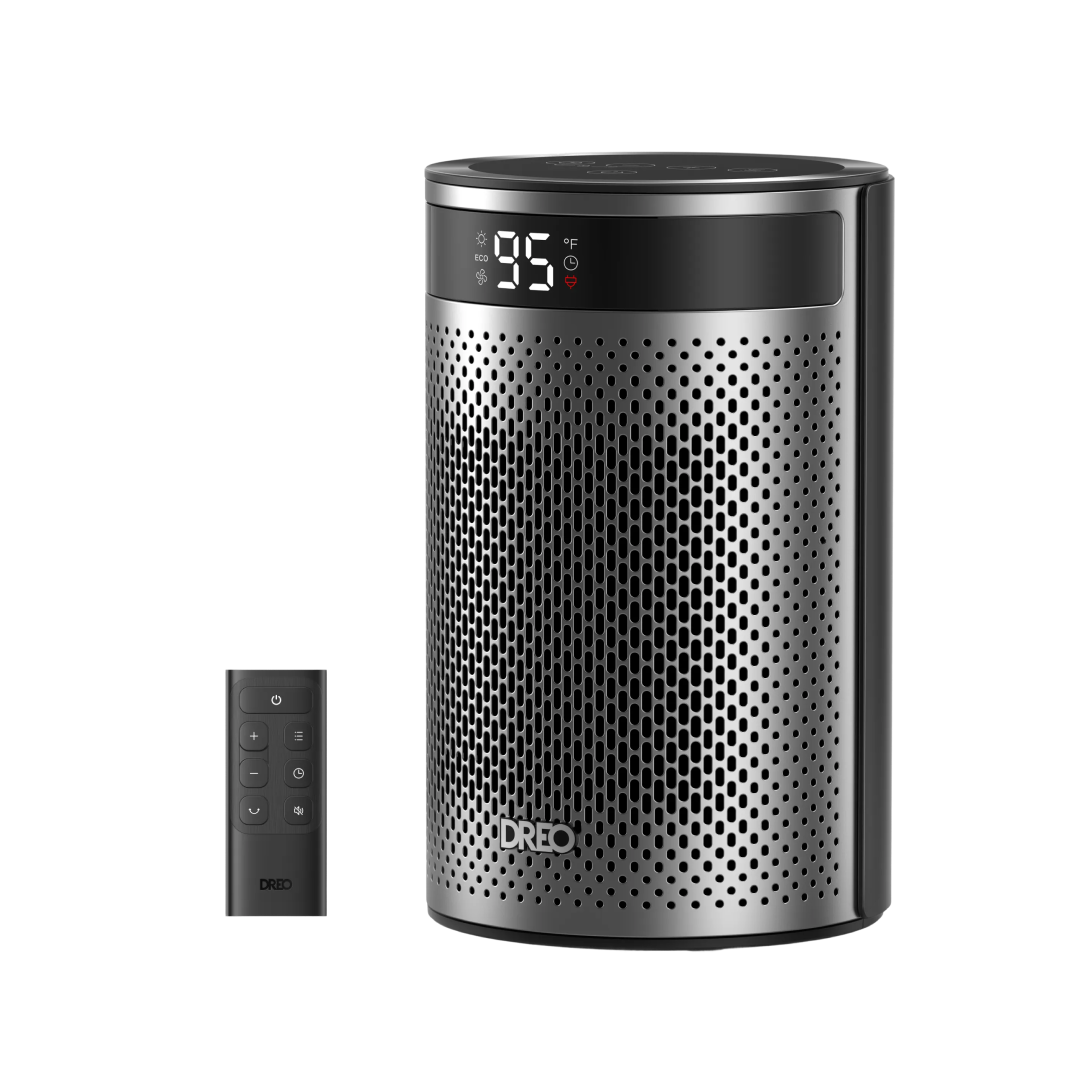
Explore this need in the finder →DREO sells the Atom 416 as a compact portable ceramic fan heater. Its US product page names it “Heater Atom 416,” while the matching user manual calls it a PTC Fan Heater Atom 416 and identifies the electrical model as DR-HSH030. The DREO US collection record has one default variant, SKU 10-04030-101; there is no finish option in that record. This exact model identity matters because a similar model number can conceal different controls or safety instructions.
A small, upright body with simple heat modes
DREO lists the body at 9.88 inches high, 6.1 inches wide and 6.02 inches deep, with a weight of 3.19 pounds. It is a modest object to carry and store, and noticeably shallower than the DREO Heater 320 body. Those are appliance dimensions, not the safe operating envelope: the manual still calls for clear space around the hot air outlet and the housing. Keep the full clearance in mind when planning a spot, rather than treating a short body as a license to tuck it beside bedding, paper or furniture.
The US manual rates the DR-HSH030 at 1,500 watts on 120 volts, 60 hertz. Power Heat offers three steps: 1,000, 1,300 and 1,500 watts. ECO is a separate thermostat-controlled mode with a selectable target from 41°F to 95°F; the heater cycles as room temperature changes. Fan Only is also a separate mode, for moving room air without turning on the heat. The manual does not list several selectable fan-only speeds, so do not assume that the fan can be fine-tuned like a multi-speed air circulator. Heating itself is fan-driven, not quiet fanless convection.
Compact does not mean aim-adjustable
The documents make a clearer case for small dimensions than for moving the outlet. The Atom 416’s US product feature list and the DR-HSH030 manual describe the power, ECO and fan-only controls but do not document a manual tilt angle or a powered oscillation arc. Treat either movement feature as unconfirmed if it is essential. The Heater 320 is a more explicit choice for manual up-and-down aiming: its US documentation lists a 0–60° hand-set tilt. For a heater that is documented to sweep horizontally, DREO’s Whole-Room Heater 517 lists powered 70° horizontal oscillation and a separate manual vertical adjustment. Those are meaningful differences, not cosmetic upgrades.
Its timer shuts off a running heater
The Atom 416’s timer is a 0–12-hour auto-off countdown set while the heater is running. It is not a scheduled start that warms a room before you arrive. A separate 24-hour continuous-run shutoff is off by default; the manual explains how to enable or disable it from standby. After the normal power-off command, the fan runs for about 30 seconds to clear residual heat. ECO can stop heating when the selected target is reached and resume when the room cools, but it is still a temperature-control mode, not a calendar or remote-start schedule.
The control panel and supplied remote cover the basics: heat level or target temperature, mode, timer, display, mute and child lock. The manual says the display can be switched off with the remote; the child lock is toggled by a long button press. It also describes a memory function for the previous temperature and working mode. The package diagram shows a remote and two AAA batteries. None of this requires a phone app; app control is not documented in the US materials reviewed.
Placement limits are part of the product choice
The DR-HSH030 manual is explicit about where this heater does not belong. It prohibits outdoor use and use in bathrooms, laundry areas and similar locations, and warns against a position where water could reach it. Set it on a stable, secure surface; do not use a soft surface that can block an air opening. Keep combustible material at least three feet from the front and away from the sides and rear. The front surface can become very hot. Plug the unit directly into a wall receptacle: the manual says not to use an extension cord or a relocatable power strip.
Tip-over and overheat shutoffs are documented safeguards, not permission to ignore those instructions. For cleaning, turn the unit off, unplug it and let it cool. The manual recommends a soft dry cloth for the exterior and a dry cloth or cotton-tipped swab for the inlet; it prohibits cleaning agents, abrasive scrubbers, water intrusion and user disassembly. Repairs beyond cleaning belong with an authorized service representative.
Who should shortlist it?
Choose the Atom 416 when a compact floor-portable PTC heater, three heat outputs, a 41–95°F ECO target, separate fan-only operation and a simple remote matter more than documented air sweep or angle adjustment. Its 1,000-watt low setting is higher than the Heater 320’s documented 900-watt low step, while its body is slightly shorter and shallower. Choose the 320 instead when a verified manual tilt or lower 900-watt heat step matters; consider the 517 if a documented horizontal sweep is a must. If you need fanless heat, an outdoor or bathroom appliance, a delayed start, app control as an essential capability, or a promise that a room of a certain size will reach a particular temperature, this model is not established as a fit. DREO advertises coverage up to 200 square feet, but room insulation, layout, outdoor temperature and the home’s heating system affect results; this is not an independent room test.
DREO Heater Atom 416 product page · DR-HSH030 US user manual
Key details at a glance
| Maximum listed input | 1500 W |
|---|---|
| US supply voltage | 120 V |
| Published body height | 9.88 in |
| Published body width | 6.1 in |
| Published body depth | 6.02 in |
| Published body weight | 3.19 lb |
| Installation form | Floor-standing and movable |
| Exact manual permits bathroom use | No |
| Power-heat levels | 3 |
| Listed wattage values | 1000 / 1300 / 1500 W |
| Separate fan-only mode | Yes |
| Temperature setting range | 41–95°F in 1°F steps in ECO mode, per DREO's US product page |
| Timer behavior | The DR-HSH030 US manual documents a 0–12-hour auto-off countdown for a running heater, not a delayed start. A separate 24-hour continuous-run shutoff is off by default; it can be enabled or disabled from standby. The fan continues for about 30 seconds after normal power-off. |
| Can the heater start on a timer? | No |
| Fanless convection heating | No |
| Heated-air direction | |
| Control lock | Yes |
Use the exact model’s instructions for operating limits, supplied equipment and version differences.
Sources for this assessment
Check whether the room and routine line up.
Check room restrictions and full wall clearances first, then compare fan-only versus fanless heat, fit, app controls and the timer behavior the exact manual describes.