
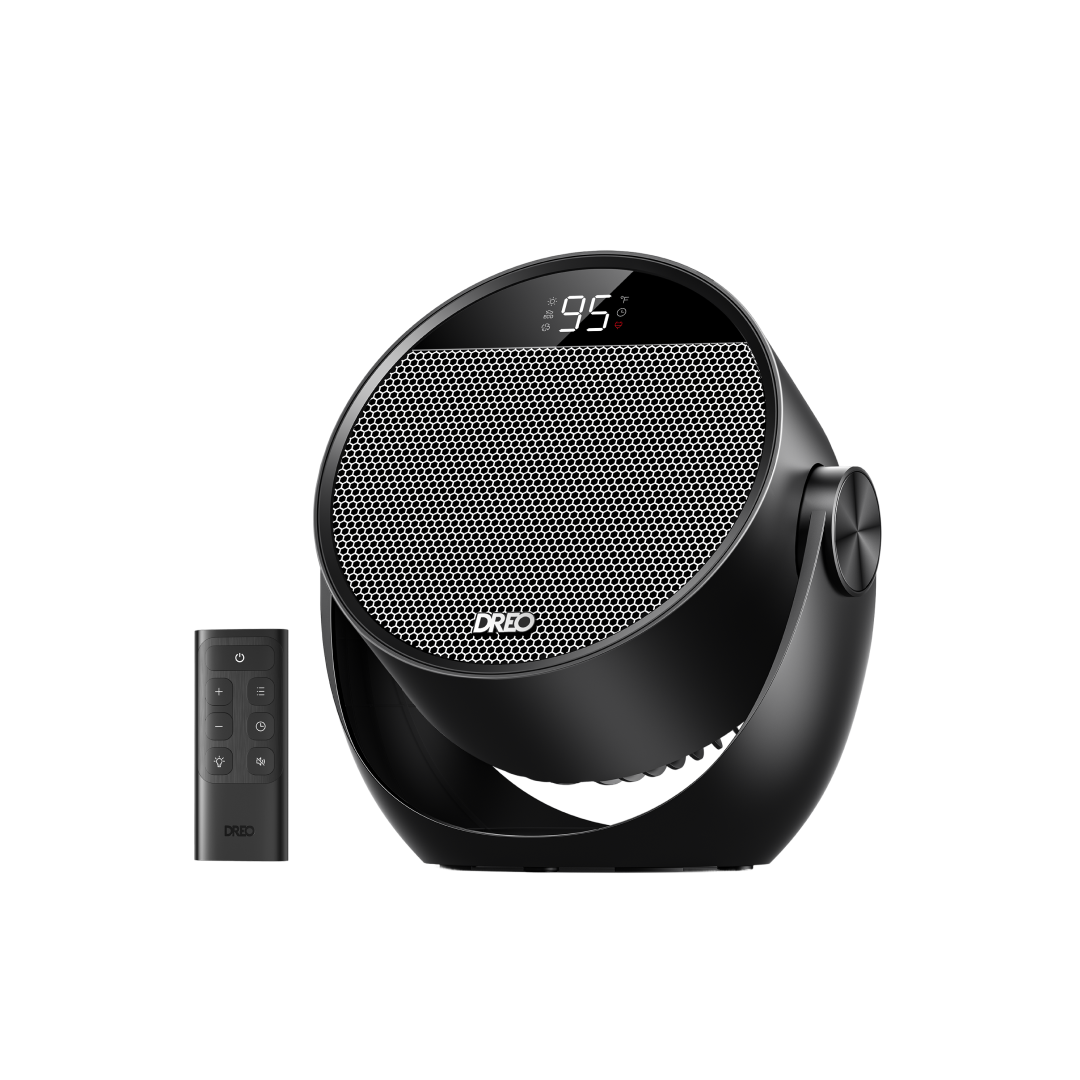
Your needs, this model
Does it fit your priorities?
Can I manually aim the Heater 320's outlet upward or downward?
Yes. The US product page and DR-HSH020 manual document a 0–60° manually adjustable vertical tilt; they do not establish powered vertical movement.
Explore this need in the finder →Will this heater move room air without running its heating element?
Yes. Its US manual lists a distinct fan-only mode with three speeds, F1 through F3. Heating itself still uses forced airflow.
Explore this need in the finder →Will its listed body fit under an 11-inch height limit?
The DREO product listing gives a 10.12-inch body height, which fits that body cap. This is not a clearance measurement; the manual still requires three feet in front of combustible material.
Explore this need in the finder →Can its timer start the heater later, before I enter the room?
No later start is documented. The US manual describes the timer as a countdown that shuts off a running heater.
Explore this need in the finder →DREO sells this compact black heater as the Heater 320. Its support page calls it Ceramic Heater 320, and the US manual cover says PTC Fan Heater Atom 320; the support record and manual identify the same standard model, DR-HSH020. The US collection record lists one finish, Black, SKU 10-04020-101. The name changes across DREO's materials, so check the model label rather than matching on “320” alone.
A small body with adjustable up-and-down aim
The feature that gives the 320 a clear job is its hand-set vertical tilt. DREO lists a 0–60-degree range, letting you point the front outlet toward a seated work area or a lower seating position when the heater is placed safely. This is manual adjustment, not powered up-and-down movement. The US materials inspected do not document an automatic horizontal sweep either. If you want the heater to move its outlet across more than one direction without repositioning it, the Whole-Room Heater 517 adds 70-degree powered horizontal oscillation; the 714 and 715 document powered motion on both axes.
The listed body is 9.65 inches deep, 5.71 inches wide and 10.12 inches high, at 3.54 pounds. That makes it easier to measure into a low storage spot or carry between rooms than a tall tower, but those dimensions describe only the appliance. They do not describe its operating clearance. The manual says to use a flat, stable surface, keep combustible material at least three feet in front, and keep it away from the sides and rear. Leave the space it needs even when the housing itself looks small.
Heat, ECO and fan-only modes are separate jobs
The exact US DR-HSH020 manual rates the PTC fan heater at 1,500 watts on 120 volts, 60 hertz. Its three heat settings are 900, 1,300 and 1,500 watts. ECO mode accepts a target from 41°F to 95°F in one-degree steps and cycles the heater according to the sensed temperature; that thermostat cannot guarantee a target in an open, drafty or oversized space. A separate fan-only mode has three speeds, F1 through F3, for moving existing room air without producing heat. The heating itself remains fan-forced, not fanless convection.
Choose it if you want those basic controls in a short, light body and will use the manual tilt as a set-and-leave aiming adjustment. If quiet still-air warmth matters more than a blower, compare the fanless Convection Heater 711 or wall-mounted 711S. If a heater must distribute warmth by a powered sweep, the 517 or a two-axis 714/715 better fits that requirement. Those are different ways of moving heated air, not performance ratings for a particular room.
Timer and remote: shutoff, not a scheduled start
The included remote uses the supplied CR2025 coin cell. Its timer sets an auto-off countdown from zero to twelve hours while the heater is running; the manual does not document a future start. There is also a separate 24-hour continuous-run shutoff, disabled by default. After a normal power-off command, the fan continues for about 30 seconds to cool the heater. That brief run-on is part of the appliance's operation, not a cooling or air-conditioning mode.
Placement limits outweigh the small footprint
The US manual prohibits outdoor use and use in bathrooms, laundry areas or similar locations. It also warns against soft surfaces where openings could be blocked, requires a direct wall receptacle rather than an extension cord or power strip, and notes that the front surface becomes very hot. The manufacturer lifestyle images show the appliance beside beds, tables and desks; treat them as product imagery, not as permission to ignore the manual's clearances. Do not place it where bedding, papers, curtains or other combustible material can approach the hot front. Tip-over and overheat protections are safeguards, not a substitute for suitable placement or supervision.
For care, switch it off, unplug it and let it cool. Wipe the outside with a soft dry cloth and use a dry cloth or cotton-tipped swab at the air inlet. The manual says not to use cleaning agents or abrasive scrubbers, immerse the unit, allow water inside, or unscrew the heater. It recommends unplugging when the heater is not in use and contacting authorized service for repairs.
Who should consider the Heater 320?
Shortlist the Heater 320 when you need a portable indoor fan heater with a genuinely compact body, a manually adjustable vertical outlet, three heat levels, ECO control and a separate three-speed fan-only mode. It is a poor match for a bathroom, a location without the required open space, fanless heating, remote starting, app control as an essential feature, or motorized multi-axis movement. DREO's product page advertises quick heating and a 34 dB sound figure; those are manufacturer claims, not independent measurements, and they do not establish room-heating capacity. This assessment is based on the US product record and DR-HSH020 manual, not a room test.
DREO Heater 320 product page · DREO Ceramic Heater 320 / DR-HSH020 support page · DR-HSH020 US user manual
Key details at a glance
| Maximum listed input | 1500 W |
|---|---|
| US supply voltage | 120 V |
| Published body height | 10.12 in |
| Published body width | 5.71 in |
| Published body depth | 9.65 in |
| Published body weight | 3.54 lb |
| Installation form | Floor-standing and movable |
| Exact manual permits bathroom use | No |
| Power-heat levels | 3 |
| Listed wattage values | 900 / 1300 / 1500 W |
| Separate fan-only mode | Yes |
| Documented fan-only speeds | 3 |
| Temperature setting range | 41–95°F in 1°F increments in ECO mode |
| Timer behavior | The US DR-HSH020 manual describes a 0–12-hour countdown shutoff for a running heater, not a delayed start. A separate 24-hour continuous-run shutoff is disabled by default. The fan continues for about 30 seconds after power-off. |
| Can the heater start on a timer? | No |
| Fanless convection heating | No |
| Heated-air direction | |
| Manual vertical outlet tilt | Yes |
| Manual tilt range | 60° |
| Control lock | Yes |
Use the exact model’s instructions for operating limits, supplied equipment and version differences.
Sources for this assessment
Check whether the room and routine line up.
Check room restrictions and full wall clearances first, then compare fan-only versus fanless heat, fit, app controls and the timer behavior the exact manual describes.