
Your needs, this model
Does it fit your priorities?
Can the standard 711 provide fanless convection heat without a fan-only breeze?
Yes. Its manual and product listing identify fanless convection, but there is no separate fan-only mode. It heats without providing an unheated air stream.
Explore this need in the finder →Can the standard 711 timer turn the heater on later?
Yes. With the heater off, the manual says to set its 0–24-hour timer; the heater turns on when the countdown ends. This is different from its separate 24-hour auto-off setting, which is not enabled by default.
Explore this need in the finder →Can the standard 711 stay movable on its caster wheels?
Yes. The US manual instructs you to fit both supplied caster wheels and operate the heater upright; unplug it and let it cool before moving it by its handle.
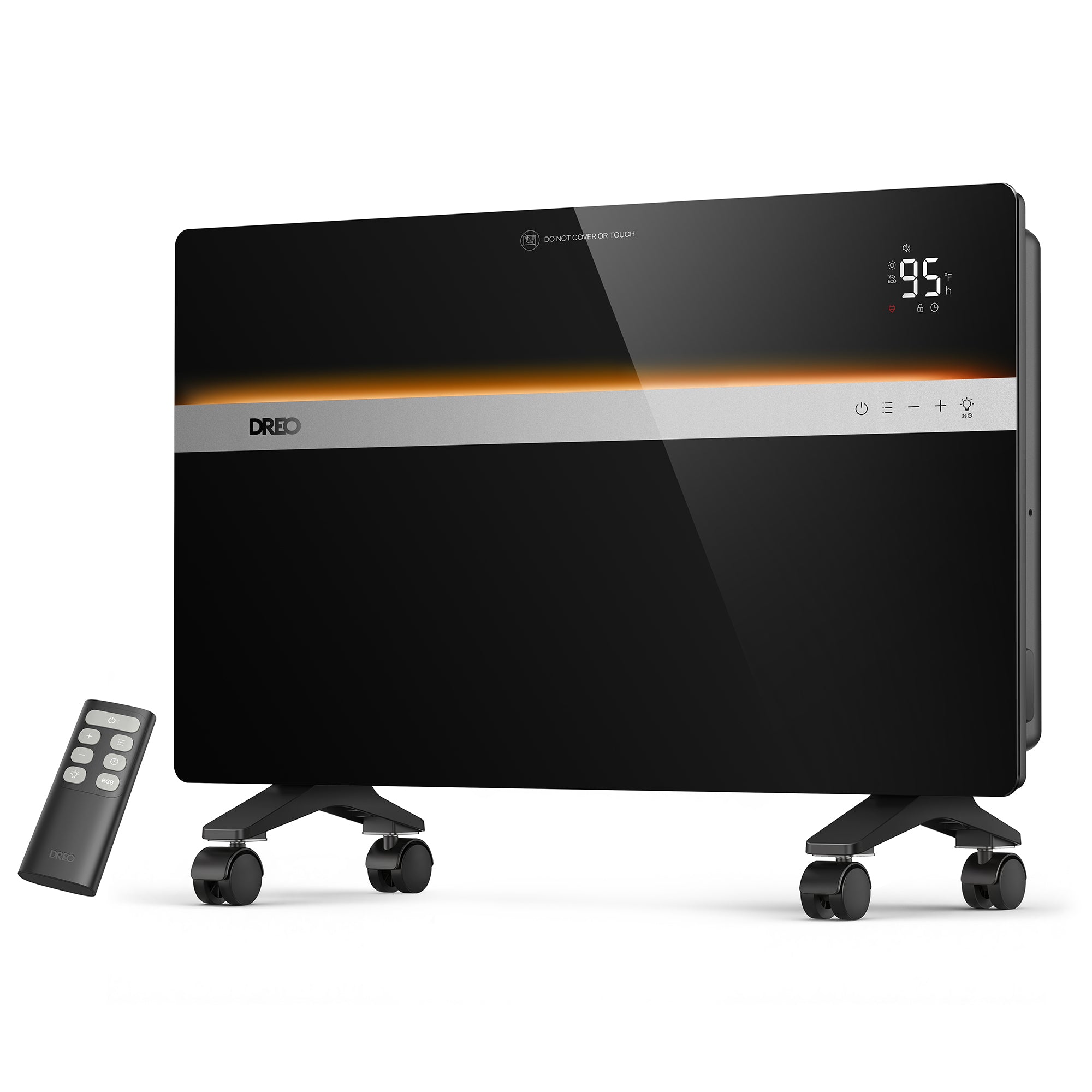
Explore this need in the finder →The DREO Convection Heater 711 is the floor version of the maker’s flat, fanless panel design. Its caster wheels and handle make it easier to relocate than a mounted heater, but they do not turn it into a fan: this model has no separate fan-only setting, no selectable air speeds and no oscillation. Choose it for controlled supplemental warmth in one indoor spot, not for moving air around a room.
What three heat levels and ECO mode actually change
The DR-HSH041 manual identifies three power-heat steps: 900, 1,100 and 1,500 watts. In ECO mode the heater adjusts power against a set temperature from 41°F to 95°F, in one-degree increments, and switches off after reaching that target. The distinction is practical: Power Heat lets you select a fixed output level, while ECO aims at a chosen temperature. A setting range is a control feature, not a claim that the panel can heat every room to that temperature.
DREO calls it fanless whole-room convection. Air warmed by a convection heater moves without a motor-driven fan, which avoids the fan noise and direct air stream associated with a tower fan-heater. It also means there is no fan-only breeze for summer, no fan speed to tune, and no motorized swing to broaden airflow. I would not treat the word “whole-room” or the maker’s energy-saving language as independent proof of room coverage, heating time or electricity savings: the product documents provide no controlled comparative test for a particular space.
Wheel-mounted and movable, but not a wall heater
The package includes two caster wheels, and the manual explains how to attach them using the pre-installed screws. It explicitly warns not to operate the heater until those wheels are properly installed and says to use the appliance upright. Let it cool and unplug it before moving it by the handle. This set-up suits someone who wants a panel that can be rolled between rooms; it is not a safe substitute for anchoring a wall heater or propping the unit against furniture.
The manual and live product page reviewed here do not provide a reliable body-width, depth or weight specification, so a product photograph is not enough to decide whether it fits a narrow gap. Measure only after finding the correct version’s full dimensions from its seller or maker, then preserve the clearance and location rules in the supplied instructions. The current US manual also does not identify a supply voltage on the pages reviewed. Its 1,500-watt maximum is useful for estimating load, but not a replacement for checking the unit label and the circuit that will serve it.
Timer behavior is broader than a simple auto-off
The 711’s timer runs from zero to 24 hours. While the heater is running, a timer can stop it after the chosen interval; while it is off, the manual says that setting the timer starts it when the countdown ends. That makes a delayed start a documented feature on this standard version. Keep it separate from the 24-hour continuous-run auto-off: that protection setting is not on by default. The timer itself is not the same as an app schedule, and the standard 711’s product and manual do not establish phone-app control.
The remote can change the basic heat and timer settings from across the room, and the front ambient-temperature indicator gives a glanceable signal in addition to the display. A child lock disables the buttons on the heater, not the remote, according to the manual. Those controls add convenience but do not eliminate the need to use the unit as instructed, check it during operation and keep its cord and surrounding space clear.
Which 711 should you choose?
The product name is easy to misread beside the similarly named 711S. They are not merely color variants. The standard 711 reviewed here (model DR-HSH041) comes with caster wheels and is intended to operate upright on the floor. The 711S (DR-HSH041S) is the Smart Convection Heater; its US manual requires a wall bracket and prescribed clearance, and adds Wi-Fi app controls and scheduling. Pick the standard 711 when moving a heater between approved floor locations matters more than app access. Pick the 711S only if permanent mounting, the wall it needs and its clearances all work.
If moving air without heat is essential, look instead at a fan-equipped model. The Tower Heater 718 has a simple fan-only mode and selectable oscillation, while the MC706 adds more fan speeds and named airflow patterns. Those towers take more floor space and use forced airflow; this convection panel’s appeal is the quiet, fanless heating approach rather than a second life as a fan. If neither placement form nor timer behavior is a must-have, compare it with the shorter Solaris Max (2nd Gen.) and the other reviewed heaters through the finder.
What the paperwork does not promise
This assessment is based on DREO’s US listing, the exact DR-HSH041 support record and its US user manual—not a hands-on trial. The documents establish controls, output steps, wheel assembly and timer behavior, but they do not support claims about measured sound levels, energy savings, exact coverage, warm-up speed or the quality of warmth at a given distance. Check the model suffix and package details on an offer: the wall-mounted 711S has a different installation plan, and its features should not be assumed for the standard wheeled 711.
Key details at a glance
| Maximum listed input | 1500 W |
|---|---|
| Installation form | Floor-standing and movable |
| Power-heat levels | 3 |
| Listed wattage values | 900 / 1100 / 1500 W |
| Separate fan-only mode | No |
| Documented fan-only speeds | 0 |
| Maximum documented horizontal sweep | 0° |
| Temperature setting range | 41–95°F in 1°F increments |
| Timer behavior | Manual documents a 0–24-hour timer that turns the heater off when it is running or starts it when it is off; separate 24-hour continuous-operation auto-off is not enabled by default. |
| Can the heater start on a timer? | Yes |
| Fanless convection heating | Yes |
| Control lock | Yes |
Use the exact model’s instructions for operating limits, supplied equipment and version differences.
Sources for this assessment
- DREO Convection Heater 711 US product page
- DREO US heater collection native record for Convection Heater 711
- DREO Convection Heater 711 product data
- DREO official Convection Heater 711 standard support page
- DREO Convection Heater 711 US user manual, DR-HSH041, revision 1.1
- CPSC model query for DREO DR-HSH041 (empty on check date)
- CPSC variant SKU query for DREO 711 Black SKU 10-040411-004
- CPSC variant SKU query for DREO 711 Silver SKU 10-040411-003
Check whether the room and routine line up.
Check room restrictions and full wall clearances first, then compare fan-only versus fanless heat, fit, app controls and the timer behavior the exact manual describes.