
On this page
Your needs, this model
Does it fit your priorities?
Does the thermostat use a lower stage after reaching the set temperature?
In AUTO it runs on HIGH to the target, then LOW for ten minutes before switching off when the room is at or above the setpoint. The wattage of LOW is not stated.
Explore this need in the finder →Can a buyer require the DR-999 Low setting to be no more than 1,000 W?
No reliable wattage mapping is provided for the DR-999 LOW stage, so it cannot meet an essential numeric cap.
Explore this need in the finder →Does the DR-999 timer turn the heater off after a set period?
Yes. Its remote offers a one-to-twelve-hour countdown for a running unit, not a delayed start.
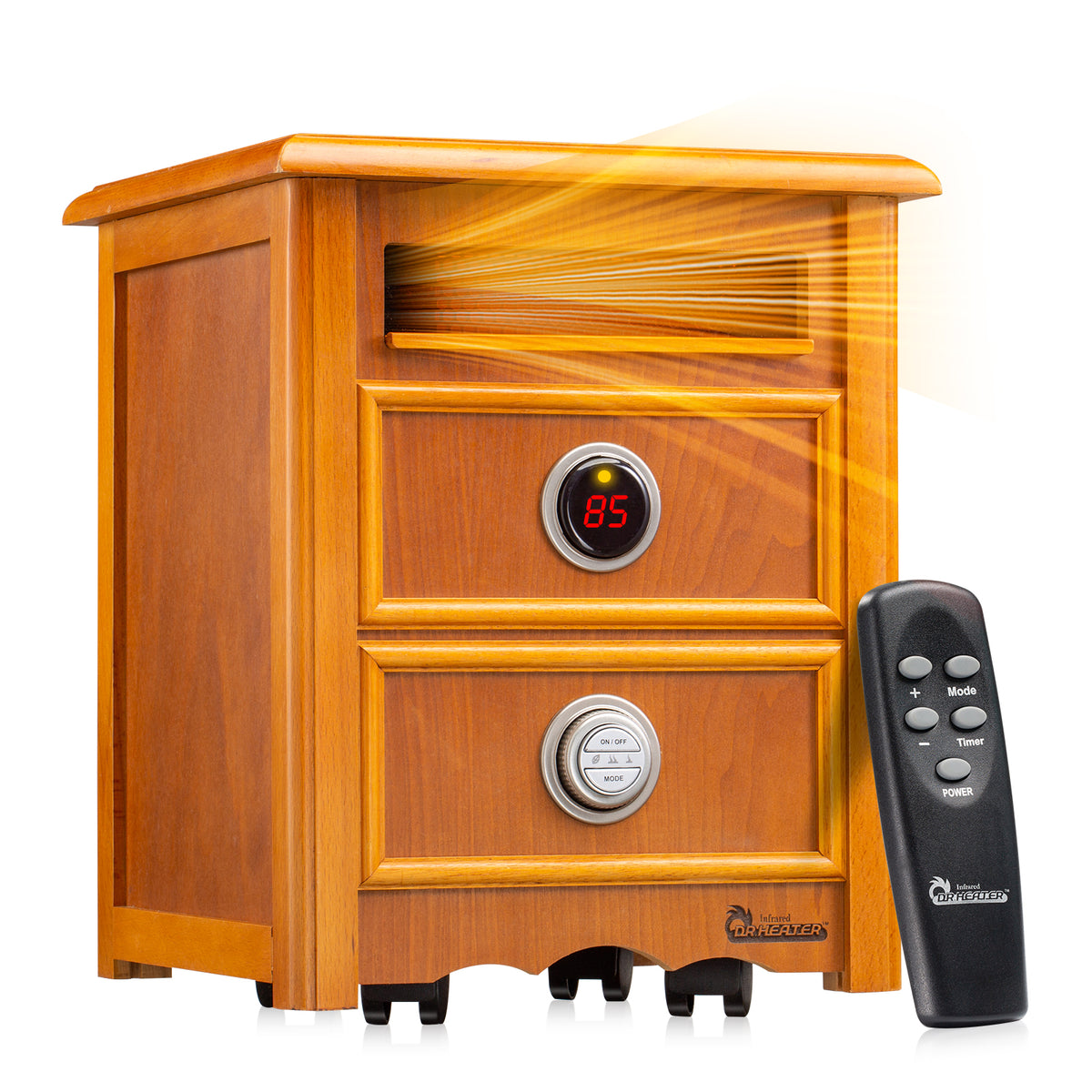
Explore this need in the finder →The Dr. Infrared Heater DR-999 is the nightstand-style member of this portable infrared heater family. Its U.S. product page identifies a furniture-like cabinet and a 1,500-watt heater; the current collection snapshot marked the exact DR-999 SKU unavailable. That stock status is recorded as observed, not as a reason to omit the model or imply current inventory elsewhere. The product is a heater with a decorative cabinet, not a usable bedside table.
The useful distinction is the thermostat sequence
The DR-999 manual documents two heat settings, a remote and an automatic thermostat. In AUTO, the heater runs on HIGH until the room reaches the selected temperature, switches to LOW for ten minutes, and then turns off if the temperature is at or above the setting. The fan continues briefly to remove residual heat. This sequence can reduce output after the setpoint is reached, but the manual does not give a wattage for the named LOW stage. A buyer with a strict low-wattage cap should not assume the stage is 1,000 watts just because that value appears in manuals for neighboring DR models.
The manual also gives a one-to-twelve-hour timer that switches off a running heater. That countdown is different from a scheduled start and does not authorize unattended use. The instructions caution about heaters left operating unattended; neither an AUTO thermostat nor a timer changes that. If the intended routine requires the manual to expressly permit unsupervised use, this product does not meet that requirement.
The exact manual lists overheat and inlet-air protection and a tip-over switch. These are useful safeguards, but they do not replace clearance, stable placement or adult supervision. Keep the intake unobstructed, use the unit upright on a flat and dry surface, and switch it off if the heater is damaged or keeps triggering a fault.
Check the space as carefully as the style
The DR-999 is rated at 120 volts, 60 hertz and 1,500 watts with a grounded three-prong plug. Its manual says to use a properly grounded wall outlet and not to operate it outdoors, in bathrooms, laundry areas or similar locations, or where it might fall into water. Leave at least three feet between the front and combustible material, and keep the sides and rear clear as the instructions direct. The wood-look cabinet can resemble a small nightstand, but the heater’s hot-air openings and electrical cord mean it should not be treated as a surface for a lamp, book or drink.
The appliance has a fan-driven heating chamber, so it is not fanless convection and the manual does not offer a fan-only setting. The listed heat settings are two, but the exact wattage mapping of LOW is unknown. App control and powered oscillation are not documented for this configuration. Do not use it where one of those features is essential without finding exact manufacturer evidence.
Cleaning and comparison
The rear intake filter can be cleaned; the manual explains how to remove it and advises switching off and unplugging before maintenance. Dust the housing and vacuum the filter only as directed, then reinstall it before heating. It is a maintenance item, not evidence that the DR-999 is an air cleaner. As a cabinet-style appliance, it may take more floor space than a compact portable unit; the exact page’s visual styling should not substitute for a verified measurement, so this review does not make a footprint claim.
For a less furniture-like, better-documented two-stage setup, compare the DR-968, which lists HIGH at 1,500 watts and LOW at 1,000 watts. The DR-998 family adds an oscillating outlet and built-in humidifier, but also requires distilled water and additional cleaning. The DR-999’s appeal is the cabinet/nightstand design and its documented thermostat sequence; its LOW wattage is the material limit when comparing electrical needs.
Who should keep it on the list?
Consider the DR-999 if the nightstand-style cabinet is the form you want, a 1,500-watt 120-volt fan heater suits the room, and you are comfortable with the automatic HIGH-to-LOW-to-off behavior despite the unknown LOW-stage input. Do not choose it because a marketing image appears to offer a bedside surface, or because you assume it has the same 1,000-watt stage as a DR-968-family manual. The manufacturer’s captured listing was sold out when checked; stock can change, but the observation remains a point-in-time record.
This review uses the exact DR-999 page and matching owner’s manual; it is not a personal-use report or an independent test of heating, safety cutoffs or noise.
Dr. Infrared DR-999 product page · DR-999 manual
Key details at a glance
| Maximum listed input | 1500 W |
|---|---|
| US supply voltage | 120 V |
| Installation form | Floor-standing and movable |
| Exact manual permits bathroom use | No |
| Power-heat levels | 2 |
| Separate fan-only mode | No |
More specifications and setup details
| Temperature setting range | 50–85°F (manufacturer/manual range where shown) |
|---|---|
| Timer behavior | The manual documents a 1–12 hour remote auto-off countdown. AUTO runs High to the setpoint, then Low for 10 minutes, then turns off if the target is met; the wattage of the Low stage is not stated. |
| Can the heater start on a timer? | No |
| Fanless convection heating | No |
| Heated-air direction | Fan forced |
| Heating element description | Quartz infrared and PTC ceramic dual-heating system with fan-forced airflow (manufacturer description) |
Use the exact model’s instructions for operating limits, supplied equipment and version differences.
Sources for this assessment
Check whether the room and routine line up.
Check room restrictions and full wall clearances first, then compare fan-only versus fanless heat, fit, app controls and the timer behavior the exact manual describes.