
On this page
Your needs, this model
Does it fit your priorities?
Does the DR-968 provide a named LOW wattage stage?
Yes. The exact manual states LOW is 1,000 W and HIGH is 1,500 W; ECO chooses between the stages.
Explore this need in the finder →Can the DR-968 run a fan without heat or schedule a later start?
No separate fan-only or delayed-start mode is documented. The remote timer is a 1–12 hour shutoff countdown.
Explore this need in the finder →Is a 12-hour shutdown countdown documented?
Yes. The remote timer turns off a running heater after a selected 1–12 hours; it is not permission for unattended use.
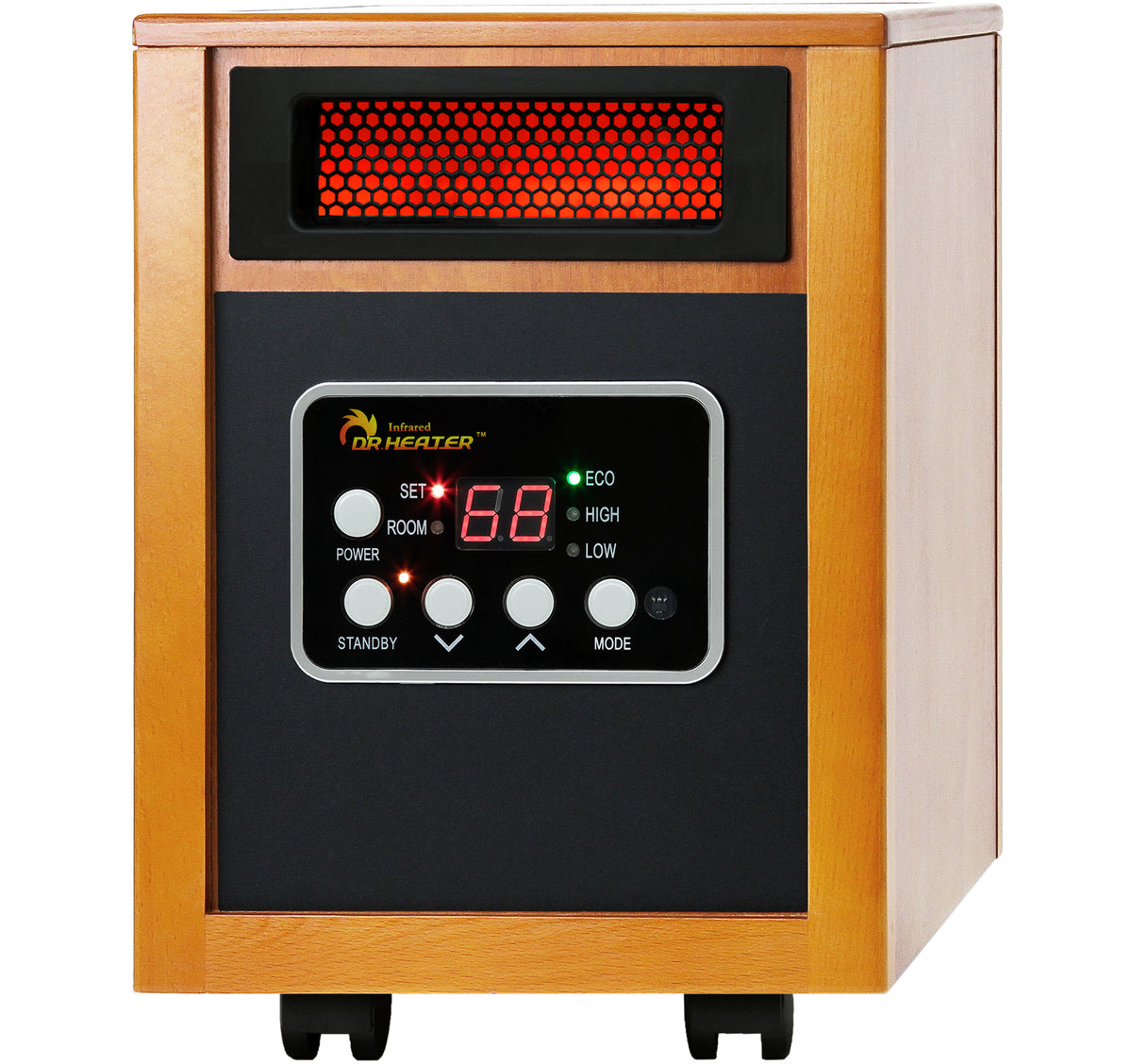
Explore this need in the finder →The Dr. Infrared Heater DR-968 is a portable, fan-forced infrared-and-convection unit built around a two-setting, 1,500-watt heater. Its value is in straightforward heat and room-temperature control rather than a long list of specialized modes. The exact model number on the official manual is DR-968; the U.S. collection lists SKU DR-968. That pairing matters because adjacent Dr. Infrared models add different controls or humidifier parts.
Two power settings, plus automatic temperature control
The manual lists ECO, HIGH, LOW and Standby. HIGH is rated at 1,500 watts and LOW at 1,000 watts; ECO selects between them as the heater works toward its set temperature. The selectable temperature and a room-temperature display make this more than a fixed-output radiant box, but a thermostat cannot guarantee an even temperature throughout a drafty or open-plan room. Treat the company’s “dual heating” description as a product-design claim, not a measured advantage over another heater.
There is no documented fan-only setting. The blower is part of the heating system, so this is not a summer air mover and not fanless convection. The manual describes the two heat settings but no powered left-right sweep. If air movement without heat is important, choose a fan heater whose manual explicitly names fan-only; if you want to warm a stationary zone without blower airflow, compare an oil-filled radiator or a true convection panel instead.
Timer and maintenance are part of the choice
The remote duplicates the panel’s main controls, including an auto-off countdown adjustable from one to twelve hours. That switches a running heater off later; it does not schedule a delayed start, and it is not permission to leave the appliance unattended. The manual urges particular caution when a heater is left operating unattended. If unattended permission is an essential need, this model’s instructions do not grant it.
There is an electrostatic rear filter, which can be removed and vacuumed. The manual’s maintenance sequence involves removing screws from the filter bracket, so cleaning is more involved than simply wiping an exposed grille. Switch off, unplug and let the heater cool before cleaning. Keep the inlet and outlet clear; blocked airflow can trigger the safety cutoff and can also interfere with normal operation.
Electrical and room placement limits
This is a 120-volt, 60-Hz, 1,500-watt appliance with a maximum continuous draw listed as 12.5 amps. It comes with a grounded three-prong plug and is intended for a properly grounded outlet. The manufacturer says to plug it directly into the wall rather than an extension cord or relocatable power tap. Before adding a high-load heater to a circuit, consider what other equipment uses that circuit; an adapter does not make a connection safe.
The manual calls for at least three feet from combustible material in front and away from the sides and rear. Set it on a firm, dry, level surface where the cord will not cross a walkway. The tip-over switch and overheat cutoffs are protective features, not a reason to place it close to curtains, bedding or papers. Dr. Infrared says not to use this model outdoors or in bathrooms, laundry areas or similar wet locations, and warns against a location where it could fall into water. This is not a heater for bathroom duty.
Comparisons and who should choose it
Choose the DR-968 if you want a portable 120-volt heater with two named heat levels, ECO temperature control, a remote, a twelve-hour shutoff countdown and a removable filter. The DR-978 is a related two-setting model with its own nighttime control behavior; compare the exact manual rather than assuming that “hybrid” or “more heat” language establishes a performance advantage. The DR-968H adds a humidifier with a separate water bottle, but that feature brings distilled-water handling and monthly cleaning. The DR-998 also adds a humidifier and a rotatable outlet, at the cost of more components and upkeep.
The page and manual do not agree on the DR-968’s weight: the product page says 20 pounds while the manual’s specification gives 18. I leave weight out of the recommendation rather than selecting whichever number seems more convenient. This assessment is based on the U.S. product information and model-specific manual, not ownership or a heat-output test. Dr. Infrared’s coverage, sound and comfort statements are manufacturer claims, not measurements made for this review.
Dr. Infrared DR-968 product page · DR-968 manual
Key details at a glance
| Maximum listed input | 1500 W |
|---|---|
| US supply voltage | 120 V |
| Installation form | Floor-standing and movable |
| Exact manual permits bathroom use | No |
| Power-heat levels | 2 |
| Listed wattage values | 1000 / 1500 W |
More specifications and setup details
| Separate fan-only mode | No |
|---|---|
| Temperature setting range | ECO set temperature up to 85°F (exact numeric lower bound not used) |
| Timer behavior | 1–12 hour countdown turns off a running heater; delayed start is not documented. |
| Can the heater start on a timer? | No |
| Fanless convection heating | No |
| Heated-air direction | Fan forced |
| Heating element description | Quartz infrared and PTC ceramic dual-heating system with fan-forced airflow (manufacturer description) |
Use the exact model’s instructions for operating limits, supplied equipment and version differences.
Sources for this assessment
Check whether the room and routine line up.
Check room restrictions and full wall clearances first, then compare fan-only versus fanless heat, fit, app controls and the timer behavior the exact manual describes.